In the Netflix teen drama Crew Girl, 16-year-old solo rowing champ Teagan Tao has her life uprooted when her hotel-magnate dad gets a tip that he’s about to be arrested for financial crimes and disappears.
asserted
he → have → crimes
Suddenly, Teagan (Miku Martineau) and her flighty mom, Ella (Jessica Paré), are broke and moving across the country to the crumbling New England house where Ella grew up.
asserted
Ella → move → house
The town is all clam shacks and marinas—and the prestigious Easton Prep, where Teagan matriculates thanks to an education trust that was somehow spared from the seizure of the Taos’ assets.
asserted
that → matriculate → assets
The only problem, besides the rampant snobbery, is that Eaton has no girls’ crew team.
asserted
Eaton → have → team
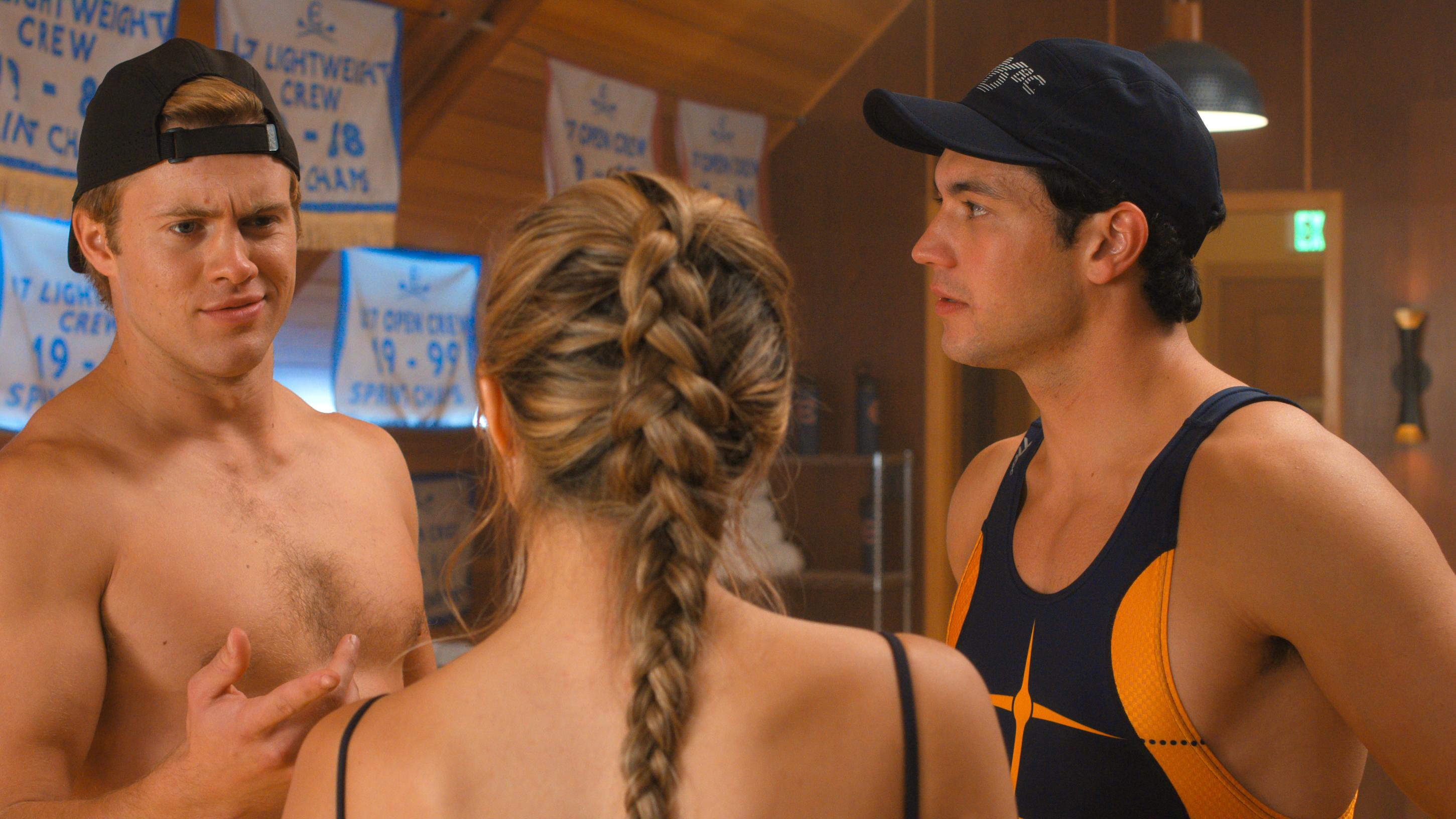
Forced to coxswain for the boys, Teagan starts falling for two of her teammates: kind, working-class townie Cam Dillinger (Kyle Clark) and bratty airline scion Josh Regis (Sam Braun), who’s locked in a premature succession battle with his cousin Ryder (Connor Paton).
asserted
who → force → cousin
Meanwhile, a gay rower, Baloo (Jude Wilson), is secretly hooking up with a guy on a rival team.
asserted
rower → hook → team
All of which is to say that Crew Girl, whose first season is now the no. 1 show on Netflix, plays like a greatest-hits compilation of teen romance tropes.
asserted
season → say → tropes
First among the classics is a love triangle (see: Twilight, Riverdale, The Vampire Diaries, My So-Called Life).
asserted
triangle → see → Twilight
As is often the case, this one is enhanced by the quaintness of its small-town setting (Dawson’s Creek, One Tree Hill) and complicated by both wealth disparities (Gossip Girl, Pretty in Pink) and one character’s fish-out-of-water, new-kid-in-school status (The O.C., Beverly Hills, 90210).
asserted
one → enhance → school
There’s also a youthful mom (you might remember Paré as Mad Men’s Megan) doing a painfully slow will-they-won’t-they dance with an old friend (Thomas Cadrot), à la Gilmore Girls’ Lorelai and Luke
uncertain
they → ’ → Lorelai
But what’s remarkable about Crew Girl—which is, despite an effervescent lead and a few fun storylines built around eccentric minor crew-boy characters, otherwise decidedly mid—is how comprehensively it showcases the conventions unique to the genre’s newest generation.
asserted
it → ’ → generation
TV has, in the last few years, capitalized on publishing’s pandemic-era romance boom, churning out love stories tailored to the young, female audience driving authors like Emily Henry and Ali Hazelwood up best-seller lists.
asserted
TV → capitalize → lists
Often, that means adapting popular YA or New Adult novels; Prime Video’s success with Jenny Han’s coming-of-age, beach-town love triangle The Summer I Turned Pretty paved the way for Netflix’s take on Ali Novak’s My Life with the Walter Boys as well as XO, Kitty, Han’s spinoff of her book-to-film franchise To All the Boys I’ve Loved Before.
asserted
I → mean → Boys
Queer romance, mainly of the gay male variety, from Netflix’s tender and chaste Heartstopper to the spicy Canadian phenomenon Heated Rivalry, which streams on HBO Max in the U.S., has also jumped from page to screen.
asserted
which → stream → screen
(Crew Girl isn’t an adaptation, but a novelization released in tandem with the show suggests it’s meant to feel like one.)
uncertain
it → release → one
This year has seen a particular glut of new titles, from Netflix’s figure-skating drama Finding Her Edge to Prime’s Off Campus and Every Year After.
asserted
year → see → Campus
The latter platform even scored a hit in August with an exceptional original teen romance, Sterling Point, proving the niche isn’t entirely dependent on preexisting IP.
asserted
niche → score → IP
These shows have all the love triangles and class struggles and outsider angst that have defined youthful romance tales since Jane Austen was writing them, capturing eternal adolescent fantasies (being desirable enough to have two people fighting over you) and fears (not measuring up to the rich kids) alike.
asserted
people → have → kids
Pretty appears to have sparked a mini-trend of siblings competing for the same crush, a trope that also pops up in Every Year After, Walter Boys, and Finding Her Edge.
asserted
that → appear → Edge
Like Crew Girl’s Martineau, many are multiracial but play characters with vaguely defined backgrounds who live with either a single white parent or a white surrogate family.
asserted
who → play → parent
(New York magazine just spotlighted the "Wasian generation," a long list of up-and-coming white and Asian stars, citing Heated Rivalry’s Hudson Williams, Pretty’s Lola Tung, and XO, Kitty’s Anna Cathcart among other white and Asian stars.)
asserted
magazine → spotlight → stars
Liberal and minority viewers get to see mixed-race families and romances, and a TV landscape that isn’t all white.
asserted
that → get → families
The anti-”woke” crowd is spared identity politics, non-English dialogue, and often all other forms of cultural specificity.
asserted
crowd → spar → specificity
Savvy streamers avoid backlash from both sides.
asserted
streamers → avoid → sides
What’s most striking about these series, though, are the novel ways in which they embrace physicality.
asserted
they → ’ → physicality
With the steamy exceptions of Heated Rivalry and Off Campus (both geared toward a slightly older age range), the sexual content is pretty PG-13.
asserted
content → gear → range
Objectification is kept to a minimum, at least by characters we’re supposed to like.
asserted
we → keep → characters
Yet bodies are conspicuously activated, in what feel like pointed responses to—and, for young viewers, escape hatches from—digital disembodiment.
asserted
what → activate → disembodiment
Summer romances, and specifically those that bring together wealthy vacationers and the locals who work for them, aren’t new to fiction.
asserted
who → bring → fiction
It’s the prominence of nature in the recent crop of teen romances (and teen hits in other genres, like Netflix’s Outer Banks) that makes an impression.
asserted
that → ’ → impression
As it toggles between protagonist Percy’s (Sadie Soverall) life in her late 20s and a sequence of idyllic teenage lake-house summers glimpsed in flashbacks, Every Year After uses its setting to visualize two brothers’ rivalry for her affection.
asserted
After → toggle → affection
In one recurring image, Percy sits at the edge of her house’s dock, looking on as sensitive Sam (Matt Cornett) and arrogant Charlie (Michael Bradway) shove each other off a slippery wooden raft.
asserted
Sam → recur → raft
Sterling Point brings a high-strung New York City girl (Ella Rubin) to an island in Canada’s Muskoka region, a paradise of lush, lakefront forests.
asserted
Point → bring → forests
Her rich-vs.-poor-boy love triangle plays out over lazy days spent boating, swimming, and sunbathing on rocky beaches.
asserted
triangle → play → beaches
An abundance of sports romances make such physicality even more explicit.
asserted
physicality → make → romances
In Off Campus and Heated Rivalry, the boys who serve as eye candy for any viewer attracted to men are always slamming into each other on the ice and changing together in the locker room.
asserted
who → serve → room
In Finding Her Edge, a show about young Olympics hopefuls at a residential training center, an ice-dancing duo is bound to become a love affair (as long as the guy is into girls).
asserted
guy → find → girls
Even the neurotic hero of Heartstopper (Joe Locke) finds first love on the rugby field.
asserted
hero → find → field
Crew Girl casts many thirsty gazes on the musclebound upper bodies of Teagan’s teammates.
asserted
Girl → cast → teammates
They’re about ambition and passion and the competitive spirit as romantic accelerants—about how the shared commitment to spend hours every day striving for excellence while one’s peers are screwing around online can bond people.
asserted
peers → ’re → people
…and 13 more, not listed.