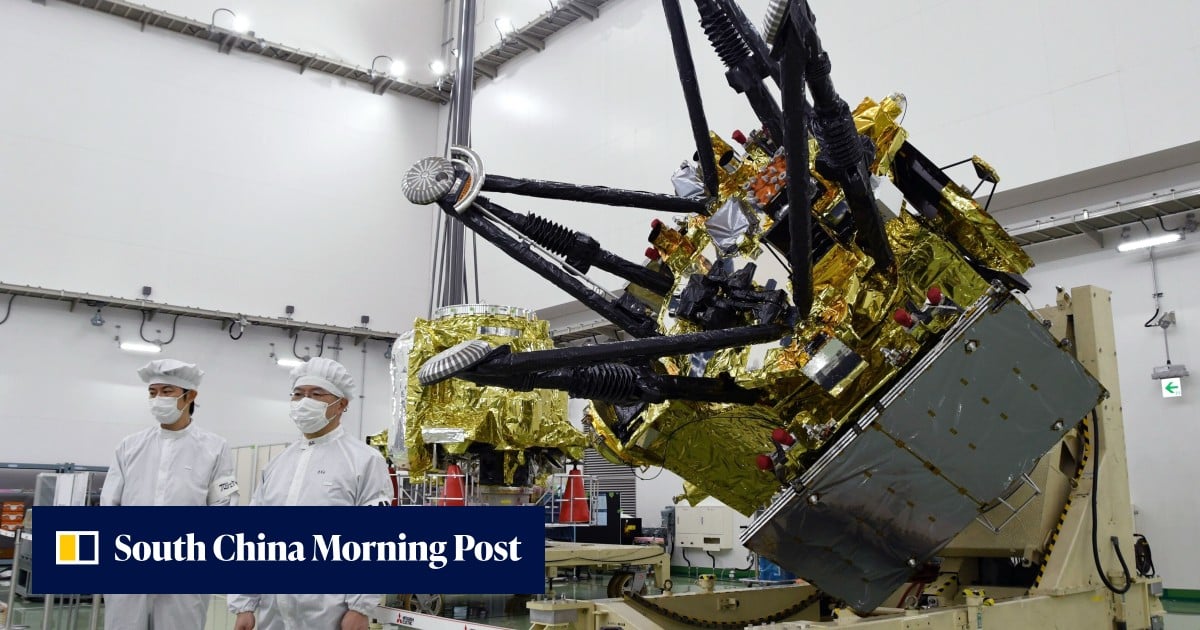
Japan to launch first-ever mission to get samples from a Martian moon

Read the original at New York Post ↗
Cite

Associated Press. (2026, October 18). Japan to launch first-ever mission to get samples from a Martian moon. New York Post. https://nypost.com/2026/10/18/science/japan-to-launch-first-ever-mission-to-get-samples-from-a-martian-moon/

Dated from the outlet's own feed. Check the original for its byline.

New York Post · collected 2026-10-18 · by Associated Press

Quick Summary

Japan plans to launch a spacecraft on October 18, 2026, aimed at Phobos, one of Mars's moons, for the first mission to collect samples. The five-year endeavor, led by Japan’s Aerospace Exploration Agency (JAXA) with support from NASA and other agencies, seeks to uncover details about Phobos' formation and composition. Scientists hope that studying materials from Phobos, which may contain up to 0.1% Martian material, will provide insights into the origins of life in the solar system and assist future manned missions to Mars.
Written locally by qwen2.5:14b on 2026-10-18, using this article's own text rather than the other coverage of the same event (that is the story summary below).

AI analysis runs on qwen2.5:14b, locally

Story summary

On 2026-10-18, Japan launched a spacecraft on the world’s first mission to bring back samples from Phobos, one of Mars's two moons. The unmanned Martian Moons eXploration (MMX) probe was carried by a new H3 rocket and includes 13 instruments, such as a rover developed jointly by France and Germany, a NASA sampling device, and the European Space Agency’s deep space communication device. Expected to take five years, this mission aims to provide insights into how Phobos and Deimos formed and might shed light on the origins of life in the solar system. The probe will orbit Phobos for up to three years before landing and collecting at least 10 grams of surface material from the moon. This marks a significant step towards potential future human exploration of Mars, as studying Martian moons could help establish them as bases for manned missions.

Written for “Japan Launches Martian Moon Mission” on 2026-10-18, grounded in this article and the 3 other(s) covering the same event.

Story

📰 Japan Launches Martian Moon Mission
Science · 4 article(s) covering the same event. Compare every outlet's account →

Compared with similar articles

This article reads unscored and hedges 10% of its claims. Each row says how that neighbour differs.
Toronto Star · 0.89 cosine similarity
⚖️ leaning not scored 🔴 10% hedged 4 of 40 📰 publisher trust 63
“Both articles describe the exact same upcoming launch of a spacecraft to Phobos by Japan's space agency on October 18, 2026.”
Dawn
⚖️ leaning not scored 🔴 35% hedged 7 of 20 📰 publisher trust 71
“Both articles describe the exact same upcoming space mission to Mars's moon Phobos, set for launch on October 18, 2026.”
South China Morning Post
⚖️ leaning not scored 🔴 50% hedged 2 of 4 📰 publisher trust 64
“Both articles describe Japan's preparation for a mission to Mars' moons, specifically mentioning the MMX probe and its goal of retrieving samples from Phobos.”
How this article was measured signals, leaning charts, publisher record, byline, topics and claims

Signals How these are calculated →

Claims extracted
42
sentences that state something as happening or true
Uncertain
10%
4 of 42 hedged ("reportedly", "may", "according to")
Leaning
not political
takes no side on a contested political question
Publisher signals
67/100
New York Post's corrections and hedging, across everything collected from it. Not a measure of accuracy.
Outlets on this story
4
Science
Same framing elsewhere
2
articles that frame the event the way this one does
Analyzed 2026-10-18 · how these are computed

How this is being covered How these are calculated →

Article leaning vs. publisher reliability
Source leaning vs. consistency

Publisher

New York Post · 11448 article(s) · 32 correction(s) detected
Running correction rate · 32 correction(s)

Who wrote this

Associated Press
446 article(s) here · 1 carrying a prediction
🔮 Japan is set to launch a spacecraft on the world’s first mission to bring back samples from Phobos, one of the two small, potato-shaped moons orbiting Mars.
🔮 Trudy’s center was expected to remain near the Mexican coast through Sunday evening before moving south of the Baja California Peninsula.
🔮 French President Emmanuel Macron will hold an emergency meeting with top government officials on Sunday afternoon, before addressing the nation at 8 p.m., according to his office. “The right to protest is a fundamental right.
🔮 The chaos, which is sure to shuffle the poll and College Football Playoff seeding forecasts, cleared a path for No. 3 Miami to take over the top poll spot after beating rival Florida State 43-35 in a double-overtime classic that ended in controversy.
🔮 An additional helicopter will be deployed later today, according to the Coast Guard.
🔮 “It looked like it may have snaked on him or just skipped by him, took his eye off of it,” Cleveland manager Stephen Vogt said.
🔮 Florida State appeared to give itself a chance when Daniels connected on a fourth-and-21, 36-yard heave that would have made it 43-41 — only to have the play called back by holding.
🔮 The Cougars, which will look to avoid a letdown when they travel to UCF on Saturday, had a chance to go up 28-10 in the third quarter before a pick penalty by Kasper wiped out a 39-yard touchdown catch by JoJo Phillips.
🔮 Georgia (6-1, 4-1 Southeastern Conference) saw its streaks of nine straight wins over Auburn and 53 consecutive wins over unranked teams come to an end in a loss that also will end the Bulldogs’ short one-week stay atop the AP Top 25.
🔮 Trudy’s center was expected to approach the Mexican coast on Saturday and pass near it into Sunday.
Wire or desk byline, not an individual reporter.
Also by Associated Press
Nothing else under this byline is closely related to this article, so these are simply their most recent.
All 446 articles by Associated Press →

Topics

Associated Press JAXA Japan MMX Martian

Subjects

JAXA ORG · 3× Japan GPE · 3× MMX ORG · 3× Martian NORP · 3× Japanese NORP · 2× Kawakatsu ORG · 2× NASA ORG · 2× Associated Press ORG · 1× TOKYO GPE · 1× The Japan Aerospace Exploration Agency’s ORG · 1×

Narrative

The spacecraft will carry 13 instruments, including a rover jointly developed by France and Germany that will land on the moon, as well as a NASA sampling device and instrument to measure gamma rays, and the European Space Agency’s deep space communication device.
framing: assertive · carried by 2 article(s) · first seen 2026-10-18
🔮 Japan is set to launch a spacecraft on the world’s first mission to bring back samples from Phobos, one of the two small, potato-shaped moons orbiting Mars.
2026-10-18 · Toronto Star
Japan to launch spacecraft on a mission to get samples from a Martian moon · assertive framing
2026-10-18 · New York Post
Japan to launch first-ever mission to get samples from a Martian moon · assertive framing

Claims (42 extracted, 4 hedged)

Japan to launch first-ever mission to get samples from a Martian moon By asserted
Japan → launch → moon
Japan is set to launch a spacecraft on the world’s first mission to bring back samples from Phobos, one of the two small, potato-shaped moons orbiting Mars. asserted
Japan → set → Mars
Scientists hope the mission, which is expected to take five years, will provide clues to how Phobos and its smaller sibling Deimos formed, and hopefully even shed light on the origins of life in the solar system. asserted
Phobos → hope → system
The Japan Aerospace Exploration Agency’s launch of the spacecraft Tuesday on a new Japanese mainstay H-3 rocket comes as the United States, China and others consider sending astronauts to Mars. asserted
States → come → Mars
Samples from Phobos will provide useful data for scientists to consider using a Martian moon as a base for a future manned mission to the planet, said MMX project manager Yasuhiro Kawakatsu. asserted
Kawakatsu → provide → planet
“Despite their potential importance, Martian moons have never been fully investigated,” Kawakatsu said. asserted
Kawakatsu → investigate → importance
“They are known as the most important unclimbed mountains in the solar system.” asserted
They → know → system
Japan leads the international mission that includes equipment and communications support from NASA and other national space agencies. asserted
that → lead → NASA
JAXA aims to study how Mars’ moons formed Since the 1960s, dozens of missions have been sent to Mars, but its moons largely remain a mystery. asserted
moons → aim → Mars
Phobos and Deimos take their names from the Greek mythological personifications of fear and terror, sons of the war god Ares, whose Roman counterpart is Mars. asserted
counterpart → take → Ares
Multiple Russian attempts to land on Phobos, including one in 2011, have failed. asserted
attempts → land → 2011
A key question will be how they formed and what they are made of. asserted
they → form → what
Some scientists think the two irregular crater-pocked bodies could be remnants of debris formed after a large celestial object crashed into Mars. uncertain
object → think → Mars
Others say the moons could be asteroids that have come from elsewhere. uncertain
that → say → ?
JAXA officials think samples from Phobos will provide answers. asserted
samples → think → answers
“We can almost certainly come to a conclusion by analyzing (Phobos) soil samples,” MMX principal investigator Kiyoshi Kuramoto said. asserted
Kuramoto → come → samples
Scientists chose to collect samples from Phobos mainly because the moon is closer to Mars than Deimos and therefore may have more information about the planet. uncertain
moon → choose → planet
Material from Mars is expected to make up about 0.1% of the material collected from Phobos, JAXA officials say. asserted
officials → expect → Phobos
Phobos, about 20 to 30 kilometers (10 to 20 miles) in diameter, orbits Mars at a distance of about 6,000 kilometers (3,700 miles) three times a day. asserted
Phobos → orbit → kilometers
Samples from Phobos could also shed light on the origin of Deimos as the two moons are believed to have similar roots, Kuramoto said. uncertain
Kuramoto → shed → roots
The mission also includes plans to fly by Deimos and collect observations. asserted
mission → include → observations
MMX will spend 3 years studying Phobos It will be a long journey to reach the red planet, 55 million kilometers (34 million miles) away from Earth at their closest point. asserted
It → spend → point
The actual flight distance will be 500-600 million kilometers (310-370 miles), Kawakatsu said. asserted
Kawakatsu → say → ?
After launching on the H3 rocket, the spacecraft will arrive at the Mars region in around August, 2027. asserted
spacecraft → launch → August
Then it will fly near and around Phobos for three years to collect data and gather samples from the moon before returning home in 2031. asserted
it → fly → 2031
MMX is made up of three modules — for propulsion, exploration and return — and weighs about 5 tons. asserted
MMX → make → tons
Only the third module will return home, with the samples stored in a capsule. asserted
samples → return → capsule
The spacecraft will carry 13 instruments, including a rover jointly developed by France and Germany that will land on the moon, as well as a NASA sampling device and instrument to measure gamma rays, and the European Space Agency’s deep space communication device. asserted
that → carry → rays
A Japanese radiation monitor will collect data that can help a future manned Mars exploration. asserted
that → collect → exploration
The mission will collect moon samples from Phobos The French-German rover Idefix lands on Phobos first. asserted
rover → collect → Phobos
During a 100-day mission in around 2029, it will explore the surface of the moon to help the subsequent Japanese soil-sampling. asserted
it → explore → sampling
Once the MMX lands some time later, JAXA scientists aim to collect at least 10 grams (0.35 ounces) of soil from the moon from two sampling attempts using U.S. and Japanese methods. asserted
scientists → land → methods
NASA’s sampling device uses pressurized gas to lift surface dust into a container, and JAXA’s coring method will collect samples from a depth of about 2 centimeters (less than 1 inch). asserted
method → use → centimeters
In the first attempt, the MMX will collect surface and underground samples using both devices, and take additional underground samples in the second landing. asserted
MMX → collect → landing
Scientists say collecting samples from multiple locations increases the chances of obtaining any potential traces of past microbial life from Mars. asserted
collecting → say → Mars
The samples will be stored in a heat-protected capsule designed to survive reentry into Earth’s atmosphere. asserted
samples → store → atmosphere
It’s expected to land in Australia before being sent back to Japan. asserted
It → expect → Japan
Japan’s two Hayabusa missions returned asteroid samples, the first in 2010 and again in 2020. asserted
missions → return → 2020
The moon’s extremely low gravity is a challenge The spacecraft has to choose a relatively smooth and level site for its landing based on topographical data provided by the rover, and then collect samples within two hours. asserted
spacecraft → have → hours
Landing on the pockmarked moon, which has just one two-thousandth of Earth’s gravity, is a challenge. asserted
which → land → gravity
…and 2 more, not listed.

💬Give feedback
🕘History 🎫Support