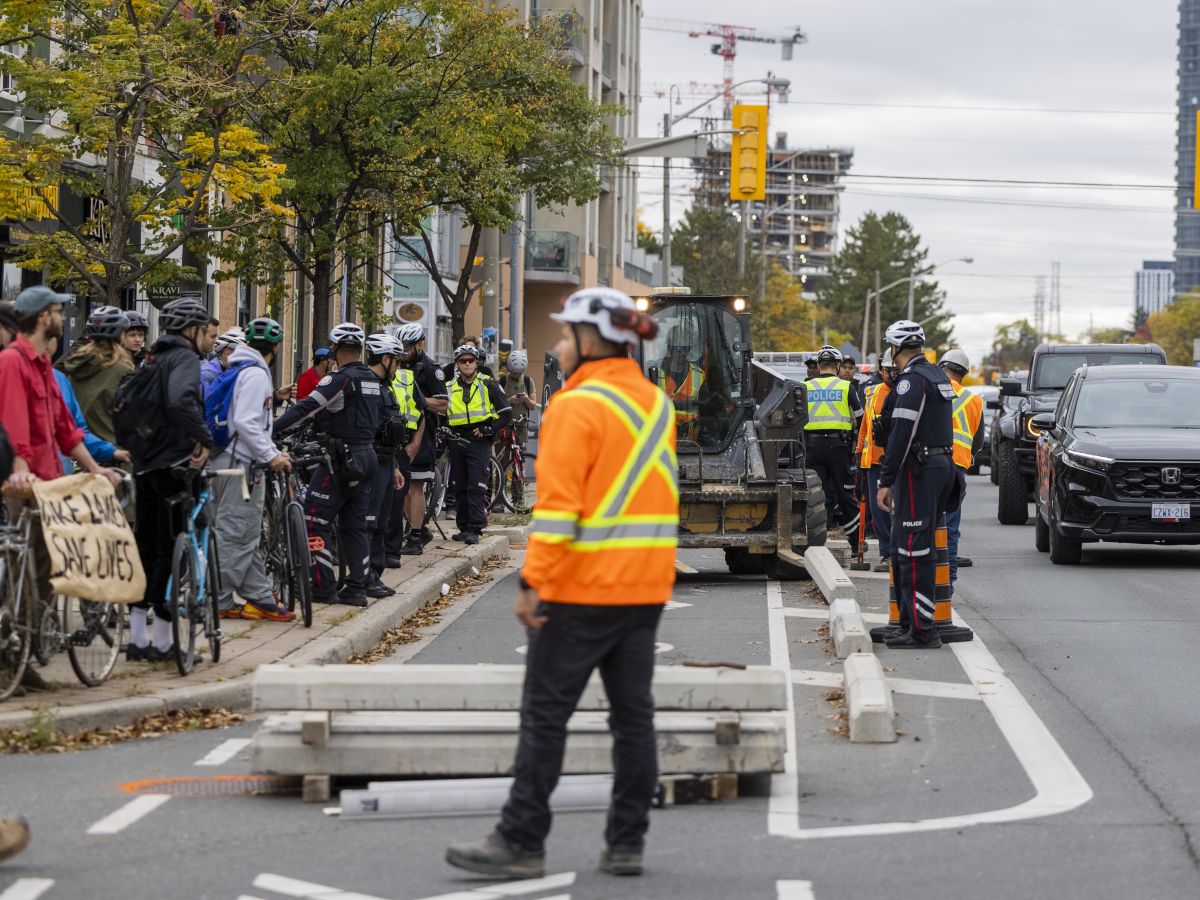
Bike lanes may seem to be a local Toronto issue, but here's why they're important to the nation

Read the original at Toronto Star ↗
Cite

Lorinc, J. (2026, October 17). Bike lanes may seem to be a local Toronto issue, but here's why they're important to the nation. Toronto Star. https://www.thestar.com/opinion/contributors/bike-lanes-may-seem-to-be-a-local-toronto-issue-but-here-s-why-they-re-important-to-the-nation/article_35105b8d-bae2-4b03-8d32-88fc409681b8.html

Dated from the outlet's own feed. Check the original for its byline.

Toronto Star · collected 2026-10-17 · by John Lorinc

Quick Summary

Premier Doug Ford's decision to remove bike lanes in Toronto has sparked legal battles with CycleTO challenging the provincial government's actions. After an appeals court upheld Ford's law, allowing for the removal of bike lanes on major streets by November 27, CycleTO is now seeking a hearing from the Supreme Court of Canada. The group argues that removing safety infrastructure violates cyclists' rights under Section 7 of the Charter of Rights and Freedoms. This case could be influenced by another pending Supreme Court case involving Paul Drover's lawsuit against Elections Canada residency requirements, which also hinges on Section 7 rights.
Written locally by qwen2.5:14b on 2026-10-17, using this article's own text rather than the other coverage of the same event (that is the story summary below).

AI analysis runs on qwen2.5:14b, locally

Story summary

As of October 17, 2026, Premier Doug Ford's controversial decision to remove bike lanes in Toronto is facing renewed scrutiny. In September, provincial officials requested bids to dismantle the bike lanes on Yonge, University, Bloor, and Danforth streets, with a deadline of November 27. However, the Ministry of Transportation has already awarded the contract, and crews have started removing them despite ongoing legal challenges.

CycleTO, an advocacy group, initially won a court case in 2024 but lost on appeal in August 2026. They are now seeking intervention from the Supreme Court of Canada, which could take months to decide if it will hear the case. The national significance of this issue lies in its potential impact on charter rights, as highlighted by a hypothetical scenario where provincial budget cuts lead to health care access issues and possible violations of citizens' rights under Section 7 of the Canadian Charter of Rights and Freedoms.

Written for “Bike Lanes In Toronto” on 2026-10-18, grounded in this article and the 0 other(s) covering the same event.

Story

📰 Bike Lanes In Toronto
Politics · 1 article(s) covering the same event.

Compared with similar articles

This article reads unscored and hedges 20% of its claims. Each row says how that neighbour differs.
The Globe and Mail
⚖️ leaning not scored 🔴 0% hedged 0 of 6 📰 publisher trust 52
“Article A discusses the legal challenge to Ontario's bike lane removal plan being taken to the Supreme Court, while Article B comments on the broader implications and actual progress of removing bike lanes.”
Toronto Star
⚖️ leaning not scored 🔴 0% hedged 0 of 2 📰 publisher trust 63
“Article A reports on cyclists seeking an appeal to Canada's top court regarding bike lane removal, while Article B discusses the ongoing process of removing bike lanes and its national implications.”
National Post
⚖️ Leans strongly right 🔴 4% hedged 1 of 28 📰 publisher trust 60
“While both articles discuss the removal of bike lanes in Toronto, they describe different phases or aspects of the process rather than the exact same occurrence.”
Toronto Star
⚖️ leaning not scored 🔴 5% hedged 2 of 43 📰 publisher trust 63
“Article A discusses the debate and concerns surrounding the removal of bike lanes, while Article B focuses on the broader implications and legal process leading to the actual removal.”
The Globe and Mail
⚖️ leaning not scored 🔴 5% hedged 2 of 43 📰 publisher trust 52
“The articles discuss related issues concerning bike lanes in Toronto but describe different aspects of the situation, with one focusing on a rally and petition while the other addresses legal and political developments.”
How this article was measured signals, leaning charts, publisher record, byline, topics and claims

Signals How these are calculated →

Claims extracted
35
sentences that state something as happening or true
Uncertain
20%
7 of 35 hedged ("reportedly", "may", "according to")
Leaning
withheld
no quote in the article backed the model's score
Publisher signals
63/100
Toronto Star's corrections and hedging, across everything collected from it. Not a measure of accuracy.
Outlets on this story
1
Politics
Same framing elsewhere
1
articles that frame the event the way this one does
Analyzed 2026-10-17 · how these are computed

How this is being covered How these are calculated →

Article leaning vs. publisher reliability
Source leaning vs. consistency

Publisher

Toronto Star · 8014 article(s) · 22 correction(s) detected
Running correction rate · 22 correction(s)
2026-10-07
Correction
2026-09-24
Correction

Who wrote this

John Lorinc
2 article(s) here · 1 carrying a prediction
🔮 Premier Doug Ford, who picked this fight with a 2024 law that empowered the province to remove segregated cycle paths, would have Torontonians believe his polarizing war-on-the-bike is done and dusted now that an appeals court has upheld that legislation.
🔮 He also proposed a “partnership” with governments (in the U.S. and other democracies) — including a relaxation of anti-trust rules that would otherwise prevent tech giants from collaborating.
Also by John Lorinc
Nothing else under this byline is closely related to this article, so these are simply their most recent.

Topics

Canada CycleTO Ontario Section 7 the Supreme Court of Canada

Subjects

CycleTO ORG · 6× Drover PERSON · 5× Canada GPE · 3× Ontario GPE · 3× Ford ORG · 2× Ottawa GPE · 2× Paul Drover PERSON · 2× the Supreme Court ORG · 2× the Supreme Court of Canada ORG · 2× the Supreme Court’s ORG · 2×

Narrative

For example, if a provincial agency, in the name of budget cuts, closes an emergency room in a small-town hospital and then someone in that community falls ill or dies because they couldn’t access care in a timely way, have their charter rights been violated?
framing: assertive · carried by 1 article(s) · first seen 2026-10-17
🔮 Premier Doug Ford, who picked this fight with a 2024 law that empowered the province to remove segregated cycle paths, would have Torontonians believe his polarizing war-on-the-bike is done and dusted now that an appeals court has upheld that legislation.

Claims (35 extracted, 7 hedged)

Is the bike lane battle in Toronto settled? asserted
battle → settle → Toronto
Premier Doug Ford, who picked this fight with a 2024 law that empowered the province to remove segregated cycle paths, would have Torontonians believe his polarizing war-on-the-bike is done and dusted now that an appeals court has upheld that legislation. asserted
court → pick → legislation
Provincial officials in early September asked for bids to remove the bike lanes on Yonge, University, Bloor and Danforth, with a deadline for submissions of November 27. asserted
officials → ask → November
But the Ministry of Transportation had already awarded the contract, and crews have begun the dismantling them. asserted
crews → award → them
But there’s another clock ticking — one that could determine if CycleTO, which challenged the Ford government’s bike lane ban, can persuade the Supreme Court of Canada that the legal issues have national relevance. uncertain
issues → ’ → relevance
Last year, after CycleTO took the province to court, Justice Paul Schabas ruled in the group’s favor and blocked the contentious removal of the bike lanes. asserted
Schabas → take → lanes
But this past August, Ontario’s appeal court over-turned Schabas’s verdict. asserted
court → turn → verdict
CycleTO this week moved to ask the Supreme Court of Canada to weigh in, a vetting process that could take months to produce an answer. uncertain
that → move → answer
The outcome depends heavily on a completely different case known as Attorney General of Canada v. Paul Drover, which is currently before the Supreme Court. asserted
which → depend → Court
It, too, pivots on the Charter of Rights claim at the heart of CycleTO’s case, and the decision could determine the trajectory of the cycling coalition’s case holds water. uncertain
trajectory → pivot → water
CycleTO argues that, by eliminating infrastructure designed to ensure safety, the province is effectively depriving cyclists’ of their right to life, liberty and security of the person, also known as Section 7 of Canada’s Charter of Rights and Freedoms. asserted
province → argue → Rights
The lower-court judge found that the Ford government failed to offer up a justification for removing lanes and exposing cyclists to injury or death. asserted
government → find → injury
Ontario’s court of appeal disagreed, asserting that the lower court’s ruling essentially prevented the government from addressing problems such as traffic congestion. asserted
ruling → disagree → congestion
The Drover case is potentially precedent-setting and relevant to the bike lane case. asserted
case → set → case
It began when a man named Paul Drover was hired as an assistant returning officer in a federal riding near Ottawa. asserted
man → begin → Ottawa
In 2017, Elections Canada informed him he’d lost the job because he moved out of the riding, contrary to federal rules requiring electoral officers to live in the districts where they work. asserted
they → inform → districts
He sued, claiming those rules prevented him from earning a living, which, he claimed, violated his right to life, liberty and security. asserted
he → sue → life
The case ended up in Ontario’s appeals court, which found that Mr. Drover had a point. asserted
Drover → end → point
In a 109-page ruling, the justices ruled that the Canada Elections Act’s residency requirements did violate his Section 7 rights and struck them down. asserted
requirements → rule → them
Ottawa appealed, and that case is now on the Supreme Court’s docket, awaiting a hearing. asserted
case → appeal → hearing
In the early years of the Charter, Section 7 challenges primarily involved criminal cases in which defendants claimed their rights had been violated as part of a judicial proceeding. asserted
rights → involve → proceeding
Over time, successive rulings expanded Section 7 to include civil cases. asserted
rulings → expand → cases
What makes Drover’s appeal different is that it involves an administrative decision by a civil servant, which is why, among other reasons, it ended up at the Supreme Court. asserted
it → make → Court
Lots of litigants try to get their cases in front of Canada’s highest court but only a few succeed because the Supreme Court’s justices only weigh in on cases with broad implications. asserted
justices → try → implications
That’s why they took on the Drover appeal. asserted
they → ’ → appeal
After all, if Drover wins, the case could serve as a precedent that causes governments to tread gingerly in situations in which a civil servant has made a decision that allegedly undermines someone’s life and liberty. uncertain
that → win → life
CycleTO’s bike lane case potentially pries opens that door even further, by exposing any government policy decision that might cause harm to a Charter challenge. uncertain
that → pry → challenge
For example, if a provincial agency, in the name of budget cuts, closes an emergency room in a small-town hospital and then someone in that community falls ill or dies because they couldn’t access care in a timely way, have their charter rights been violated? asserted
rights → close → way
If the Supreme Court agrees with Drover and then agrees to hear CycleTO’s case, this future scenario becomes more plausible. asserted
scenario → agree → case
But we won’t know until the Drover case is resolved, which could take months. uncertain
which → know → months
In an ideal democratic system, duly-elected politicians take their responsibilities to constituents seriously, and make policy or administrative choices that don’t create harm or risk. asserted
that → elect → harm
The evidence presented in the CycleTO trial clearly showed that the Ford government ignored all sorts of expert advice, as well as its own data, about the implications of removing segregated bike lanes. asserted
government → present → lanes
Queen’s Park has opted instead for an incredulous message track about how removing the bike lanes on Bloor, Yonge and University will relieve congestion city-wide. asserted
removing → opt → congestion
Does accountability for this kind of blithe disregard of cyclist and driver safety only happen at the ballot box every four years? asserted
accountability → happen → box
The resolution of Drover’s appeal — the facts of which could scarcely be more different than Doug Ford’s bike lane culture war — may play an outsized role in answering the question. uncertain
facts → play → question

💬Give feedback
🕘History 🎫Support