Faisal Islam: What I learned from a week with the world's top finance leaders

Read the original at BBC News ↗
Cite

Islam, F. (2026, October 17). Faisal Islam: What I learned from a week with the world's top finance leaders. BBC News. https://www.bbc.co.uk/news/articles/cm4g189jvnxjo?at_medium=RSS&at_campaign=rss

Dated from the outlet's own feed. Check the original for its byline.

BBC News · collected 2026-10-17 · by Faisal Islam analysis

Quick Summary

Economist Faisal Islam discusses insights from the IMF meetings in Bangkok, focusing on conflicting forces affecting global economic growth—crises such as energy shocks and trade conflicts versus resilience shown by smaller economies and massive spending on AI. Finance leaders acknowledged both risks of a potential recession or debt crisis and surprising stability, particularly noting the UK's positive performance and Thailand’s challenge with Chinese electric vehicle dominance.
Written locally by qwen2.5:14b on 2026-10-17, using this article's own text rather than the other coverage of the same event (that is the story summary below).

AI analysis runs on qwen2.5:14b, locally

Story summary

At the IMF meetings in Bangkok this week, global finance leaders discussed the conflicting forces affecting the future direction of the global economy. On one side are recurring crises such as energy shocks, trade conflicts, and wars, which hinder economic growth. On the other side is a boost from massive spending on AI and the resilience shown by smaller economies in establishing new trade routes, including for oil and gas. The finance ministers and bankers at these meetings acknowledged that they do not know how things will develop but noted that bond markets are currently focusing on the US and France. French Finance Minister Roland Lescure stated that despite higher costs, he has had no trouble selling debt and believes his budget is secure.

Written for “Week With Finance Leaders” on 2026-10-17, grounded in this article and the 0 other(s) covering the same event.
Why this leaning score
This article does not take a side on a contested political question, so it has no leaning score. That is an answer rather than a gap: a match report or a rescue can be warmly or critically written without being left or right, and scoring it anyway is how approval of a subject gets recorded as a political position.
No political leaning scored for article 86389 · logged 2026-10-17

Story

📰 Week With Finance Leaders
Economy/Business · 1 article(s) covering the same event.

Compared with similar articles

This article reads unscored and hedges 11% of its claims. Each row says how that neighbour differs.
Dawn
⚖️ Leans left 🔴 14% hedged 3 of 22 📰 publisher trust 71
“The articles discuss different aspects of global economic conditions without focusing on the same specific incident.”
Dawn
⚖️ leaning not scored 🔴 11% hedged 1 of 9 📰 publisher trust 71
“The articles discuss general economic impacts of ongoing conflicts but describe different aspects and do not refer to the exact same incident or time frame.”
The Straits Times
⚖️ leaning not scored 🔴 4% hedged 1 of 25 📰 publisher trust 60
“The articles discuss different aspects of global economic concerns without focusing on the same specific incident or time.”
South China Morning Post
⚖️ leaning not scored 🔴 50% hedged 1 of 2 📰 publisher trust 64
“The articles discuss related topics but describe different aspects of the global economic situation; one focuses on the IMF warning about rising borrowing costs and its impact, while the other discusses broader forces affecting the global economy at a finance leaders' gathering.”
Al Jazeera
⚖️ leaning not scored 🔴 3% hedged 1 of 30 📰 publisher trust 60
“While both articles discuss the G20 finance ministers meeting in Bangkok amid geopolitical tensions, Article A is a general overview of the gathering and context, while Article B reflects on insights gained from attending the event over a week.”
The Guardian
⚖️ leaning not scored 🔴 4% hedged 2 of 48 📰 publisher trust 68
“The articles discuss similar themes but do not describe the same specific incident or meeting.”
CBC News
⚖️ leaning not scored 🔴 6% hedged 2 of 32 📰 publisher trust 60
“Article A reports on the IMF's economic forecast update at a specific meeting in Bangkok, while Article B provides a broader commentary on global economic forces and trends observed during a week with finance leaders.”
Daily Mail
⚖️ Leans left 🔴 28% hedged 11 of 40 📰 publisher trust 64
“The articles discuss different aspects of financial concerns and future directions at a similar time but do not describe the same specific incident or occurrence.”
The Hindu
⚖️ Leans left 🔴 0% hedged 0 of 24 📰 publisher trust 95
“Article A discusses broader economic trends and challenges faced by global finance leaders, while Article B reports on a specific interview with Pakistan's Finance Minister regarding energy infrastructure attacks in the Gulf.”
How this article was measured signals, leaning charts, publisher record, byline, topics and claims

Signals How these are calculated →

Claims extracted
38
sentences that state something as happening or true
Uncertain
11%
4 of 38 hedged ("reportedly", "may", "according to")
Leaning
not political
takes no side on a contested political question
Publisher signals
69/100
BBC News's corrections and hedging, across everything collected from it. Not a measure of accuracy.
Outlets on this story
1
Economy/Business
Same framing elsewhere
1
articles that frame the event the way this one does
Analyzed 2026-10-17 · how these are computed

How this is being covered How these are calculated →

Article leaning vs. publisher reliability
Source leaning vs. consistency

Publisher

BBC News · 3578 article(s) · 4 correction(s) detected
Running correction rate · 4 correction(s)

Who wrote this

Faisal Islam
16 article(s) here · 1 carrying a prediction
🔮 It follows a warning earlier this week from Heathrow's chief executive, who said that not building a third runway at the UK's busiest airport would be a "huge missed opportunity".
🔮 In the meantime it's a sportsman's bet where the roving eye of the bond markets will focus next.
🔮 While this is good news for the chancellor and the Treasury, it also points to the sort of Budget we will get in a fortnight's time.
🔮 Asked about the PM's comments, Lescure told the BBC: "British people decided, and that's obviously their 100% right, and if they're willing to come back, they will have to decide." "But what I can tell them is: come back, anytime."
🔮 - Published Artificial intelligence (AI) could trigger financial market shocks and the UK needs to be prepared for them, the governor of the Bank of England has warned.
🔮 It will reverberate well beyond the hall.
🔮 The timing of the PM's new social care plan sparked suggestions the government could be about to signal the death knell state pension triple lock after 16 years.
🔮 How long could Iran pressures last?
🔮 The latest figures show borrowing - the difference between tax receipts and government spending - was £18.3bn ($24.4bn) in August, almost a fifth higher than the year before and higher than official forecasts.
🔮 "We need to look at partnership in a different way, and the great thing is that when you look at Canada, and I would say the United Kingdom, we share the same values.
Also by Faisal Islam
Nothing else under this byline is closely related to this article, so these are simply their most recent.
All 16 articles by Faisal Islam →

Topics

Bangkok China Chinese IMF Thailand

Subjects

IMF ORG · 5× China GPE · 4× Bangkok GPE · 3× Thailand GPE · 3× Chinese NORP · 2× Budget ORG · 1× Donald Trump PERSON · 1× France GPE · 1× French NORP · 1× Roland Lescure PERSON · 1×

Narrative

But there is a third big challenge to wrestle with, on top of geopolitical instability and bond market uncertainty, one that's apparent even on the streets of Bangkok, as the chauffeurs dropped off the bankers and finance ministers for this week's gathering.
framing: assertive · carried by 1 article(s) · first seen 2026-10-17
🔮 In the meantime it's a sportsman's bet where the roving eye of the bond markets will focus next.

Claims (38 extracted, 4 hedged)

- Published When it comes to the future direction of the global economy there is a bit of a tug of war going on. asserted
it → publish → war
On the one hand holding back growth are the familiar, recurring crises from the energy shock, trade conflict and actual war. asserted
crises → hold → shock
This is reflected most clearly in the sharply rising interest rate costs for the world's advanced economies. asserted
This → reflect → economies
Pulling in the other direction is the boost from massive spending on AI, and the frankly astonishing resilience shown especially by smaller economies, as new routes for trade, including for oil and gas, have been established out of necessity. asserted
boost → pull → necessity
At the IMF meetings in Bangkok this week these themes came up again and again, including among those at the very top table. asserted
themes → come → table
But not even they know which way things are going to go. asserted
things → know → ?
In the meantime it's a sportsman's bet where the roving eye of the bond markets will focus next. asserted
eye → rove → markets
Currently they seem to be looking at the US and France. asserted
they → seem → US
However, the French finance minister, Roland Lescure, has been telling the world he has had no problem selling debt, though it was more expensive, and that his Budget would be fine. asserted
Budget → tell → debt
He also suggested he had helped save the G7 group of advanced nations, which was at risk of collapsing a year ago amid Donald Trump-inspired tensions. uncertain
which → suggest → tensions
In some ways it is a miracle there has not been a global recession, or a debt crisis in a major emerging economy. asserted
it → emerge → economy
Indeed the Thai finance minister was boasting to me of how little his borrowing costs had gone up, especially in relation to the US. asserted
costs → boast → US
Another surprise is the UK being taken off the bond markets' naughty step, and instead being named model pupil by the IMF. asserted
UK → take → IMF
The IMF has taken the government's Budget plans at face value and on trust. asserted
IMF → take → trust
The reality is that the rest of the G7 lack even this. asserted
rest → lack → this
And beauty is relative, especially when it comes to borrowing. asserted
it → come → borrowing
And this moment gave Chancellor John Healey the chance of a hearing, to highlight that the UK's actual growth data has continued to outperform expectations and so far in 2026 can now be described as strong. asserted
data → give → 2026
Healey told me that he saw the figures as the first sign that AI and tech investment was starting to increase UK economic growth. asserted
investment → tell → growth
The bond financiers milling around the IMF meetings seem to be taking another look at the UK after years of crisis. asserted
financiers → mill → crisis
But there is a third big challenge to wrestle with, on top of geopolitical instability and bond market uncertainty, one that's apparent even on the streets of Bangkok, as the chauffeurs dropped off the bankers and finance ministers for this week's gathering. asserted
chauffeurs → be → gathering
Like other nations Thailand has experienced first hand the astonishing boom in sales of Chinese electric vehicles. asserted
Thailand → experience → vehicles
Thailand is sometimes dubbed the "Detroit of Asia" for its own strong car making heritage. asserted
Thailand → dub → heritage
It is the clearest example of what is known as the China Shock Two. asserted
what → know → Shock
The first China shock came in the 2000s in basic manufacturing. asserted
shock → come → manufacturing
This second wave of dramatic change has led in just the last few months to a reappraisal of how world trade is functioning and how it is going to be managed. asserted
it → lead → reappraisal
This is especially the case in the EU, which is scrambling to reassess what currently feels like a one-way street when it comes to China-Europe trade. asserted
it → scramble → trade
The extra "Made in Europe" protections that the bloc is drawing up will have a profound impact on the UK too. asserted
bloc → make → UK
If the UK is outside the new rules, China could divert its excess car production to the UK, where, like Thailand, there are currently lower tariffs and even subsidies. uncertain
China → divert → Thailand
Or the EU could invite Britain in, but ask it to follow its suit by raising tariffs to match its own. uncertain
EU → invite → own
This was a theme that cut through more than might have been expected in Bangkok this week and even seemed to provide a little entertainment. uncertain
that → cut → entertainment
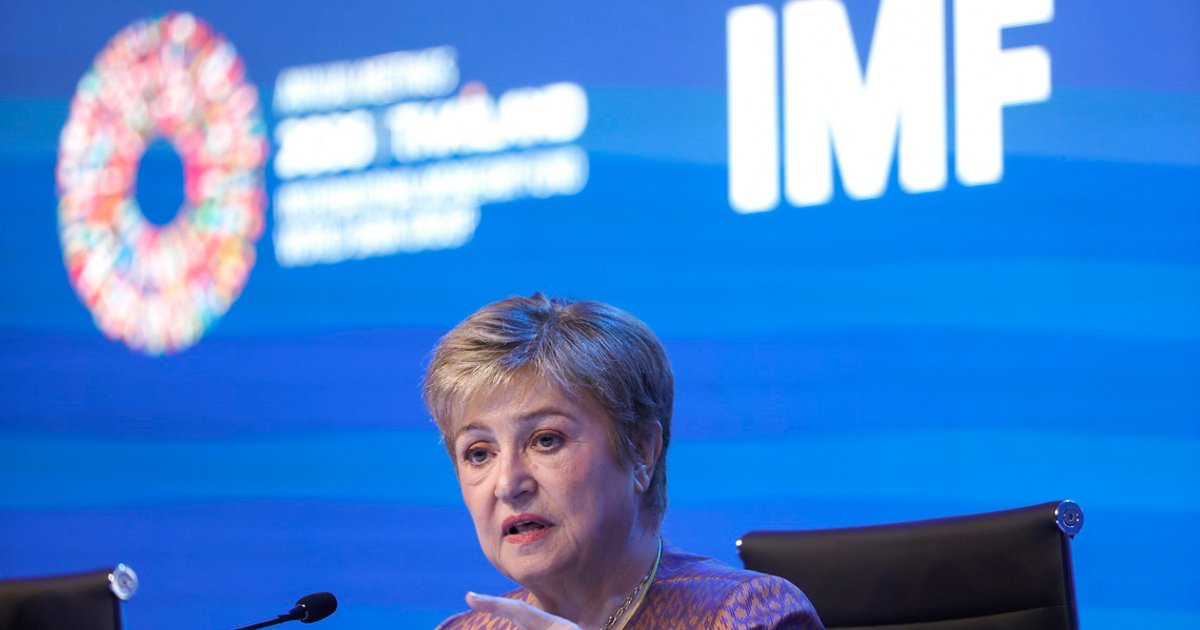
The managing director of the IMF Kristalina Georgieva rolled with laughter, suggesting the Brexit "divorcees are now dating again". asserted
divorcees → manage → laughter
The Finnish finance minister told me the UK was "flirting" with the EU. asserted
UK → tell → EU
Major banks were issuing reports about the prospect of "Breturn". asserted
banks → issue → Breturn
It is, however, the AI boom that is being relied on to provide the trampoline that is required to bounce the world economy out of its current era of multiple simultaneous crises, so many of which are linked to the decisions of President Trump. asserted
many → rely → Trump
But even that is not clear cut. asserted
that → cut → ?
In one room the transformative economic effect of AI is lionised by finance ministers. asserted
effect → lionise → ministers
In the next, central bankers fret about its power to break the cybersecurity of most of the banking system. asserted
bankers → fret → system
The financial boom around it can't last. asserted
boom → last → it

💬Give feedback
🕘History 🎫Support