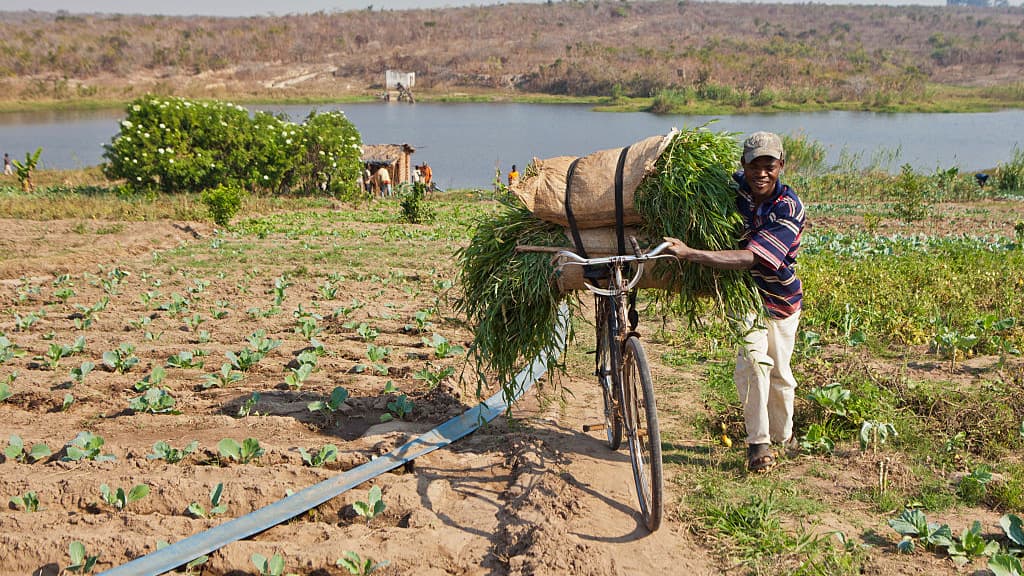
At the Africa Food Systems Forum 2026 in Kigali, Rwanda, discussions centered on boosting farmer profitability as a key to driving agricultural growth and sustainability in Africa. Elizabeth Wathuti, founder of the Green Generation Initiative, emphasized that focusing on farmers’ financial success is crucial for creating resilient food systems. Current figures show African farmers earn about $1,500 per worker annually compared to $4,300 globally, highlighting a need for increased value generation along the agriculture value chain. The forum also highlighted the potential for higher agricultural profits to spur economic growth and climate resilience by enabling investments in processing and other functions within the sector.
Written by the local model on 2026-09-13,
using this article's own text rather than the other coverage of the
same event (that is the story summary below).
Story summary
At the Africa Food Systems Forum 2026 in Kigali, Rwanda, discussions focused on the need for an agricultural revolution in Africa. Experts emphasized that focusing on farmer profitability is key to creating a sustainable food system and driving economic growth. Elizabeth Wathuti, founder of the Green Generation Initiative, highlighted that if farmers prosper, food systems will become more resilient. Despite progress in agricultural production, challenges such as climate shocks and market shifts have impeded sustainability. African farmers currently generate about $1,500 per worker annually compared to a global average of $4,300, according to AGRA (formerly the Alliance for a Green Revolution in Africa). Kingsley Moghalu, president at the Institute for Governance and Economic Transformation, argued that food systems should be at the heart of development and economic growth strategies.
Written for “Africa Agriculture Growth” on 2026-09-14,
grounded in this article and the 0 other(s) covering the same event.
Africa needs an agricultural revolution, both to feed the growing population and to power the continent’s economic growth.
asserted
Africa → need → growth
And yet, despite decades of efforts, a slew of challenges from climate shocks to market shifts have hampered progress.
asserted
slew → hamper → progress
And I was struck by a simple solution that came up time and again: focus on farmer profitability.
asserted
that → strike → profitability
“If the farmer prospers, then it means that our food systems are going to be resilient,” Elizabeth Wathuti, founder of the Green Generation Initiative, which promotes environmental community innovations in Africa, told me on a TIME panel hosted at the conference.
asserted
which → prosper → conference
The challenge is not simply producing more food.
asserted
challenge → produce → food
Agricultural production has increased in Africa over the last few decades, but growth isn’t necessarily durable.
asserted
growth → increase → decades
Agri-food supports two-thirds of African livelihoods and generates a third of the continent’s GDP.
asserted
food → support → GDP
But farmers generate less value than their counterparts elsewhere: about $1,500 per worker annually versus $4,300 globally, according to figures from AGRA, the organization formerly known as the Alliance for a Green Revolution in Africa.
uncertain
farmers → generate → Africa
Higher profits mean more farmers can afford to stay in the business and younger people will be enticed to join, thereby creating a more sustainable food system for the continent.
asserted
people → mean → continent
Profitable farming isn’t just about feeding people, as important as that is.
asserted
that → feed → people
A developed agriculture sector creates opportunities for investment in processing, trading, and other functions along the agriculture value chain, leading to further economic growth opportunities.
asserted
sector → develop → opportunities
Only around 12-15% of Africa’s agricultural GDP comes from processing, compared to more than 60% in developed regions, according to AGRA.
uncertain
% → come → AGRA
And agricultural outputs can be the basis of new industries: think of biofuels.
asserted
outputs → think → biofuels
From a climate perspective, too, higher profits create adaptive capacity.
asserted
profits → create → capacity
Farmers with margin can invest in irrigation, improved seeds, better soil health, or simply absorb a bad season.
asserted
Farmers → invest → season
“I don’t think food systems are part of the development or economic growth agenda, I think they ought to be the economic growth agenda,” Kingsley Moghalu, president at the Institute for Governance and Economic Transformation and a former central banker in Nigeria, told me on the panel.
asserted
Moghalu → think → panel
Beyond humanitarian concerns, there are more positive reasons for those of us on the outside to pay attention to the developments in Africa.
asserted
those → be → Africa
For one, the fact that Africa and other developing countries are being hit so hard first may make them a natural place to innovate solutions before they migrate to other developed markets.
uncertain
they → develop → markets
And, second, more mature agri-food systems in Africa create opportunities for investors and companies to do business on the continent that might not have otherwise considered the region.
uncertain
that → create → region
Above all, though, the discussion offered an interesting reframe that can apply across geographies and sectors.
asserted
that → offer → geographies