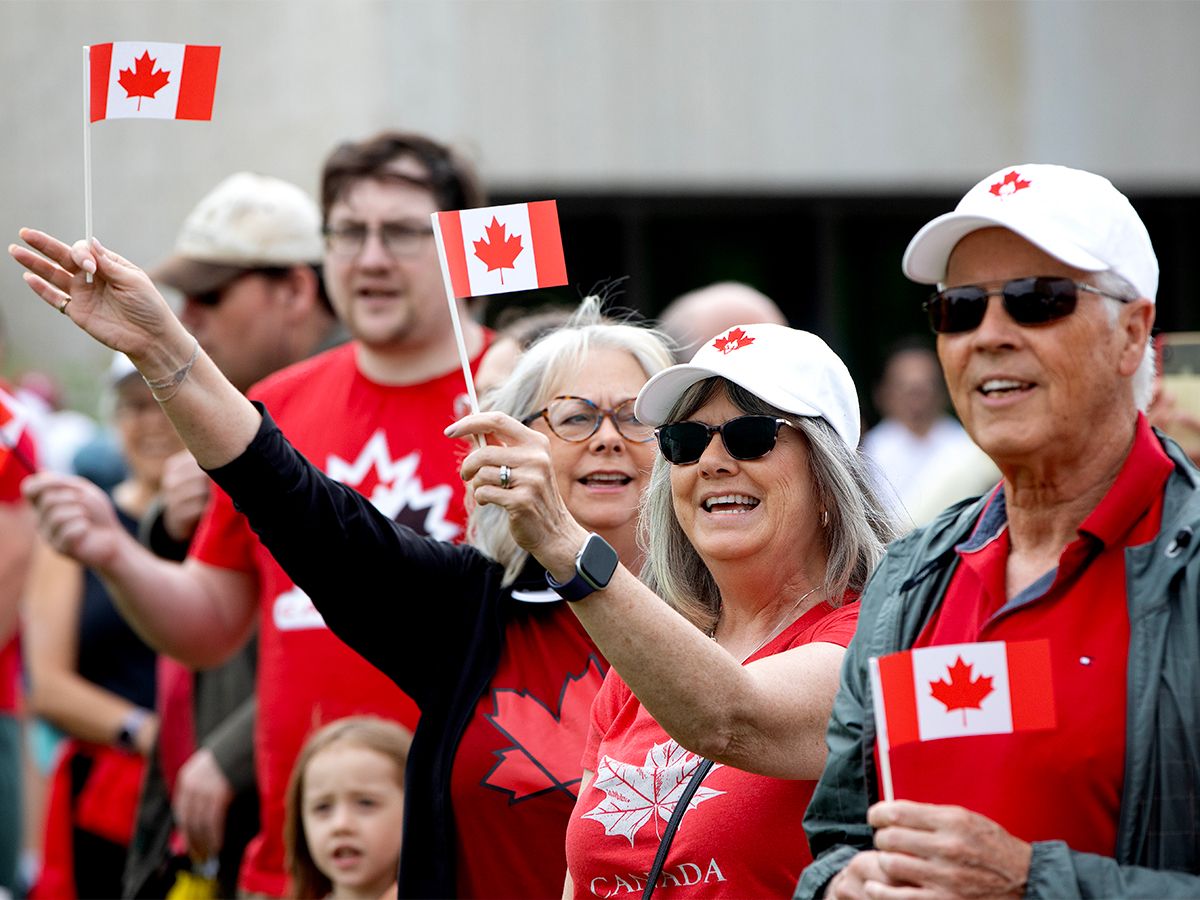
‘National identity now matters as much as economic well-being to a large share of the country’
asserted
identity → matter → country
Reading John Ivison’s Sept. 1 column on the trade talks and Michael Higgins’ column on the same immediately afterwards was edifying.
asserted
Reading → read → same
They both grasped the immediate economic cost of the ongoing trade war.
asserted
They → grasp → war
But one largely missed the deeper national anger over the attacks on our sovereignty.
asserted
one → miss → sovereignty
Together they illuminated why the collapse of Canada-U.S. negotiations is not just another trade spat.
asserted
collapse → illuminate → negotiations
They get that it is about the economy: jobs, GDP, supply chains, the risk of auto tariffs climbing to 50 per cent if Canada accepts terms that violate the letter and spirit of the 2018 CUSMA, terms Ottawa has long called illegal under the agreement.
asserted
Ottawa → get → agreement
Accepting them would mean endorsing the principle that a signed free-trade deal is written in pencil, erasable whenever Washington feels like it.
asserted
Washington → accept → it
But national identity now matters as much as economic well-being to a large share of the country.
asserted
identity → matter → country
The “51st state” threats, the “governor” jibes, the casual insults directed at Canadians as being “nasty,” are affecting us.
asserted
threats → direct → us
Maybe none of it should matter, and reason should win out over passion, but when a U.S. president can order the renaming of Lake Ontario, the body of water shared with Canada’s most populous province, to “Lake America,” the message is unmistakable: Washington defines the map, the terms, and the identity of Ontarians.
Prime Minister Mark Carney and Ontario Premier Doug Ford may be playing partisan politics.
uncertain
Carney → matter → politics
But Canadians largely do not mind.
asserted
Canadians → mind → ?
The alternative, appearing as a country whose major industries can be slowly dismantled, whose cultural and language protections can be bargained down, whose sovereignty can be subordinated, cuts deeper than a temporary GDP hit.
asserted
sovereignty → appear → hit
A GDP decline registers on a spreadsheet.
asserted
decline → register → spreadsheet
A sense of self does not.
asserted
sense → do → self
It is about who gets to define Canada’s place and its own self-identification.
asserted
who → get → place
Canadians are being undeservedly maligned, mistreated, and they know it.
asserted
they → malign → it
Higgins focused on the economic arithmetic and found the walk-away costly.
asserted
away → focus → arithmetic
He simply does not reach the heart of the dispute: for many Canadians, a diminished sense of independence, the freedom to be true to ourselves, is the more meaningful loss.
asserted
sense → reach → ourselves
Tony D’Andrea, Toronto
‘Who would ever want to serve under Pete Hegseth?’
Re: Carney tells U.S. to stop ‘doing memes’ and ‘throwing shade’ as war of words escalates — Christopher Nardi, Sept. 1; and Pete Hegseth’s post just the latest ‘frat boy’ insult to Canada, academics say — Chris Knight, Sept. 1
asserted
academics → want → Canada
When I was a recruit at the Royal Military College 50 years ago, the College Sergeant Major was a man who reportedly weighed 380 pounds at the time.
uncertain
who → weigh → time
The Sergeant Major was a 30-year infantry veteran whose distinguished career had included wartime service in Korea.
asserted
career → include → Korea
He was, literally, a larger-than-life presence who was respected and well-liked by the cadets, someone who was a father figure to many of us, myself included.
asserted
myself → respect → us
Which brings us to U.S. Secretary of War Pete Hegseth’s recent post appearing to ridicule an instructor at the Army Cadet Training Centre in Vernon, B.C.
asserted
Which → bring → Vernon
I suppose we should ask ourselves, what else could we expect from someone who works for a president who has a yellow stripe running down his back?
uncertain
who → suppose → back
Perhaps Secretary Hegseth should ask his boss where he was when Americans of his generation were fighting and dying in Vietnam 60 years ago.
asserted
Americans → ask → Vietnam
Maybe in Hegseth’s next post, he might decide to take shots at Gen. Sir Arthur Currie, who, commanding the Canadian Corps during the final two years of the First World War, led the Canadians to some of their greatest victories.
uncertain
who → decide → victories
Currie was a large man who would have hardly fit the image of the lean-and-mean warrior that Hegseth imagines himself to be.
asserted
himself → fit → that
Nevertheless, Currie proved himself to be one of the most effective battlefield commanders of the Great War, so much so that some historians have speculated that had the war continued for another year, British prime minister David Lloyd George would have given him command of all forces of the British Empire.
asserted
George → prove → Empire
I find it hard to see how any military professional, regardless of their service affiliation or rank, would ever want to serve under Pete Hegseth.
asserted
professional → find → Hegseth
Someone needs to tell Trump, Hegseth, and all the rest of their contemptible and pathetic gang to go jump in Lake ONTARIO.
asserted
Someone → need → ONTARIO
Michael Higgins writes, “Tariffs on trucks isn’t a sovereignty issue, it’s a trade one and best dealt with at the negotiating table.”
asserted
it → write → table
In the Second World War, Canada’s automotive sector was a decisive strategic asset that was converted to serve the Allied cause.
asserted
that → convert → cause
(As we all know, the Americans were very late to join the war effort.)
asserted
Americans → know → effort
By the end of the war, Canada had produced over 800,000 military transport vehicles, including troop carriers, ammunition trucks, artillery tractors, wireless/radio trucks, ambulances, workshops, water tankers, fuel carriers, maintenance vehicles, recovery vehicles, gun platforms, mobile laundries, and engineering vehicles.
asserted
Canada → produce → carriers
Approximately 650,000 such military vehicles were supplied to Canada’s allies, while Canada itself took up the rest.
asserted
Canada → supply → rest
Without maintaining this capability domestically, Canada will be unable to act to defend itself in a war, at least as far as producing the necessary equipment as needed.
asserted
Canada → maintain → equipment
If the United States is successful at its stated goal of terminating Canada’s domestic truck industry and moving production to the United States, Canada will be left a sitting duck.
asserted
Canada → terminate → States
Graham Haig, Toronto
‘Maybe we can rename Lake Ontario (at least for now) to Lake Hissyfit’
asserted
we → rename → Hissyfit
Renaming Lake Ontario, whose proper name was coined by Indigenous people who preceded us by centuries, is as hideous and tone-deaf an act as all the blather about the “51st state” or the suggestion that Canada drop one of our official languages from our packaging for American products being sold here.
asserted
Canada → rename → products
Maybe we can rename Lake Ontario (at least for now) Lake Hissyfit.
asserted
we → rename → Hissyfit
…and 29 more, not listed.