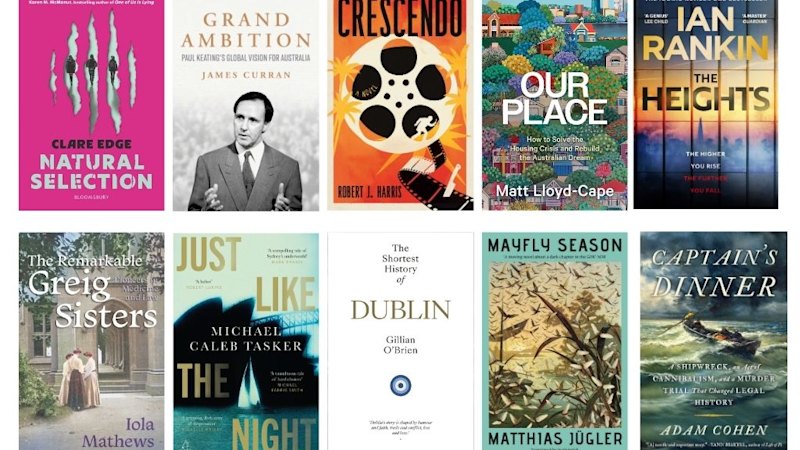
This week’s fiction ranges across feminist revenge to pulp-fiction tropes and gritty Australian noir, while our non-fiction selection includes Paul Keating, the local housing crisis and cannibalism at sea.
asserted
selection → range → sea
Fiction
Crescendo by Robert J. Harris (Polygon, $23)
Robert J. Harris launches a struggling writer into the domain of Alfred Hitchcock in this novel, which is full of the director’s favourite tropes, including damsels in distress, mistaken identities, and psychological trauma.
asserted
which → launch → distress
When Bobby Burgoyne is hired by Hitchcock to work on a screenplay for the (fictional) movie Crescendo, he’s delighted by the opportunity to prove himself, but soon a series of unfortunate events starts to plague the film set, and Burgoyne is tasked with the extra job of trying to figure out who’s trying to sabotage the production.
asserted
who → hire → production
“Someone is out to murder my movie,” deadpans the director.
asserted
director → murder → movie
Bobby teams up with a former lover, who’s also a gun newspaper reporter, and the two get into all manner of dangerous scrapes, all the while “cracking the wise” in their repartee.
asserted
two → team → repartee
Harris informs his novel with the charm, glamour, and seediness of 1950s Hollywood; there are car chases and cigarettes aplenty.
asserted
Harris → inform → Hollywood
And while this novel is a tribute to the pulp fiction of yore as well as the oeuvre of Hitchcock, its twisty plot is well conceived and executed.
asserted
plot → conceive → Hitchcock
Mayfly Season by Matthias Jügler, translated by Jo Heinrich (The Indigo Press, $25)
asserted
Season → translate → Heinrich
Based on historical events, this novella-sized book — a bestseller in Germany —packs an emotional punch.
asserted
book → base → punch
In spare, considered prose, Matthias Jügler tells the story of Hans and his wife Katrin, whose newborn son, Daniel, is reported to have died hours after his birth in 1978 in East Germany.
asserted
son → tell → Germany
Katrin never accepted the authorities’ verdict, and her suspicions, coupled with Hans’ Stoic stonewalling, led to the dissolution of their marriage.
asserted
suspicions → accept → marriage
Forty years later, an unexpected phone call reveals that their child is very much alive.
asserted
child → reveal → ?
Interspersed between the tense narrative of lost and found are more bucolic descriptions of seasonal changes and fishing.
asserted
descriptions → intersperse → changes
These may seem incongruous, but for Hans, a keen angler, the patterns in the natural world provide stability in an unpredictable world.
uncertain
patterns → seem → world
In times of confusion and despair, contemplating and witnessing the migration and spawning habits of fish offer distraction and solace.
asserted
contemplating → contemplate → distraction
Mayfly Season is a quiet, contemplative book, and a reminder that “something doesn’t cease to exist just because it’s always out of sight”.
asserted
it → cease → sight
Though she aspires to “go citizen”, find an honest paying job and blend into society again, two factors mitigate against her.
asserted
factors → aspire → her
She was brought up by a grifter father, a card shark who plied his trade across America, and her daughter, Lena, is involved in hustling scams of her own.
asserted
daughter → bring → own
It’s not long before Sera is drawn into the dark side again.
asserted
Sera → ’ → side
“There were so many ways to make easy money,” Sera reflects, but later, she realises there were equally as many ways for things to go wrong.
asserted
things → be → money
Written in spare prose, the narrative moves back and forth between Sera’s past and present to explore both the stain of familial influence and the sacrifice of maternal love.
asserted
narrative → write → love
As noir as it gets, with its gritty setting and morally compromised characters.
asserted
it → get → setting
Natural Selection by Clare Edge (Bloomsbury, $20)
Natural Selection cleverly riffs on that viral hypothetical TikTok question that asks whether women prefer to be alone in the woods with a wild bear or a strange man.
asserted
women → riff → bear
Clare Edge’s novel is a feminist revenge thriller with supernatural elements that explores generational misogyny and sexual misconduct in a rural town ruled by guns and machismo.
asserted
that → explore → guns
When three teenagers, Outlaw, Megan, and Bee, team together to punish a fellow student for his misbehaviour, they unwittingly set off a course of events in which predator becomes prey.
asserted
predator → team → which
The death toll soon grows.
asserted
toll → grow → ?
Divided into points of view of each of the three girls, the narrative captures a town so beset with male privilege, entitlement, and abuse that the women’s preference would always be the bear.
asserted
preference → divide → privilege
How they wreak vengeance and reclaim their safety, however, makes for an interesting take on girl power; this YA thriller for older teens is a timely tale told in urgent bursts of hurt and outrage.
asserted
thriller → wreak → hurt
The Heights by Ian Rankin (Hachette, $35)
The Heights is a fancy high-rise in London, the domain of the cashed-up and elite, but when a humble night-shift concierge is found murdered in the lobby, it’s up to Detective Sergeant Gillian Gish and her team to figure out the culprit.
asserted
it → cash → culprit
This novel is Ian Rankin’s first standalone thriller in 20 years, so one expects something special, however, it’s a little disappointing that it reads like a typical police procedural, with the requisite plot twists and red herrings.
asserted
it → expect → twists
There’s nothing wrong with it — Rankin keeps the narrative moving along — but the pacing is slow, and the suspense dialled down as the occupants of the building and their associates are methodically interviewed, and authorities follow various leads.
asserted
authorities → ’ → leads
The suspects include a pop star, an actress, a Russian oligarch, a gangster, and an art dealer – many of whom have reason to kill the concierge.
asserted
many → include → concierge
Not surprisingly, the rich and affluent have resources at their disposal to hide their secrets.
asserted
rich → have → secrets
But the book’s tagline, “the higher you rise, the further you fall,” has resonance.
asserted
you → rise → resonance
The phrase that inevitably comes to mind in any discussion of Paul Keating’s career is “big picture”, a phrase often spoken by the right with a sneer, and invoked by much of the left as a badge of honour.
asserted
that → come → honour
Professor James Curran, in this deeply informed study, examines Keating’s vision for an independent Australia – the republic, Indigenous reconciliation and our place in Asia.
asserted
Curran → inform → Asia
But it’s also a study of Keating himself, with all his contradictions.
asserted
it → ’ → contradictions
Fittingly, he begins with the 27-year-old Keating, newly arrived in parliament, standing at Churchill’s grave, paying homage to his hero.
asserted
he → begin → hero
Never mind that Churchill was an Empire man down to his bootstraps; to Keating, he was the embodiment of leadership, especially having the courage of your convictions and being prepared to take risks.
asserted
he → mind → risks
Woven into this is the paradox of Keating the European aesthete and his insistence on the country finding its place in Asia.
asserted
country → weave → Asia
…and 29 more, not listed.
 The Aporia