The Sydney Morning Herald
· collected 2026-10-02 · by Thuy On, Fiona Capp
This week’s fiction ranges across cosy drama, speculative fiction and a satire of aimless young men, while our non-fiction picks include a remarkable Indigenous military biography, tips for understanding cognitive change and evolutionary lessons from Richard Dawkins.
asserted
picks → range → Dawkins
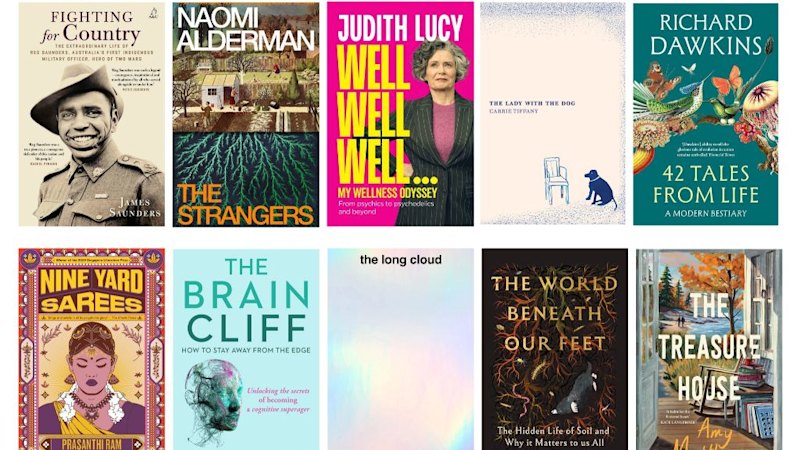
Though they can be read as self-contained units of their own, the 11 short stories in Nine Yard Sarees have overlapping characters and storylines, with a focus on the diasporic narratives of Indian women, from youth to old age.
asserted
stories → read → age
The book is a polyphonic wonder – a multi-generational exploration of sibling and parent-child relationships, traditional values butting against the desire for autonomy, new and long-term marriages, interracial couplings, patriarchal and caste systems, and more.
asserted
book → butt → autonomy
Set mainly in Singapore, “the land of Chinese people and Western modernity”, the non-chronological collection follows the winding paths of an extended Tamil Brahmin family, whether living in close quarters or separated by land and seas.
asserted
collection → Set → land
It also comes with a large supporting cast of characters, and feels epic in scale despite its length.
asserted
It → come → length
Nine Yard Sarees won the 2024 Singapore Literature Prize for English Fiction and has all the colour and tumult you’d expect, but it’s also perceptive, nuanced and empathetic, giving voice to women of different socio-economic backgrounds.
asserted
it → win → backgrounds
A standout tale is about a domestic worker sponsored by higher-class, affluent Indians in Singapore.
asserted
tale → sponsor → Singapore
The Strangers by Naomi Alderman (Fig Tree, $34.99)
An odd book that tries to braid memoir and speculative fiction, The Strangers is an uneasy mix that doesn’t quite gel.
asserted
that → try → memoir
Following the death of her mother, the narrator sets up a camera in her parents’ backyard and accidentally records what could possibly be a new species in the UK.
uncertain
what → follow → UK
They are the strangers of the title, badger-like creatures whose long proboscis resembles an elephant’s trunk.
asserted
proboscis → resemble → trunk
Promptly nicknamed “mimmoths”, they are soon discovered across the globe, prompting all manner of conspiracy theories on whether they are harbingers of hope or pests with malicious intent.
asserted
they → nickname → intent
The book leaves open-ended what these mammals represent, so the reader can insert whatever they deem fit (immigrants? Fear of the unknown?).
asserted
they → leave → unknown
Moreover, the narrator (also called Naomi) is possibly an unreliable one, still processing not only the loss of her mother, but also her inability to carry a pregnancy to term.
uncertain
narrator → call → term
With its play of fact and fiction, The Strangers reads like a meshing of disparate ideas that don’t work together as a whole.
asserted
that → read → whole
The Long Cloud by Hector Mackenzie (Scribe, $29.99)
After a decade hustling in London, washed-out model Xander returns to New Zealand for a holiday and reconnects with his family, exes and old friends.
asserted
Xander → hustle → family
Hector MacKenzie’s debut novel favours short chapters with long sentences in lower case, mostly without punctuation, so the effect is an unfiltered stream-of-consciousness narrative from a 30-year-old with an inferiority complex.
asserted
effect → favour → complex
Xander feels he’s a failure because he’s not a “doctor or a writer or a musician or an artist or a producer”, just someone who trades on his fading good looks.
asserted
who → feel → looks
His successful actress girlfriend, who financially supports him, also presents a challenge to his masculinity.
asserted
who → support → masculinity
The Long Cloud immerses you in the mindset of an immature and anxious kidult, and a lot of the prose reads like rambling journal entries full of vaping, drinking and hangouts with small-town inhabitants.
asserted
lot → immerse → inhabitants
But when Xander meets someone whose radiance pierces his maudlin self-pity, there is a chance he may upend his life.
uncertain
he → meet → life
The book is a study in arrested development; it both satirises and indulges in the depiction of rudderless young men.
asserted
it → satirise → men
The Treasure House by Amy Matthews (Simon & Schuster, $34.99)
With a hardscrabble background and after a string of shabby rentals, all Zoe ever wanted for herself and her 11-year-old daughter, Florence, was stable accommodation.
asserted
Zoe → want → herself
So despite barely knowing “a nail from a screw”, she decides to buy what’s euphemistically called a “treasure house” in a small seaside town in the US state of Maine, which is full of holidaymakers and retirees.
asserted
which → know → holidaymakers
Its low price reflects its decrepitude.
asserted
price → reflect → decrepitude
The narrative is divided into two parts: the present, with full-scale cleaning and renovation of the “gnarled crone of a cottage” and its garden, undertaken by an enthusiastic team of helpers, and the 1950s, from the perspective of Marly, a previous occupant.
asserted
narrative → divide → Marly
Despite some traumatic content involving drug addiction and its effects, The Treasure House is a wholesome, cosy drama that prefers to focus on new beginnings, community goodwill and the balm of romance.
asserted
that → involve → romance
The mother-daughter relationship between Zoe and her precocious preteen is sweetly drawn out, with Gilmore Girls vibes.
asserted
relationship → draw → vibes
The Lady with the Dog by Carrie Tiffany (NewSouth, $29.99)
This tiny book (only 108 pages) shares its title with an Anton Chekhov short story, but where Chekhov’s tale deals with an affair between two married people, this one, as Carrie Tiffany points out in her afterword, is dedicated to her late mum, who suffered from Alzheimer’s disease.
asserted
who → share → disease
The unnamed woman in this novella has received a diagnosis not long before a new dog – also unnamed – arrives in the home she shares with her husband.
asserted
she → receive → husband
It is apparently the sixth canine to have graced the household, but the woman’s memory is patchy and unreliable.
asserted
memory → grace → household
Her past bleeds into the present, with recollections of family dogs from yesteryear mingled with the antics of the latest creature.
asserted
recollections → bleed → creature
It’s a sad story of mental disintegration.
asserted
It → ’ → disintegration
Not only is she unable to recognise a photo of her younger self, but she is constantly confused about timelines and despairs that “most things are her fault now”.
asserted
things → recognise → timelines
Interspersed among the spare text are coloured line drawings by Noel McKenna that add poignancy to the story.
asserted
that → add → story
Tiffany is adept at depicting the collapse of language and identity.
asserted
Tiffany → depict → language
With its cover image of a man in uniform, Fighting for Country looks at first glance to be a standard military biography.
asserted
Fighting → look → glance
The man is clearly Indigenous, and the title doesn’t just refer to doing service for the nation.
asserted
title → refer → nation
His nephew, James Saunders, sets the mood early with Reg as a boy walking the shores of Lake Condah in Victoria’s Western District, in the footsteps of his forebears on Gunditjmara Country.
asserted
nephew → set → Country
With a flair for evocative, immersive storytelling, James takes us into Reg’s world, revealing how the battles of the Gunditjmara for their Country echoed through his youth, his service in two wars and civilian life.
asserted
battles → take → wars
“They were the first defenders of Australia, and their work did not end with treaties of Europe or medals from allies.”
asserted
work → end → allies
…and 29 more, not listed.
 The Aporia