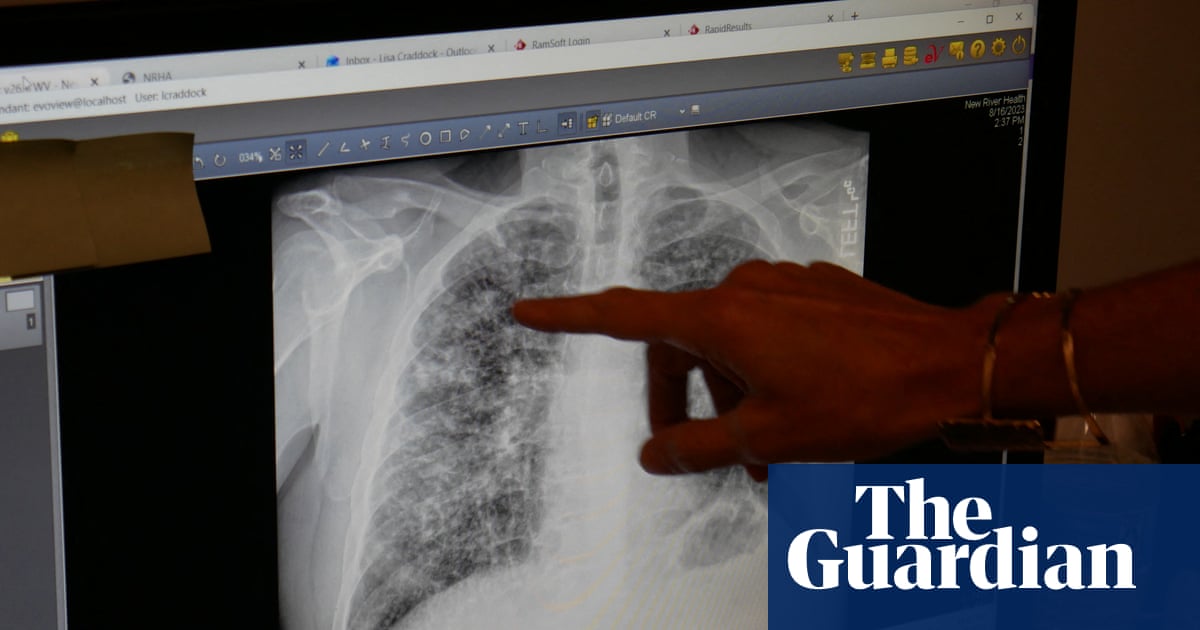
Silicosis is one of the oldest workplace hazards and public health experts have known for decades how to prevent it.
asserted
experts → know → it
Yet a new wave of workers, from Appalachian coalminers to Latino countertop fabrication workers, are developing and dying from the disease as industry fights new protections and regulators fail to defend the rules that could protect them.
uncertain
that → develop → them
John Robinson’s grandfather developed black lung back when coalminers could spend decades in the mines before being diagnosed with the disease, often dying in their 60s, 70s and 80s.
uncertain
coalminers → develop → 60s
But Robinson, who mined for coal in south-west Virginia, was diagnosed when he was 47.
asserted
he → mine → Virginia
He’s part of a trend that has grown over the past two decades in central Appalachia, where more coalminers are developing black lung disease at younger ages.
asserted
coalminers → ’ → ages
“Now, honey, how are these men getting sick?
asserted
men → get → ?
Something’s causing it,” Robinson said.
asserted
Robinson → cause → it
“At one time, you didn’t say black lung around the coal site unless you wanted to lose a job.
asserted
you → say → job
It’s such an outbreak right now they can’t hide it.”
asserted
they → ’ → it
Around 2018, doctors throughout the US started documenting outbreaks of lung disease among countertop fabrication workers too.
asserted
doctors → start → workers
That same year, a 38-year-old Hispanic man in California, whose work involved grinding stone edges at a countertop fabrication company, died of respiratory failure.
asserted
work → involve → failure
Public health experts say the cause of both outbreaks is inhalation of tiny crystalline silica dust on the job and prevention involves limiting workers’ exposure through sampling and tamping down the dust to stop particles from becoming airborne.
asserted
prevention → say → particles
This means different things depending on the occupation.
asserted
This → mean → occupation
For miners, the 2024 Mine Safety and Health Administration (Msha) rule years in the making and passed under the Biden administration was supposed to address the occupational hazard.
asserted
rule → pass → hazard
But within months of the rule going into effect, industry groups petitioned to overturn it.
asserted
groups → go → it
When the Trump administration failed to defend the rule, the eighth circuit court of appeals stayed it and Msha notified the court that it will reconsider portions of the rule impacted by the industry challenge.
asserted
it → fail → challenge
The National Stone, Sand & Gravel Association (NSSGA) led the legal challenge of Msha’s 2024 silica dust rule.
asserted
Association → lead → rule
The trade group represents sand, gravel and stone mining companies.
asserted
group → represent → companies
NSSGA did not oppose the rule’s reduction of the permissible exposure limit from 100 micrograms per cubic meter to 50 micrograms per cubic meter per eight-hour shift, said Kerry Lynch, NSSGA’s senior director of communications.
asserted
Lynch → oppose → communications
Lynch did not respond to questions about why it brought the legal challenge of the rule.
asserted
it → respond → rule
But in a letter to Msha before the rule was finalized, NSSGA said it takes issue with the frequent air sampling and medical surveillance requirements.
asserted
it → finalize → requirements
The American Exploration & Mining Association (AEMA) is one of the industry groups that joined the petition to challenge Msha’s 2024 silica dust rule.
asserted
that → join → rule
In a written statement to the Guardian, AEMA’s executive director, Mark Compton said that the AEMA supports lowering the permissible exposure limit (PEL) of silica to better protect miners.
asserted
AEMA → write → miners
“We joined the petition challenging the 2024 silica rule because the rule would actually undermine miner safety and health due to the restrictions Msha imposed on its implementation,” Compton said.
asserted
Compton → join → implementation
“The rule takes an inflexible, cookie-cutter approach that doesn’t account for the variability in locations and types of actions at different operations, engineering controls are not always technically or economically feasible, contrary to Msha’s assertion in the 2024 rule.
asserted
controls → take → rule
Greater use of administrative controls such as job rotation and acceptance of personal protective equipment in the form of respirators should be allowed to achieve and comply with the reduced PEL.”
asserted
use → allow → PEL
Countertop fabrication workers should be protected under a 2016 Occupational Safety and Health Administration (Osha) rule, which also faced industry pushback when it was implemented.
asserted
it → protect → pushback
Industry groups including NSSGA challenged the rule in court, arguing that Osha’s stricter exposure limit was “not based on sound science”.
asserted
limit → include → science
The appeal to “sound science” has long been a tactic used by industries seeking to cast doubt on research that could lead to stricter regulation, a strategy that David Michaels, an epidemiologist and professor at the Milken Institute School of Public Health of George Washington University, documented in his book Doubt Is Their Product.
uncertain
Doubt → use → book
But the artificial stone slabs that fabrication workers cut to make countertops can contain up to 90% silica, meaning the Osha rule alone is not protective enough, said Michaels, who previously served as assistant secretary of labor for Osha from 2009 to 2017.
asserted
who → cut → 2017
“It’s also often that many small employers are not in compliance.
asserted
employers → ’ → compliance
But even if they were in compliance I think we would still have a silicosis problem,” Michaels said.
asserted
Michaels → think → problem
“This product cannot be made in a way that’s both economic and safe.”
asserted
that → make → way
In January, Michaels testified at a congressional subcommittee hearing about mounting lawsuits against manufacturers of stone slab products and the big box stores that sell them.
asserted
that → testify → them
The lawsuits were brought by people diagnosed with silicosis from working in fabrication shops where they cut, ground and polished countertops made from engineered stone, also known as quartz, which has grown in popularity over the past decade.
asserted
which → bring → decade
But instead of aiming to protect the sick workers, the subcommittee discussed how to protect the stone slab manufacturers and distributors from litigation.
asserted
subcommittee → aim → litigation
In his opening statement, the subcommittee chair, congressman Darrell Issa of California, said: “Our hearing this morning examines the troubling rise in abusive litigation against the US stone slab industry.”
asserted
hearing → say → industry
Issa is among 16 co-sponsors of a proposed bill that would ban lawsuits against manufacturers or sellers of certain stone slab products.
asserted
that → propose → products
Michaels was the only witness to give testimony at the hearing who wasn’t representing industry.
asserted
who → give → industry
He suggested that instead of prohibiting lawsuits that the US should prohibit the sale of engineered stone products with high concentrations of silica.
uncertain
US → suggest → silica
…and 19 more, not listed.
 The Aporia