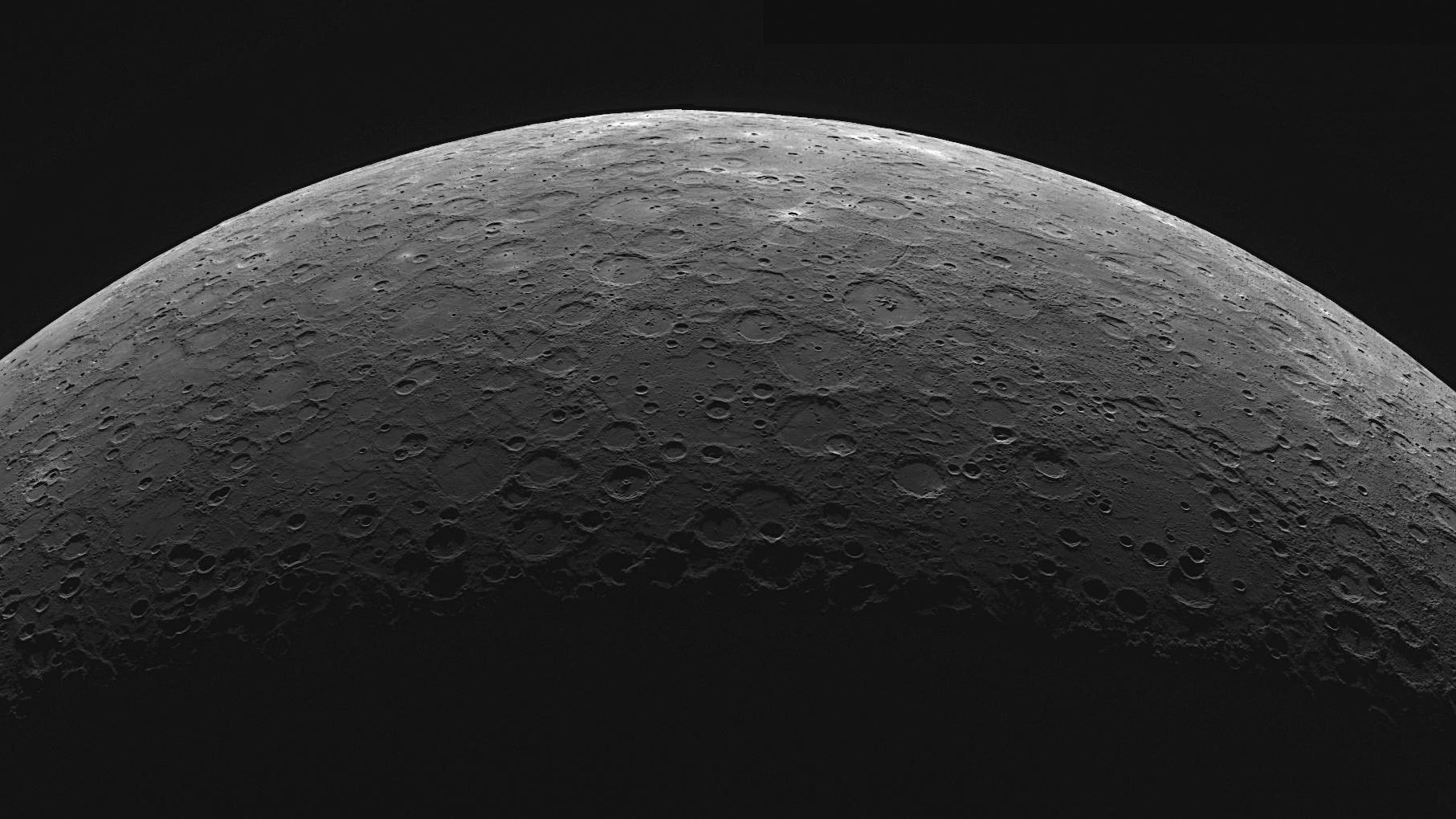
The solar system’s smallest planet, it measures just 3,023 miles across—or barely 3.6% of the 88,846 mi. diameter of Jupiter, the solar system’s largest.
asserted
it → measure → Jupiter
Saturn’s moon Titan and Jupiter’s Ganymede both also have greater diameters than Mercury.
asserted
Titan → have → Mercury
And according to a new study in Geophysical Research Letters, Mercury has actually put in the work to get as small as it is, spending part of the past 4.5 billion years shrinking—significantly more than planetologists once thought.
uncertain
planetologists → accord → years
That matters.
asserted
That → matter → ?
Figuring out the history of Mercury provides clues to how all rocky worlds like the moon and Mars formed.
asserted
worlds → figure → moon
And what happens in our solar system surely happens in ones much farther afield in space.
asserted
happens → happen → space
How did scientists measure Mercury’s shrinking?
asserted
scientists → measure → shrinking
The findings come courtesy of data gathered by the Mercury MESSENGER spacecraft—a ship whose name was derived from the decidedly clumsy acronym “MErcury Surface, Space ENvironment, GEochemistry, and Ranging.”
asserted
name → come → acronym
MESSENGER launched in August 2004; reached Mercury in March 2011; and completed 4,105 orbits of the planet before running out of fuel and crashing into the surface on April 30, 2015.
asserted
MESSENGER → launch → April
In those four-plus years on the job, MESSENGER did a lot of work, studying Mercury with seven different scientific instruments—including its Mercury Laser Altimeter, a ranging tool that could measure surface features to within one meter; and a dual imaging system that used two cameras to map the surface in wide- and narrow-angle and black and white and color.
uncertain
that → do → angle
Scientists have known for a long time that Mercury has gotten steadily smaller since its birth.
asserted
Mercury → know → birth
The planet was formed when dust, gas, rocks, and asteroids left over from the formation of the sun collided and collected, coalescing into a discrete body and generating enormous amounts of heat in the process.
asserted
dust → form → process
Over the eons much of that heat dissipated, causing Mercury to contract by what astronomers estimated to be 2.5 miles to 10 miles in diameter.
asserted
astronomers → dissipate → diameter
To confirm that conclusion, MESSENGER scientists used the spacecraft’s laser altimeter and dual-imager to scan the planet looking for so-called shortening structures, which are distortions in the surface made up of wrinkles, ridges, and what are known as lobate scarps—cliff-like structures that form when the crust pushes rock upward along a fault.
asserted
crust → confirm → fault
Shortening structures form when a planet contracts; the greater the number of those surface features, the greater the planetary shrinkage has been.
asserted
shrinkage → shorten → features
MESSENGER did its best to map shortening structures across the entirety of the planet, but two things made that job a challenge.
asserted
job → do → planet
For starters, the more powerful of its two imaging systems, the laser altimeter, could not operate effectively if the spacecraft was more than 930 miles away from the planet—a proximity it reached only when it was over Mercury’s north polar region during its sweeping elliptical orbits; at other points it was as much as 9,500 miles distant.
uncertain
it → image → points
The dual-imaging system could survey the surface during those more remote approaches, but it did not produce the detailed three-dimensional pictures the laser altimeter did.
uncertain
altimeter → image → pictures
The shortening structures formed early in the planet’s history, and in the eons since, Mercury has been steadily pounded by incoming asteroids, gouging out craters and scattering debris, obscuring the telltale scars of planetary contraction.
asserted
Mercury → shorten → contraction
It’s possible to read through that rubble—tracing shortening structures until they are covered up by craters or rocks and estimating what their course and reach was—but that takes planet-wide three-dimensional maps, something that MESSENGER did not provide.
asserted
MESSENGER → ’ → that
With the cooperation of NASA, the custodian of the MESSENGER images, a team led by Gaku Nishiyama, a planetary scientist at the German Aerospace Center Institute of Space Research and the lead author of the new paper, harvested two-dimensional pictures taken by the spacecraft’s dual-imaging system and combined them in such a way that every patch of surveyed land was captured twice—from slightly different angles each time.
asserted
patch → lead → angles
“We used a digital terrain model generated through so-called stereophotogrammetric technique,” says Nishiyama.
asserted
Nishiyama → use → technique
“Combining two images taken at different viewing angles [is similar to the way] human beings recognize stuff with both eyes.
asserted
beings → combine → eyes
So two-dimensional images are combined to derive three-dimensional topography.”
asserted
images → combine → topography
With the help of that detailed terrain map, Nishiyama and his colleagues were able to study the entirety of Mercury with a resolution never before achieved.
asserted
Nishiyama → study → resolution
That helped the team infer the location and reach of shortening structures that were otherwise covered up over time, and that, in turn, led them to conclude that previous calculations of Mercury’s historical shrinkage were underestimates.
asserted
calculations → help → shrinkage
“We find a lack of shortening structures in rough regions,” the researchers wrote, “suggesting that roughness-related processes obscure pre-existing structures.
asserted
processes → find → structures
This biases previous contraction estimates downward… implying that Mercury’s contraction is up to 30% larger than previously thought.
asserted
contraction → bias → estimates
What can Mercury’s shrinking teach us about the planet and our solar system?
asserted
shrinking → teach → planet
Increased shrinkage means planetologists have to rethink what they previously believed about the chemical composition and temperature of Mercury’s core, with lower sulfur or silicon content than previously believed, leading to faster cooling and more contraction.
asserted
they → increase → cooling
It could also suggest that Mercury’s core started out hotter than suspected, which resulted in a more dramatic volume change when it finally did cool down.
uncertain
it → suggest → change
“More shrinking means Mercury could have a larger metal core, less light elements like silicon mixed into the metal core, or a higher starting temperature,” said Nishiyama in a statement that accompanied the release of the study.
uncertain
that → mean → study
What Nishiyama and his colleagues learned about Mercury’s cooling and shrinking could have implications for the study of other rocky worlds like the moon and Mars.
uncertain
learned → learn → moon
The moon has more craters and other rough features than Mercury, making it more important to try to interpret the shortening structures that did survive in order to estimate potential lunar shrinkage—learning if what happened on Mercury indeed happened on the moon and perhaps Mars.
asserted
happened → have → moon
If so, says Nishiyama, all three worlds are likely to be contracting still, as heat continues to escape from their interiors into space.
asserted
heat → say → space
Meantime, Mercury will get a closer look soon.
asserted
Mercury → get → look
In 2018, the European and Japanese space agencies launched the BepiColombo spacecraft on an eight-year journey to Mercury.
asserted
agencies → launch → Mercury
The ship will arrive in December and begin science operations in April 2027.
asserted
ship → arrive → April
BepiColombo has a significantly more powerful laser altimeter than MESSENGER’s, able to resolve surface changes as small as 20 centimeters (8 in.).
asserted
BepiColombo → have → centimeters
The spacecraft will also be in a less eccentric orbit than MESSENGER, putting more of Mercury’s surface within its crosshairs.
asserted
spacecraft → put → crosshairs
…and 1 more, not listed.
 The Aporia