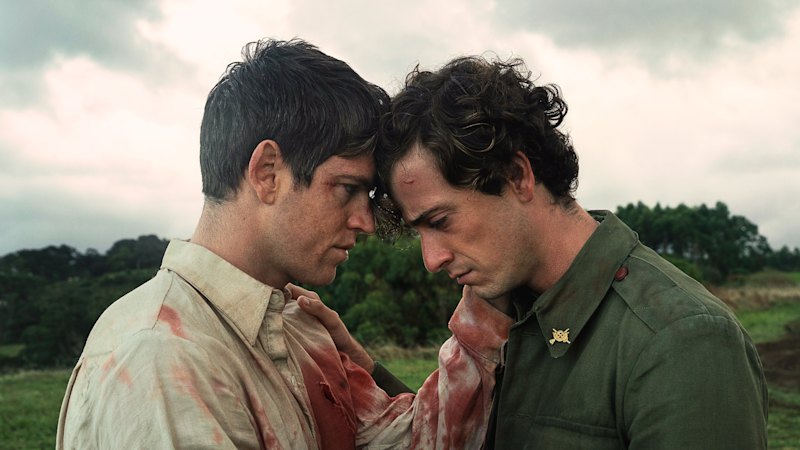
La Bola Negra at London Film Festival: Grand and achingly moving

Read the original at Evening Standard ↗
Cite

Pettit, H. (2026, October 14). La Bola Negra at London Film Festival: Grand and achingly moving. Evening Standard. https://www.standard.co.uk/culture/film/la-bola-negra-at-london-film-festival-review-b1300889.html

Dated from the outlet's own feed. Check the original for its byline.

Evening Standard · collected 2026-10-14 · by Hannah Pettit

Quick Summary

La Bola Negra, directed by Javier Calvo and Javier Ambrossi, premiered at the London Film Festival and tells interconnected stories of three gay men across different periods in Spanish history: Carlos in 1932, Sebastián during the Spanish Civil War, and Alberto in 2017. The film highlights the struggles and freedoms these characters experience due to their sexuality against various social and political backdrops. Featuring standout performances by Milo Quifes, Guitarricadelafuente, Miguel Bernardeau, Carlos González, and Penélope Cruz, La Bola Negra is praised for its rich cinematography and production design but noted for having less compelling transitions between time periods.
Written locally by qwen2.5:14b on 2026-10-14, using this article's own text rather than the other coverage of the same event (that is the story summary below).

AI analysis runs on qwen2.5:14b, locally

Story summary

La Bola Negra, directed by Javier Calvo and Javier Ambrossi, premiered at the London Film Festival in 2026 as a critically acclaimed arthouse film. The movie, set across different periods of Spanish history, follows three interconnected gay men. Carlos, living in 1932 Granada, faces societal rejection due to rumored homosexuality. Sebastián, a young musician from 1937 during the Spanish Civil War, meets an injured Republican soldier named Rafael Rodríguez Rapún who was an actor and former Atlético Madrid player before joining the war. The film also features a third storyline set in 2017 involving Alberto, a postgrad history student who is linked to Federico García Lorca through Rapún’s relationship with him. Each character's story explores themes of identity, societal acceptance, and historical impact across generations.

Written for “La Bola Negra At London Film Festival” on 2026-10-14, grounded in this article and the 0 other(s) covering the same event.
Why this leaning score
This article does not take a side on a contested political question, so it has no leaning score. That is an answer rather than a gap: a match report or a rescue can be warmly or critically written without being left or right, and scoring it anyway is how approval of a subject gets recorded as a political position.
No political leaning scored for article 80274 · logged 2026-10-14

Story

📰 La Bola Negra At London Film Festival
Entertainment · 1 article(s) covering the same event.

Compared with similar articles

This article reads unscored and hedges 13% of its claims. Each row says how that neighbour differs.
The Sydney Morning Herald
⚖️ Leans left 🔴 2% hedged 1 of 47 📰 publisher trust 61
“The articles describe different reviews or discussions about the same film but do not focus on the same specific event.”
How this article was measured signals, leaning charts, publisher record, byline, topics and claims

Signals How these are calculated →

Claims extracted
15
sentences that state something as happening or true
Uncertain
13%
2 of 15 hedged ("reportedly", "may", "according to")
Leaning
not political
takes no side on a contested political question
Publisher signals
67/100
Evening Standard's corrections and hedging, across everything collected from it. Not a measure of accuracy.
Outlets on this story
1
Entertainment
Same framing elsewhere
1
articles that frame the event the way this one does
Analyzed 2026-10-14 · how these are computed

How this is being covered How these are calculated →

Article leaning vs. publisher reliability
Source leaning vs. consistency

Publisher

Evening Standard · 5201 article(s) · 45 correction(s) detected
Running correction rate · 45 correction(s)

Who wrote this

Hannah Pettit
5 article(s) here · 1 carrying a prediction
🔮 He spends the rest of the film in a state of limbo, unsure of whether he should deny the rumours or accept that society will reject him because of his sexuality.
🔮 With a runtime of nearly two-and-a-half hours, there’s the distinct feeling that Artificial could’ve been a bit tighter and more incisive with its messaging.
🔮 He also monologues constantly on everything from IRA bombs and Hank Williams to varieties of cheese and the wild horses that roam the island, frequently prompting hilarious cuts to Rockwell’s confused face.
🔮 Help has arrived in the form of determined weather forecaster, Makoto Aoyama (Masami Nagasawa), who expertly uses her meteorological knowledge to map the movements of Ghidorah.
Also by Hannah Pettit
Nothing else under this byline is closely related to this article, so these are simply their most recent.

Topics

Granada Nationalist Spain Spanish the Spanish Civil War

Subjects

Alberto PERSON · 4× Sebastián PERSON · 4× Carlos PERSON · 3× Rapún PERSON · 2× Spain GPE · 2× Spanish NORP · 2× Javier Ambrossi PERSON · 1× Javier Calvo PERSON · 1× Los Javis PERSON · 1× Milo Quifes PERSON · 1×

Narrative

It’s slowly revealed that Rapún’s relationship with the real-life Spanish playwright Federico García Lorca, on whose unfinished queer play this film is partly based, is linked to the third storyline, which is set in 2017 and follows a postgrad history student called Alberto (Carlos González).
framing: assertive · carried by 1 article(s) · first seen 2026-10-14
🔮 He spends the rest of the film in a state of limbo, unsure of whether he should deny the rumours or accept that society will reject him because of his sexuality.
2026-10-14 · Evening Standard
La Bola Negra at London Film Festival: Grand and achingly moving · assertive framing

Claims (15 extracted, 2 hedged)

If there’s one arthouse film you must see this year, it’s this. asserted
it → ’ → ?
Directed by Javier Calvo and Javier Ambrossi, or ‘Los Javis’ as they are affectionately known in their native Spain, La Bola Negra is a sprawling spectacle which weaves together the storylines of three interconnected gay men living in different periods of Spanish history. asserted
which → direct → history
The first is Carlos (Milo Quifes), a wealthy young man living in 1932 Granada, who is refused membership of an exclusive casino because of his rumoured homosexuality. asserted
who → live → homosexuality
He spends the rest of the film in a state of limbo, unsure of whether he should deny the rumours or accept that society will reject him because of his sexuality. asserted
society → spend → sexuality
The second storyline is that of Sebastián (Guitarricadelafuente), a young musician who is forced to join Spain’s Nationalist faction in 1937, during the Spanish Civil War. asserted
who → force → War
It’s because of this, though, that Sebastián meets someone who will change the course of his life and whose acquaintance will reverberate through the years. asserted
acquaintance → ’ → years
An injured Republican soldier, Rafael Rodríguez Rapún (Miguel Bernardeau), who was an actor and played for Atlético Madrid before the war, is placed under his watch. asserted
who → play → watch
Rapún is due to be executed and is only being kept alive for information, but that doesn’t stop the two secretly drawing close in the short time they have together. asserted
they → execute → time
It’s slowly revealed that Rapún’s relationship with the real-life Spanish playwright Federico García Lorca, on whose unfinished queer play this film is partly based, is linked to the third storyline, which is set in 2017 and follows a postgrad history student called Alberto (Carlos González). asserted
which → reveal → student
As an out gay man living in Madrid with his boyfriend, Alberto is much freer to enjoy the life that Carlos and Sebastián could never have had. uncertain
Carlos → live → that
Against the wishes of his mother, Teresa (Lola Dueñas), with whom he is constantly arguing, Alberto journeys to Cantabria after finding out that his recently-deceased grandfather has left him something in his will. asserted
grandfather → argue → will
We learn more about Carlos and Sebastián’s stories through Alberto, as the three plotlines gradually converge to form one grand, sweeping portrait of love which defies social and political oppression. asserted
which → learn → oppression
Over its two-and-a-half-hour runtime, La Bola Negra skillfully unearths the queer expression that’s been suppressed over the decades, whether that’s in a wartime setting, under the rule of fascism or amid conservative family conflict. asserted
that → unearth → conflict
It’s an achingly moving film, brought to life by a knockout ensemble cast (Penélope Cruz has a standout cameo) and delightfully rich cinematography and production design from Gris Jordana and Roger Bellés respectively. asserted
Cruz → ’ → Jordana
While the transitions between the time periods could be a bit more seamless and the modern-day storyline feels noticeably less compelling than the other two, all things considered, La Bola Negra deserves all the praise (and possible Oscars) it will get and more. uncertain
it → feel → praise

💬Give feedback
🕘History 🎫Support