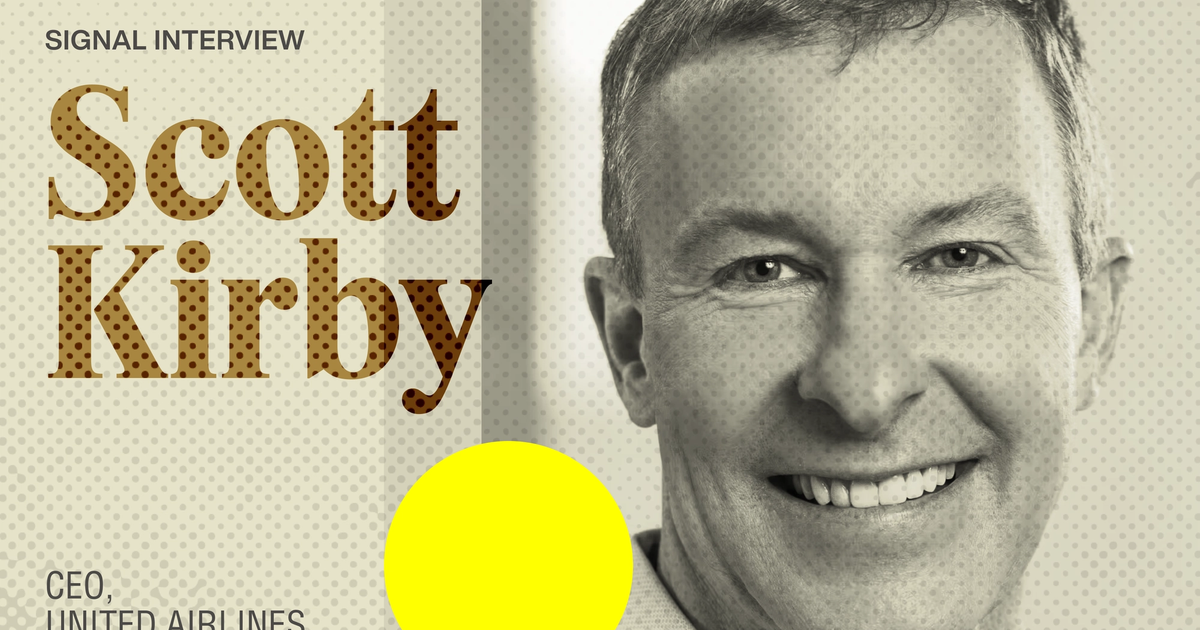
“Every senior executive should have to go play high-stakes poker with their own money,” Scott Kirby says, explaining how a lifetime of gambling has informed how he balances risks and rewards.
asserted
he → have → risks
United Airlines’ card-counting CEO was a good enough blackjack player to get banned by casinos from Las Vegas to the Caribbean, and he still believes in a calculated bet.
asserted
he → count → bet
“The biggest mistake that most people make in their career is never making a big mistake because they never take a chance,” he tells The CEO Signal.
asserted
he → make → Signal
If you just wait for sure things, “you don’t ever make any big mistakes, but you never do anything big.”
asserted
you → wait → anything
Kirby placed one of the longest-odds wagers of his career earlier this year, when he approached American Airlines — and, reportedly, Delta Air Lines — about a possible merger.
uncertain
he → place → merger
Combining two of the three largest US carriers would transform the country’s aviation industry to such an extent that many analysts predicted regulators would never clear such a deal.
asserted
regulators → combine → deal
By one calculation, a combined United-American would account for 40% of US domestic flying capacity.
asserted
American → combine → capacity
American publicly rejected United’s overture, and Kirby admits that “my push on consolidation” remains “hypothetical” without a willing merger partner.
asserted
push → reject → partner
Even so, that is not deterring him from making the case that United should be allowed to get much, much larger.
asserted
United → deter → case
The Chicago-based company has improved its hand in his six years as CEO, Kirby says, strengthening its reputation and profitability as its stock climbed out of an industry-wide pandemic nosedive.
asserted
stock → base → nosedive
But he still sees gaps in its network that would be hard to fill without a deal, from New York to Miami, and parts of the world, like the Middle East and Asia, where its service lags the best local flag carriers.
asserted
service → see → carriers
Kirby’s not asking for the state subsidies that some of those rivals enjoy, he says, but he wants “the scale to compete” with all of them.
asserted
scale → ask → them
“I’d like to create an airline that all US citizens are proud of, and think of as a flag carrier.”
asserted
citizens → like → carrier
He is “100% certain that [a United-American] merger would be good for customers,” rather than raising prices for passengers, he says, anticipating the first question antitrust regulators would pose about a combination that his target dismissed as “negative for competition and for consumers.”
asserted
target → raise → consumers
He is not chasing a rumored consolation-prize bid for the smaller, more digestible JetBlue, he adds.
asserted
he → chase → JetBlue
“It’s really just as hard to integrate a small airline as it is a big airline.
asserted
it → ’ → airline
So if you’re going to go through that brain damage, my first choice is do something big.”
asserted
choice → go → something
How to turn a commodity into a beloved brand
Kirby’s contention is that opposition to further consolidation in his industry is rooted in an outdated view that air travel is a commodity product, where customers only care about which carrier has the most convenient schedule and the lowest price.
asserted
carrier → turn → schedule
His strategy at United has been all about proving that an airline can be something more.
asserted
airline → prove → United
The secret fact about his role is that “being a CEO is a pretty easy job,” Kirby says.
asserted
Kirby → say → role
He is just one person, he explains, “but if I can lay out a vision that people believe in and a direction that they want to go, and I’ve got 120,000 people that want to go there with me, nothing could stop us.”
uncertain
nothing → explain → us
The vision he is now setting out for them is not just that United should be the world’s best airline, but that it should aspire to become “one of the most loved consumer brands around.”
asserted
it → set → brands
That is not easy in an industry where extreme weather and air traffic control delays often leave passengers grounded and frustrated, he notes, but it starts with creating an airline that employees can be proud of.
asserted
employees → leave → that
United’s decision to replace “crappy” in-flight WiFi with SpaceX’s Starlink satellite internet service, and use of AI to improve how it communicates with customers about delays, helps that goal, Kirby believes.
asserted
Kirby → replace → goal
One of the simplest ways leaders can improve employee morale is to focus on fixing such everyday frustrations and “eliminate their need to apologize for anything,” he says.
asserted
he → improve → anything
“If you’re apologizing, you’re behind the eight ball.
asserted
you → apologize → ball
But persuading customers to pick an airline for reasons other than flight times and prices is also about what it chooses not to do.
asserted
it → persuade → what
Airlines can’t change the fees they pay airports or the price they pay for fuel, he notes, so executives who see air travel as an undifferentiated commodity end up cutting other costs at the expense of the customer, he says.
asserted
he → change → customer
The way the numbers stack up in those circumstances, “all you can do is take the cheese off the pizza.”
asserted
you → stack → pizza
Placing big bets while watching ‘the risk of ruin’
Kirby studied at the US Air Force Academy, where he initially hoped to be a fighter pilot, and the mathematical equations that underpinned his degrees in computer science and operations research still run through his analysis of United and its industry.
asserted
that → place → United
His wagers, in casinos and in the boardroom, have all been “positive expected value gambling,” underpinned by mathematical strategy, he says.
asserted
he → expect → strategy
That means he places bets only when he calculates that the odds are in his favor, and that he is constantly looking for ways to avoid losing everything if his luck turns.
asserted
luck → mean → everything
Smart gamblers always calculate their “risk of ruin,” he notes, so they bet in a way that even an extended run of bad luck will not bankrupt them.
asserted
run → calculate → them
In business, he says, that means always keeping other options open.
asserted
that → say → options
CEOs should be willing to make big bets, but to keep “an off-ramp” to avoid putting the company at risk if it all goes wrong.
asserted
it → make → risk
Kirby applied his theory most prominently in June 2021, when United placed the largest aircraft order in its history, even as its passenger numbers remained far below pre-pandemic levels.
asserted
numbers → apply → levels
That decision wasn’t much of a gamble, he says now: He was confident travel demand would recover, and his rivals’ caution about expansion also offered “probably the best risk-reward [balance] that will ever exist in the history of the industry.”
asserted
that → say → industry
When United’s directors pressed him on whether he was sure about committing to such a large order, he told them “Because everyone else is shrinking, we don’t actually have to be totally right.
asserted
we → press → them
We just have to not be totally wrong.”
asserted
We → have → ?
Underscoring his confidence, he also told the board that if he turned out to have miscalculated, “you guys should fire me.”
asserted
guys → underscore → me
…and 20 more, not listed.
 The Aporia