Gazans harvest dregs of olive groves bulldozed and cut off by Israel

Read the original at The Straits Times ↗
Cite

The Straits Times. (2026, October 14). Gazans harvest dregs of olive groves bulldozed and cut off by Israel. The Straits Times. https://www.straitstimes.com/world/middle-east/gazans-harvest-dregs-of-olive-groves-bulldozed-and-cut-off-by-israel

Dated from the outlet's own feed. Check the original for its byline.

The Straits Times · collected 2026-10-14 · by The Straits Times

Quick Summary

Haidar Abu Middain, a 60-year-old farmer in Gaza, is harvesting what remains of his family’s once-prosperous 220-acre olive orchard after much of it was bulldozed or cut off by Israeli forces. Before the conflict, the grove produced between 1,100 to 1,500 tons of olives annually; today, Abu Middain expects only enough for his family’s use due to extensive destruction. The article highlights that Gaza's agriculture authorities estimate that out of two million olive trees before the war, fewer than 150,000 remain standing now, drastically reducing this year’s harvest from 40,000 tons to about 5,000 tons of olives and 700 tons of oil instead of the usual 5,000.
Written locally by qwen2.5:14b on 2026-10-14, using this article's own text rather than the other coverage of the same event (that is the story summary below).

AI analysis runs on qwen2.5:14b, locally

Story summary

Gazans are struggling to harvest what remains of their olive groves after Israeli troops bulldozed and restricted access to much of the land in Gaza. Traditionally, olive orchards in Gaza would yield between 1,100 to 1,500 tons of olives annually. Now, with around half of these lands inaccessible due to Israeli restrictions, harvests are drastically reduced. Haidar Abu Middain, a 60-year-old farmer from Deir al-Balah, has lost access to nearly two-thirds of his family’s orchard spanning 900 dunums (220 acres). Only about 20-30 trees remain intact out of the thousands that once stood, producing barely enough olives for a few barrels of oil. This severe reduction in supply has pushed olive prices up to around $500 per drum, making them unaffordable for most Gazan families.

Written for “Olive Groves Destroyed By Israel” on 2026-10-14, grounded in this article and the 0 other(s) covering the same event.
Why this leaning score
The article's own words the score was based on. Each is quoted verbatim and was checked against the article text before being stored, so you can find it in the original.
Reading Leans strongly left (beta estimate) Confidence high 1 quote(s) discarded as not found in the article
Leaning: leans strongly left for article 78706 (high confidence, 4 verified quotes) · logged 2026-10-14

Story

📰 Olive Groves Destroyed By Israel
World · 1 article(s) covering the same event.

Compared with similar articles

This article reads leans strongly left and hedges 0% of its claims. Each row says how that neighbour differs.
Al Jazeera
⚖️ Leans left further right than this 🔴 13% hedged 2 of 15 📰 publisher trust 60
“The articles describe different incidents involving olive harvesting and conflict with Israel, but in distinct locations (southern Lebanon vs. Gaza) and circumstances.”
How this article was measured signals, leaning charts, publisher record, byline, topics and claims

Signals How these are calculated →

Claims extracted
27
sentences that state something as happening or true
Uncertain
0%
0 of 27 hedged ("reportedly", "may", "according to")
Leaning
Leans strongly left
of the writing, not the subject · beta estimate
Publisher signals
59/100
The Straits Times's corrections and hedging, across everything collected from it. Not a measure of accuracy.
Outlets on this story
1
World
Same framing elsewhere
1
articles that frame the event the way this one does
Analyzed 2026-10-14 · how these are computed

How this is being covered How these are calculated →

Article leaning vs. publisher reliability
Source leaning vs. consistency

Publisher

The Straits Times · 2697 article(s) · 3 correction(s) detected
Running correction rate · 3 correction(s)

Who wrote this

The Straits Times
1784 article(s) here · 1 carrying a prediction
🔮 Iraqi officials have said Islamic State retains sleeper cells capable of carrying out hit-and-run attacks, raising concerns that the militants could seek to exploit security gaps despite continued Iraqi counter-insurgency operations. Supporters of pro-Iranian Iraqi militia groups celebrated the pullout and some analysts said it could empower them in the spreading conflict begun by U.S.-Israeli air strikes on Iran in February.
🔮 A new study indicates the reason may lie in how DNA changes with age in dogs.
🔮 Yemen’s health services, battered by more than a decade of conflict, economic crisis, displacement and disease outbreaks, may have limited capacity to absorb a new surge in mass casualties if fighting intensifies further, the ICRC warned.
🔮 Benko, 49, will now move from prison in his home city of Innsbruck to a roughly 60-square-metre (650-square-foot) apartment that his lawyer Norbert Wess has said has been rented for him in the city so he can better prepare for a fraud trial next month.
🔮 William Chapman died on Oct 10 after entering a tiger enclosure at Yorkshire Wildlife Park near Doncaster in northern England.
🔮 The family olive orchard he owned with his brothers and his uncles used to span 900 dunums — 220 acres — of trees that this time of year would be heavy with ripe fruit.
🔮 The United States and Russia said last week they had agreed that Moscow would initially supply more than 300,000 metric tons of diesel to US and global markets.
🔮 According to our observations, during flights, the connection could drop for 10–20 seconds at speeds of just 110–120 km/h.
🔮 Pope Leo spent a peaceful night in hospital after undergoing surgery for lung cancer, the Vatican said on Wednesday, adding that further information about his condition would be released later in the day.
🔮 Russia's state RIA Novosti news agency reported in 2024 that the Sberbank centre that was hit in Balakovo, covering an area of 55,000 square metres, will host Russia's biggest supercomputer, which is scheduled to go into operation in 2027.
2026-10-14 · assertive framing · Ukrainian drones hit Russia's biggest data centre
Also by The Straits Times
Nothing else under this byline is closely related to this article, so these are simply their most recent.
All 1784 articles by The Straits Times →

Topics

Deir al-Balah GAZA Gazans Israel Israeli

Subjects

GAZA GPE · 8× Deir al-Balah GPE · 3× Israel GPE · 2× Israeli NORP · 2× Reuters ORG · 2× CAIRO GPE · 1× Gazans NORP · 1× Haidar Abu Middain PERSON · 1× Palestinians NORP · 1× the Gaza Strip GPE · 1×

Narrative

THERE'S ZERO Bushels of olives and drums of freshly pressed oil would normally be stacked high in Gaza's markets this time of year. Nowadays there is barely any at all, and what does make it to market sells at around triple the pre-war price, nearly $500 a drum, well beyond what Gazan families can afford, said Imad al-Ajrami, 33, a shopper in Deir al-Balah market.
framing: assertive · carried by 1 article(s) · first seen 2026-10-14
🔮 The family olive orchard he owned with his brothers and his uncles used to span 900 dunums — 220 acres — of trees that this time of year would be heavy with ripe fruit.
2026-10-14 · The Straits Times
Gazans harvest dregs of olive groves bulldozed and cut off by Israel · assertive framing

Claims (27 extracted, 0 hedged)

Gazans harvest dregs of olive groves bulldozed and cut off by Israel asserted
Gazans → harvest → Israel
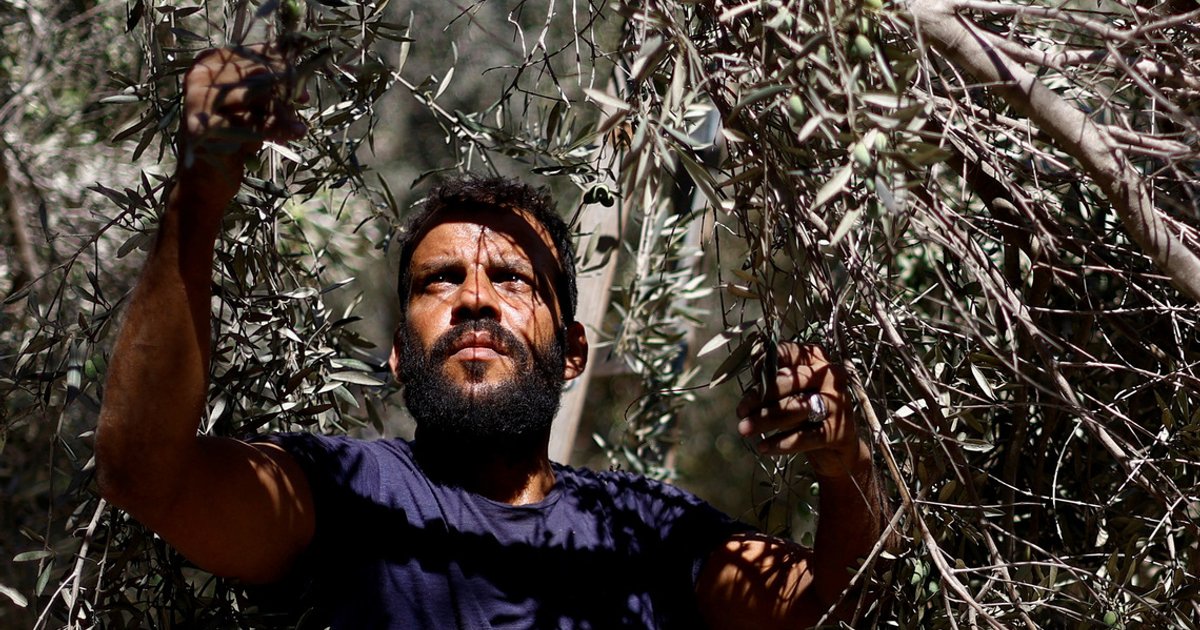
GAZA/CAIRO, Oct 14 - Haidar Abu Middain, 60, lifts a desiccated bough of a fallen olive tree and tosses it aside in the barren dirt of what was once one of the most prosperous groves in central Gaza. asserted
what → lift → Gaza
The family olive orchard he owned with his brothers and his uncles used to span 900 dunums — 220 acres — of trees that this time of year would be heavy with ripe fruit. asserted
that → own → fruit
The whole clan would come out to gather the harvest — 1,100 to 1,500 tons of olives piled in bushels — some to be sold as fruit, the rest pressed into enough fragrant oil to fill as many as 900 of the 16-litre drums in which it is typically sold. asserted
it → come → which
Today, nearly half of the orchard lies beyond the "yellow line" guarded by Israeli troops who bar Palestinians from even entering two-thirds of the Gaza Strip. asserted
who → lie → Strip
The other half of the grove, though still accessible, has mostly been bulldozed. asserted
half → bulldoze → grove
Only around 20 or 30 trees are somehow still standing. asserted
trees → stand → ?
Abu Middain reckons they will produce just two drums of oil, not even enough for his own family. asserted
they → reckon → family
"The produce before the war was blessed, it was enough to earn a livelihood for our families," he told Reuters. asserted
he → bless → Reuters
"The harvest from here used to be enough to supply the entire central area, with both oil and olives. asserted
harvest → use → oil
Before the war, olives were the jewels of Gaza agriculture, pressed into enough rich oil to serve as a staple for the local diet, and a small surplus for export to Israel. asserted
olives → press → Israel
The shady groves abutting Gaza's concrete cities were a sanctuary for families in one of the world's most densely populated territories. asserted
groves → abut → territories
But a year after a ceasefire ended major fighting, almost all of the once-proud orchards are bulldozed under. asserted
all → end → orchards
Gaza's agriculture authorities estimate that of 2 million olive trees, barely 150,000 are still standing. asserted
150,000 → estimate → trees
They anticipate a harvest of about 5,000 tons of olives instead of the usual 40,000, producing only 700 tons of oil instead of 5,000. asserted
They → anticipate → oil
THERE'S ZERO Bushels of olives and drums of freshly pressed oil would normally be stacked high in Gaza's markets this time of year. Nowadays there is barely any at all, and what does make it to market sells at around triple the pre-war price, nearly $500 a drum, well beyond what Gazan families can afford, said Imad al-Ajrami, 33, a shopper in Deir al-Balah market. asserted
Ajrami → be → market
Authorities say only seven olive oil presses are still operating, down from about 40 before the war. asserted
presses → say → war
They are barely functioning, said Fawaz Zidan, who has kept his press open in Deir al-Balah. asserted
who → function → Balah
Because there are no olives, all of it has been bulldozed, the olives are gone," he said as a handful of residents queued with plastic jerrycans to collect fresh oil from the spigot of the press. asserted
handful → be → press
In Deir al-Balah, a tiny part of central Gaza that Israeli forces declared a safe zone and held off from storming during the war, one of Gaza's few remaining olive groves still serves as a sanctuary at harvest time for Khalil Mansi and his family. asserted
one → declare → Mansi
They were out gathering the green olives, the fruit pitter-pattering as it fell from the branches onto a white cloth laid out below. asserted
it → gather → cloth
Barefoot boys climbed ladders to reach the higher branches. asserted
boys → climb → branches
Girls sat below sorting the olives from leaves and twigs. asserted
Girls → sit → leaves
Later the family sat for a picnic in the shade. asserted
family → sit → shade
Ahmed Khader, 38, had come out for a rare day of work on the harvest. asserted
Khader → come → harvest
In the old days, the season would keep a labourer like him employed for two or three months, he said. asserted
he → keep → months
"But we still have to provide for our children with a bite to eat, and we want to try to get our daily bread." asserted
we → have → bread
💬Give feedback
🕘History 🎫Support