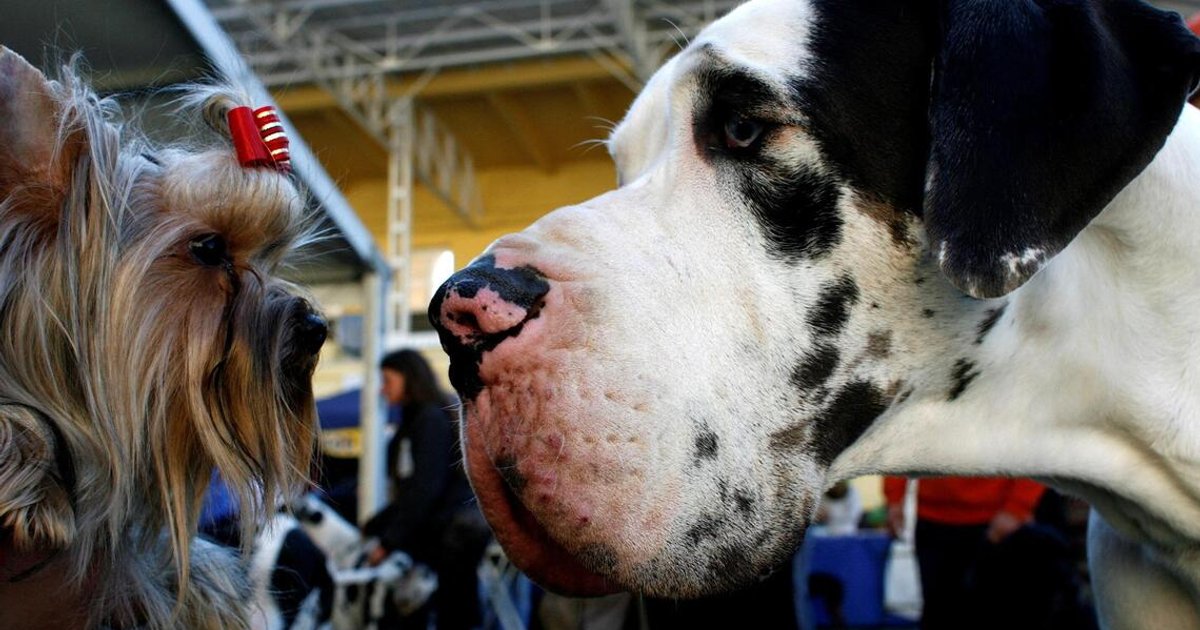
Large dogs age more quickly than small dogs at a molecular level

Read the original at The Straits Times ↗
Cite

The Straits Times. (2026, October 14). Large dogs age more quickly than small dogs at a molecular level. The Straits Times. https://www.straitstimes.com/world/united-states/large-dogs-age-more-quickly-than-small-dogs-at-a-molecular-level

Dated from the outlet's own feed. Check the original for its byline.

The Straits Times · collected 2026-10-14 · by The Straits Times

Quick Summary

A new study published in Science reveals that large dog breeds age faster than small ones at a molecular level, as indicated by DNA methylation patterns in blood. Researchers analyzed 1,640 blood samples from 894 dogs of various breeds and discovered that larger dogs and males showed signs of accelerated ageing. The study links this to a quicker erosion of methylation marks on jumping genes like LINE1s, which are usually kept silent but can cause genome instability when activated. This suggests that the shorter lifespan of large dogs is due to faster molecular ageing rather than simply hitting diseases earlier in life.
Written locally by qwen2.5:14b on 2026-10-14, using this article's own text rather than the other coverage of the same event (that is the story summary below).

AI analysis runs on qwen2.5:14b, locally

Story summary

A new study published in the journal *Science* reveals that large dogs age more quickly than small dogs at a molecular level. Noah Snyder-Mackler, a professor at Arizona State University’s School of Life Sciences and Center for Evolution and Medicine, led the research which measured DNA methylation, chemical tags that control gene activity. The findings suggest that within the same species, larger breeds like Great Danes typically die younger than smaller ones such as Chihuahuas, a pattern not seen across different mammal species where bigger animals usually live longer lives. This study provides insight into why large dogs have shorter lifespans compared to small dogs by examining how DNA changes with age in canines.

Written for “Large Dogs Age Faster Molecularly” on 2026-10-14, grounded in this article and the 0 other(s) covering the same event.

Story

📰 Large Dogs Age Faster Molecularly
Science · 1 article(s) covering the same event.

Compared with similar articles

Nothing to compare against. No article is close enough to this one for the pipeline to have linked or judged the pair.
How this article was measured signals, leaning charts, publisher record, byline, topics and claims

Signals How these are calculated →

Claims extracted
29
sentences that state something as happening or true
Uncertain
21%
6 of 29 hedged ("reportedly", "may", "according to")
Leaning
not political
takes no side on a contested political question
Publisher signals
59/100
The Straits Times's corrections and hedging, across everything collected from it. Not a measure of accuracy.
Outlets on this story
1
Science
Same framing elsewhere
1
articles that frame the event the way this one does
Analyzed 2026-10-14 · how these are computed

How this is being covered How these are calculated →

Article leaning vs. publisher reliability
Source leaning vs. consistency

Publisher

The Straits Times · 2697 article(s) · 3 correction(s) detected
Running correction rate · 3 correction(s)

Who wrote this

The Straits Times
1784 article(s) here · 1 carrying a prediction
🔮 Iraqi officials have said Islamic State retains sleeper cells capable of carrying out hit-and-run attacks, raising concerns that the militants could seek to exploit security gaps despite continued Iraqi counter-insurgency operations. Supporters of pro-Iranian Iraqi militia groups celebrated the pullout and some analysts said it could empower them in the spreading conflict begun by U.S.-Israeli air strikes on Iran in February.
🔮 A new study indicates the reason may lie in how DNA changes with age in dogs.
🔮 Yemen’s health services, battered by more than a decade of conflict, economic crisis, displacement and disease outbreaks, may have limited capacity to absorb a new surge in mass casualties if fighting intensifies further, the ICRC warned.
🔮 Benko, 49, will now move from prison in his home city of Innsbruck to a roughly 60-square-metre (650-square-foot) apartment that his lawyer Norbert Wess has said has been rented for him in the city so he can better prepare for a fraud trial next month.
🔮 William Chapman died on Oct 10 after entering a tiger enclosure at Yorkshire Wildlife Park near Doncaster in northern England.
🔮 The family olive orchard he owned with his brothers and his uncles used to span 900 dunums — 220 acres — of trees that this time of year would be heavy with ripe fruit.
🔮 The United States and Russia said last week they had agreed that Moscow would initially supply more than 300,000 metric tons of diesel to US and global markets.
🔮 According to our observations, during flights, the connection could drop for 10–20 seconds at speeds of just 110–120 km/h.
🔮 Pope Leo spent a peaceful night in hospital after undergoing surgery for lung cancer, the Vatican said on Wednesday, adding that further information about his condition would be released later in the day.
🔮 Russia's state RIA Novosti news agency reported in 2024 that the Sberbank centre that was hit in Balakovo, covering an area of 55,000 square metres, will host Russia's biggest supercomputer, which is scheduled to go into operation in 2027.
2026-10-14 · assertive framing · Ukrainian drones hit Russia's biggest data centre
Also by The Straits Times
Nothing else under this byline is closely related to this article, so these are simply their most recent.
All 1784 articles by The Straits Times →

Topics

Arizona State University’s Center for Evolution and Medicine School of Life Sciences Science Snyder-Mackler

Subjects

Snyder-Mackler ORG · 4× Arizona State University’s ORG · 1× Center for Evolution and Medicine ORG · 1× Noah Snyder-Mackler PERSON · 1× School of Life Sciences ORG · 1× Science ORG · 1×

Narrative

“We all know that big dogs usually don’t live as long as small dogs, but we have not known whether their cells actually age faster, or whether they simply hit certain diseases earlier,” said Noah Snyder-Mackler, a professor at Arizona State University’s School of Life Sciences and Center for Evolution and Medicine and one of the authors of the study published in the journal Science.
framing: mixed · carried by 1 article(s) · first seen 2026-10-14
🔮 A new study indicates the reason may lie in how DNA changes with age in dogs.
2026-10-14 · The Straits Times
Large dogs age more quickly than small dogs at a molecular level · mixed framing

Claims (29 extracted, 6 hedged)

Large dogs age more quickly than small dogs at a molecular level AI generated asserted
AI → age → level
Few animals show the link between size and lifespan as clearly as dogs. asserted
animals → show → dogs
Within this one species, large breeds such as Great Danes typically die younger than small ones such as Chihuahuas. asserted
breeds → die → Chihuahuas
A new study indicates the reason may lie in how DNA changes with age in dogs. uncertain
DNA → indicate → dogs
Across mammals, bigger species like elephants usually live longer lives than smaller ones like mice, but within a species that pattern can reverse. asserted
pattern → live → species
Earlier comparisons across species linked certain biological mechanisms to exceptional longevity, but those are less suited to explaining differences among individuals within a species. asserted
those → link → species
“We all know that big dogs usually don’t live as long as small dogs, but we have not known whether their cells actually age faster, or whether they simply hit certain diseases earlier,” said Noah Snyder-Mackler, a professor at Arizona State University’s School of Life Sciences and Center for Evolution and Medicine and one of the authors of the study published in the journal Science. asserted
Mackler → know → journal
To find out, the researchers measured DNA methylation, chemical tags that help control which genes are switched on and off. asserted
genes → find → methylation
Using age-related patterns in these tags, they built an epigenetic clock that estimated a dog’s age with a median error of less than one year. asserted
that → use → year
Analysing 1,640 blood methylation profiles from 894 pet canines of various breeds, they found that larger dogs and male dogs showed signs of accelerated molecular ageing, while dogs whose biological age appeared older than expected based on the profiles faced a higher risk of early death. asserted
age → analyse → death
“We found that large dogs show a faster-moving DNA methylation ageing signature in blood, and that this acceleration is especially strong in parts of the genome that normally help keep ‘jumping genes’ quiet,” Snyder-Mackler said. asserted
Mackler → find → genes
Jumping genes, also called transposable elements, can copy themselves and insert into new spots in the genome. asserted
genes → call → genome
LINE1s are a type of jumping gene that is normally kept silent by DNA methylation, but their activation has been linked to genome instability, cancer and other age-related disease. asserted
activation → jump → instability
In large dogs, Snyder-Mackler said, “methylation at those regions appears to erode more quickly with age, as if the genome is losing some of the tape or clamps that keep these mobile elements suppressed”. asserted
that → say → elements
This suggests that the shorter lives of large dogs reflect a faster molecular ageing trajectory. uncertain
lives → suggest → trajectory
“If large dogs simply died earlier after following the same molecular trajectory, we would look for late-life triggers of disease or mortality. asserted
we → die → disease
But if parts of the ageing programme move faster throughout adulthood, as our data suggest for the blood methylome, then there may be processes we can measure, follow over time, and potentially modify before disease appears,” Snyder-Mackler said. uncertain
Mackler → age → time
Differences by sex The researchers also found differences between male and female dogs, largely on the X chromosome – the sex chromosome that females carry in two copies and males in one. asserted
females → find → one
There, LINE1 elements showed higher methylation in males. asserted
elements → show → males
Chromosomes are thread-like structures that carry genetic information inside cell nuclei. asserted
that → carry → nuclei
“In our genome-wide analyses, the sex signal looked distinct from the body-size signal, so I would treat that as a separate biology that needs follow-up rather than the same mechanism in disguise,” Snyder-Mackler said. asserted
Mackler → look → disguise
Humans bred dogs to grow quickly and reach large adult sizes for tasks such as guarding, hunting and herding. asserted
Humans → breed → guarding
“If selection strongly favours rapid growth or large adult size before old age, late-life costs can come along for the ride,” Snyder-Mackler added. asserted
Mackler → favour → ride
Previous explanations for why large dogs tend to have shorter lives focused on growth biology. asserted
dogs → tend → biology
Researchers have also suggested that larger dogs may undergo more cell growth, develop more quickly or face a higher risk of cancer. uncertain
dogs → suggest → cancer
“Our study does not replace those ideas; it gives us a molecular layer downstream of body size,” Snyder-Mackler said. asserted
Mackler → replace → size
The findings raise the possibility that slowing molecular ageing could help extend healthy lifespan in larger dogs. uncertain
slowing → raise → dogs
Snyder-Mackler said, however, that lifespan is not governed by a single biological clock. asserted
lifespan → say → clock
Large dogs would still face breed-specific risks, meaning that slowing molecular ageing would not turn a Great Dane into a Chihuahua, in terms of lifespan, but could make one component of its ageing trajectory less compressed. uncertain
component → face → trajectory

💬Give feedback
🕘History 🎫Support