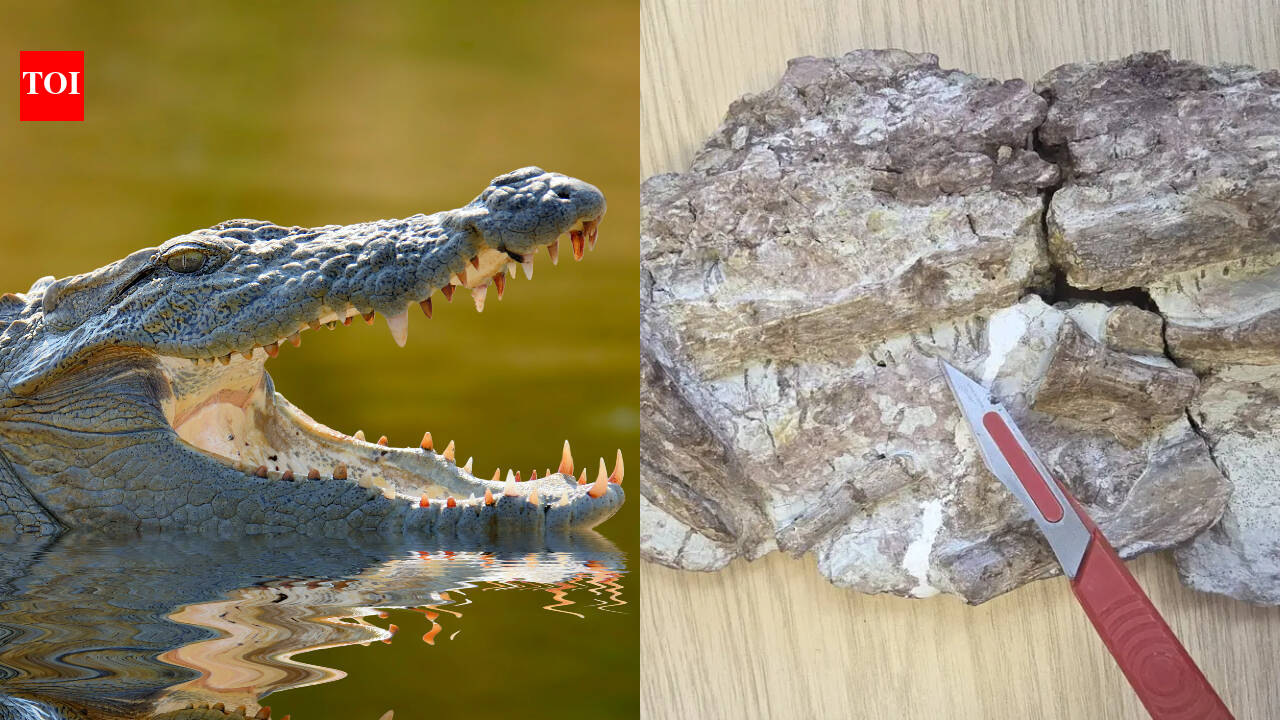
Scientists find 170-million-year-old crocodile relative with needle-thin teeth

Read the original at Times of India ↗
Times of India · collected 2026-10-13 · by TOI Science Desk

Quick Summary

Researchers in Morocco discovered fossils of a new crocodile relative dating back 170 million years, characterized by needle-thin teeth embedded in long bones. Named Ctenosuchus tenuidens, this species had an elongated snout and specialized teeth suitable for feeding on small aquatic prey like tiny fish and crustaceans. The find, detailed by scientists from the University of Portsmouth and Hassan II University, reveals a previously unknown diversity among ancient crocodile relatives during the Jurassic Period.
Written locally by qwen2.5:14b on 2026-10-13, using this article's own text rather than the other coverage of the same event (that is the story summary below).

AI analysis runs on qwen2.5:14b, locally

Story summary

Scientists discovered the remains of Ctenosuchus tenuidens, a new species closely related to crocodiles, in Morocco. Found in rocks dating back about 170 million years, these fossils reveal an array of needle-thin teeth unlike those of known thalattosuchian relatives. This group includes ancient reptiles that lived during the Jurassic Period in marine and freshwater environments within Gondwana, the ancient southern supercontinent.

The unusual discovery was made by researchers from the University of Portsmouth in the UK and Hassan II University of Casablanca in Morocco, who detailed their findings in the Journal of Vertebrate Paleontology. The delicate teeth suggest that Ctenosuchus tenuidens may have fed on smaller prey to avoid damaging its fine dentition.

This find adds significant insights into the diverse predator ecosystems of prehistoric times and highlights the importance of continued fossil research for understanding ancient life forms.

Written for “Ancient Crocodile Relative Discovery” on 2026-10-13, grounded in this article and the 0 other(s) covering the same event.

Story

📰 Ancient Crocodile Relative Discovery
Science · 1 article(s) covering the same event.

Compared with similar articles

Nothing to compare against. No article is close enough to this one for the pipeline to have linked or judged the pair.

Cite this article

TOI Science Desk. (2026, October 13). Scientists find 170-million-year-old crocodile relative with needle-thin teeth. Times of India. https://timesofindia.indiatimes.com/science/archaeology/scientists-studying-170-million-year-old-fossils-from-morocco-spotted-tiny-black-circles-under-a-microscope-scraping-revealed-needle-thin-teeth-from-a-new-crocodile-relative-that-likely-ate-shrimp-and-small-fish/articleshow/134919851.cms

Dated from the outlet's own feed. Check the original for its byline.
How this article was measured signals, leaning charts, publisher record, byline, topics and claims

Signals How these are calculated →

Claims extracted
25
sentences that state something as happening or true
Uncertain
8%
2 of 25 hedged ("reportedly", "may", "according to")
Leaning
not political
takes no side on a contested political question
Publisher signals
59/100
Times of India's corrections and hedging, across everything collected from it. Not a measure of accuracy.
Outlets on this story
1
Science
Same framing elsewhere
1
articles that frame the event the way this one does
Analyzed 2026-10-13 · how these are computed

How this is being covered How these are calculated →

Article leaning vs. publisher reliability
Source leaning vs. consistency

Publisher

Times of India · 2413 article(s) · 2 correction(s) detected
Running correction rate · 2 correction(s)

Who wrote this

TOI Science Desk
244 article(s) here · 1 carrying a prediction
🔮 The delicate teeth would probably have been poorly suited to gripping struggling, larger prey, which could have damaged them.
🔮 For park rangers working to protect endangered animals, a missed movement could have serious consequences.
🔮 She hopes the process will help developing communities that lack the infrastructure to manage large amounts of plastic waste, with fertiliser supporting farms, cleared waterways restoring irrigation, and the absence of plastic preventing accidental burning and improving air quality.
🔮 Instead of relying only on conventional laboratory models, Shen tested a potential cancer drug in clams to determine whether these animals could serve as an animal model for blood-cancer drug discovery.
🔮 But recent years have seen records broken for low sea ice in both winter and summer, raising concerns that global heating could be driving the losses.
🔮 The discovery was made during a research expedition in May 2018 using the manned submersible ‘ShenhaiYongshi’.
🔮 Real environmental restoration is never easy; it requires patience, courage, and the willingness to stand in deep water and thick mud while pushing forward.
🔮 Justin Bernstein, a 17-year-old student from Greenwich, Connecticut, has developed a research project exploring how genetically engineered bacteria could help slow Arctic ice melting.
🔮 Researchers Michael Vecchione and Odd Aksel Bergstad later examined these earlier observations in a scientific paper, suggesting that the raised sediment could indicate excavation by organisms.
🔮 The turnaround showed how removing an invasive species, alongside other conservation measures, could help a threatened seabird recover.
Wire or desk byline, not an individual reporter.
Also by TOI Science Desk
Nothing else under this byline is closely related to this article, so these are simply their most recent.
All 244 articles by TOI Science Desk →

Topics

Hassan II University of Casablanca Moroccan Morocco the University of Portsmouth

Subjects

Morocco GPE · 4× the University of Portsmouth ORG · 2× Hassan II University of Casablanca ORG · 1× Moroccan NORP · 1× University of Portsmouth ORG · 1× istock ORG · 1× the Journal of Vertebrate Paleontology ORG · 1×

Narrative

Published in the Journal of Vertebrate Paleontology, the research adds to scientists' understanding of the ecosystems that existed in Gondwana, the ancient southern supercontinent that included much of modern-day Africa.
framing: assertive · carried by 1 article(s) · first seen 2026-10-13
🔮 The delicate teeth would probably have been poorly suited to gripping struggling, larger prey, which could have damaged them.
2026-10-13 · Times of India
Scientists find 170-million-year-old crocodile relative with needle-thin teeth · assertive framing

Claims (25 extracted, 2 hedged)

Sometimes a major scientific discovery starts with something barely visible. asserted
discovery → start → something
Researchers studying Moroccan fossils found tiny black circles along a long bone. asserted
Researchers → study → bone
Under a microscope, these markings revealed an unexpected secret: an array of exceptionally slender teeth belonging to a previously unknown crocodile relative that lived around 170 million years ago. asserted
that → reveal → relative
The discovery offers a glimpse into the surprising diversity of prehistoric predators during the Jurassic Period, states a release by the University of Portsmouth. asserted
release → offer → Portsmouth
A closer look reveals a new species The species, named Ctenosuchus tenuidens, was identified by researchers from the University of Portsmouth in the UK and Hassan II University of Casablanca in Morocco. asserted
species → reveal → Morocco
It belonged to the thalattosuchians, a group of ancient reptiles related to crocodiles that occupied marine and freshwater environments during the age of the dinosaurs. asserted
that → belong → dinosaurs
Unlike modern crocodiles, which typically have robust teeth suited to gripping prey, this animal had a long, narrow snout lined with needle-like teeth so fine that they stood out from those of its known relatives. asserted
they → have → relatives
The fossils were recovered from rocks formed in ancient rivers and lakes in what is now the Atlas Mountains of southeastern Morocco. asserted
what → recover → Morocco
The discovery began when researchers examined the unusual dark markings on one of the specimens more closely. asserted
researchers → begin → specimens
Carefully scraping the surrounding material exposed elongated structures that turned out to be teeth. asserted
that → scrap → structures
Special anatomy is reflected in the name. asserted
anatomy → reflect → name
Cteno refers to a comb, suchus means crocodile, and tenuidens translates to thin teeth, a fitting description of the animal's closely spaced dental arrangement. asserted
tenuidens → refer → arrangement
Using powerful microscopes, researchers examined the teeth's internal features and identified specialised ridges and a tightly packed arrangement. asserted
researchers → use → ridges
These characteristics suggest that the animal was adapted to feeding on small, relatively soft aquatic prey rather than pursuing larger fish. asserted
animal → suggest → fish
Its likely diet included tiny fish, crustaceans such as fairy shrimp, worms and other small water-dwelling creatures. asserted
diet → include → shrimp
The delicate teeth would probably have been poorly suited to gripping struggling, larger prey, which could have damaged them. uncertain
which → grip → them
Instead, the animal appears to have occupied a specialised feeding niche, setting it apart from other long-snouted crocodile relatives. asserted
animal → appear → relatives
Evolution repeats its experiments asserted
Evolution → repeat → experiments
The discovery also highlights a recurring pattern in evolution: unrelated groups of animals can develop similar features when adapting to comparable food sources. asserted
groups → highlight → sources
The teeth and jaws of Ctenosuchus tenuidens resemble those of certain ancient aquatic reptiles called mesosaurs, as well as some long-snouted pterosaurs, including Gnathosaurus and Ctenochasma. asserted
teeth → resemble → Gnathosaurus
These flying reptiles lived during the Jurassic and are believed to have used specialised jaws for filter feeding. asserted
reptiles → fly → feeding
Such similarities suggest that different prehistoric animals independently evolved comparable feeding adaptations, demonstrating how a shared ecological challenge can produce similar anatomical solutions. asserted
challenge → suggest → solutions
Published in the Journal of Vertebrate Paleontology, the research adds to scientists' understanding of the ecosystems that existed in Gondwana, the ancient southern supercontinent that included much of modern-day Africa. asserted
that → publish → Africa
It also challenges the familiar image of crocodile relatives as predators built primarily to capture large prey. asserted
It → challenge → prey
During the Jurassic, these animals occupied a broader range of habitats and ecological roles than their modern descendants might suggest The fossils from Morocco reveal how much remains to be learned from rocks that have preserved traces of life for millions of years. uncertain
that → occupy → years
💬Give feedback
🕘History 🎫Support