Scientists discover a bamboo coral forest nearly 1,400 metres below the surface

Read the original at Times of India ↗
Times of India · collected 2026-10-13 · by TOI Science Desk

Quick Summary

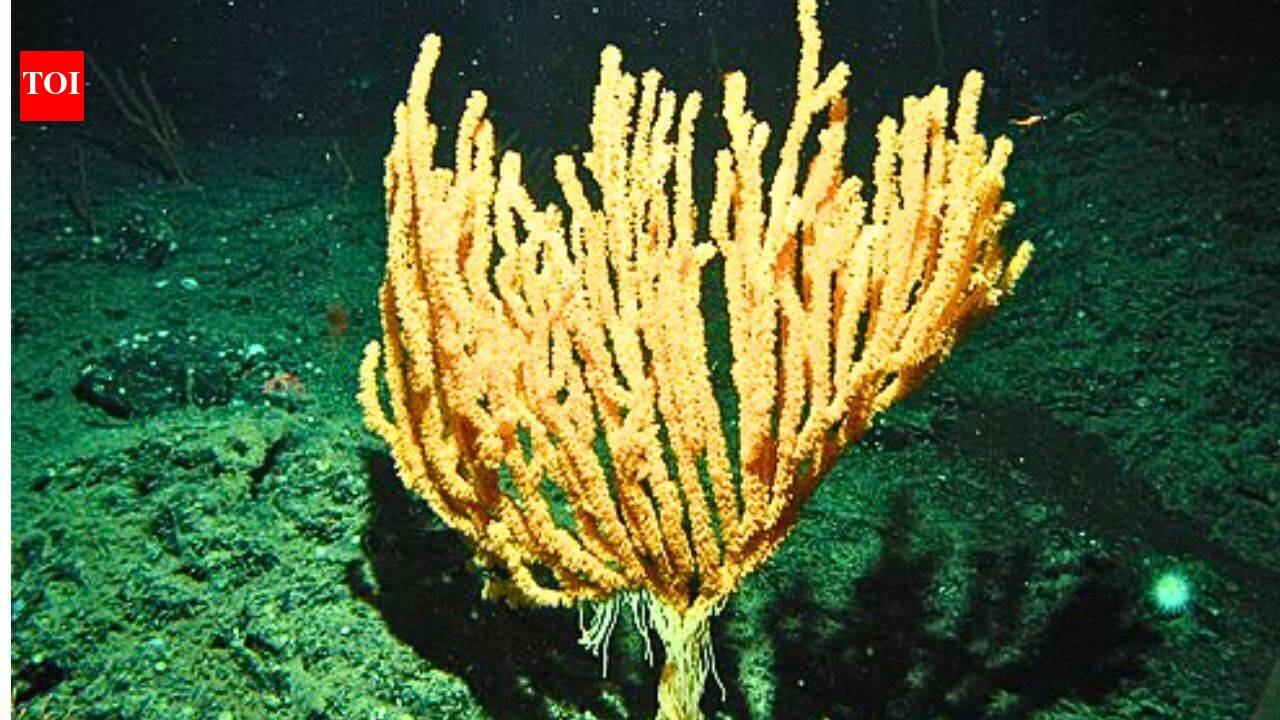
Scientists discovered a deep-water bamboo coral forest in the South China Sea near the Xisha Islands at depths ranging from 1,200 to 1,380 meters during an expedition in May 2018. Using the submersible ‘ShenhaiYongshi’, researchers found that bamboo corals became denser with decreasing depth, increasing from 24.8 colonies per 100 square meters at 1,380 meters to 220 colonies per 100 square meters at 1,200 meters. The study highlights the ecological significance of these coral forests and their role in supporting diverse marine life.
Written locally by qwen2.5:14b on 2026-10-13, using this article's own text rather than the other coverage of the same event (that is the story summary below).

AI analysis runs on qwen2.5:14b, locally

Story summary

Scientists discovered a deep-water bamboo coral forest in May 2018 near the Xisha Islands (also known as the Paracel Islands) in the South China Sea. The finding was made using the manned submersible ‘ShenhaiYongshi’ during an expedition between depths of 600 to 1,400 metres. At these depths, tall whip-shaped coral colonies grow alongside sea fans and sponges. Specifically, the densest bamboo coral forest was found at a depth range of 1,200 to 1,380 metres, marking it as the first observation of deep-water bamboo coral forests in Southeast Asia. The discovery opens new avenues for studying these unique ecosystems and understanding their conservation needs.

Written for “Deep Sea Coral Discovery” on 2026-10-13, grounded in this article and the 0 other(s) covering the same event.

Story

📰 Deep Sea Coral Discovery
Science · 1 article(s) covering the same event.

Compared with similar articles

Nothing to compare against. No article is close enough to this one for the pipeline to have linked or judged the pair.

Cite this article

TOI Science Desk. (2026, October 13). Scientists discover a bamboo coral forest nearly 1,400 metres below the surface. Times of India. https://timesofindia.indiatimes.com/science/wildlife/scientists-discover-hidden-bamboo-coral-forest-in-the-south-china-sea-nearly-1400-metres-below-the-surface/articleshow/134909349.cms

Dated when The Aporia collected the article, usually within hours of publication. Check the original for its exact date and byline.

How this article was measured signals, leaning charts, publisher record, byline, topics and claims

Signals How these are calculated →

Claims extracted
30
sentences that state something as happening or true
Uncertain
10%
3 of 30 hedged ("reportedly", "may", "according to")
Leaning
not political
takes no side on a contested political question
Publisher signals
59/100
Times of India's corrections and hedging, across everything collected from it. Not a measure of accuracy.
Outlets on this story
1
Science
Same framing elsewhere
1
articles that frame the event the way this one does
Analyzed 2026-10-13 · how these are computed

How this is being covered How these are calculated →

Article leaning vs. publisher reliability
Source leaning vs. consistency

Publisher

Times of India · 2398 article(s) · 2 correction(s) detected
Running correction rate · 2 correction(s)

Who wrote this

TOI Science Desk
242 article(s) here · 1 carrying a prediction
🔮 She hopes the process will help developing communities that lack the infrastructure to manage large amounts of plastic waste, with fertiliser supporting farms, cleared waterways restoring irrigation, and the absence of plastic preventing accidental burning and improving air quality.
🔮 Instead of relying only on conventional laboratory models, Shen tested a potential cancer drug in clams to determine whether these animals could serve as an animal model for blood-cancer drug discovery.
🔮 But recent years have seen records broken for low sea ice in both winter and summer, raising concerns that global heating could be driving the losses.
🔮 The discovery was made during a research expedition in May 2018 using the manned submersible ‘ShenhaiYongshi’.
🔮 Real environmental restoration is never easy; it requires patience, courage, and the willingness to stand in deep water and thick mud while pushing forward.
🔮 Justin Bernstein, a 17-year-old student from Greenwich, Connecticut, has developed a research project exploring how genetically engineered bacteria could help slow Arctic ice melting.
🔮 Researchers Michael Vecchione and Odd Aksel Bergstad later examined these earlier observations in a scientific paper, suggesting that the raised sediment could indicate excavation by organisms.
🔮 The turnaround showed how removing an invasive species, alongside other conservation measures, could help a threatened seabird recover.
🔮 Photographs from the original excavations show that their skeletal remains were poorly preserved, so the researchers could not rule out mistakes in the recorded orientation of their bodies.
🔮 The technology could eventually allow farmers in remote areas to make fertiliser on demand, reducing their reliance on large industrial production facilities.
Wire or desk byline, not an individual reporter.
Also by TOI Science Desk
Nothing else under this byline is closely related to this article, so these are simply their most recent.
All 242 articles by TOI Science Desk →

Topics

Scientific Reports ShenhaiYongshi the Paracel Islands

Subjects

Scientific Reports ORG · 1× the Paracel Islands GPE · 1×

Narrative

The findings provide the first set of observations of deep-water bamboo coral forests in Southeast Asia and open new opportunities to study these ecosystems and their conservation needs.
framing: assertive · carried by 1 article(s) · first seen 2026-10-13
🔮 The discovery was made during a research expedition in May 2018 using the manned submersible ‘ShenhaiYongshi’.

Claims (30 extracted, 3 hedged)

Scientists have discovered a deep-water bamboo coral forest in the South China Sea, where tall, whip-shaped coral colonies grow alongside sea fans, sponges and other marine animals. asserted
colonies → discover → fans
The forest lies at depths of 1,200 to 1,380 metres near the Xisha Islands, also known as the Paracel Islands. asserted
forest → lie → Islands
The discovery was made during a research expedition in May 2018 using the manned submersible ‘ShenhaiYongshi’. uncertain
discovery → make → ShenhaiYongshi
According to research published in Scientific Reports titled ‘ Discovery of Deep-Water Bamboo Coral Forest in the South China Sea’, the coral colonies became denser at shallower depths. uncertain
colonies → accord → depths
The findings provide the first set of observations of deep-water bamboo coral forests in Southeast Asia and open new opportunities to study these ecosystems and their conservation needs. asserted
findings → provide → ecosystems
The coral forest was discovered at the foot of the submerged Ganquan reef, near the western edge of the Xisha Islands. asserted
forest → discover → Islands
During an expedition in May 2018, researchers used the manned submersible ‘ShenhaiYongshi’ to explore underwater areas between 600 and about 1,400 metres deep. uncertain
researchers → use → areas
The expedition was originally planned to explore drowned coral reefs, so the discovery of a dense bamboo coral forest came as a surprise to the researchers. asserted
discovery → plan → researchers
Researchers spotted patches of tall, slender bamboo corals along the submersible's route. asserted
Researchers → spot → route
The colonies often stood more than two metres tall, with their curling upper sections extending their total length to as much as five metres. asserted
sections → stand → metres
The discovery marked the first recorded observation of deep-water bamboo coral forests in Southeast Asia. asserted
discovery → mark → Asia
How does the bamboo coral forest support other marine life The forest is dominated by bamboo corals temporarily identified as ‘Lepidisis sp’. asserted
forest → support → sp
These corals belong to the family Isididae and have whip-shaped, unbranched colonies with articulated skeletons. asserted
corals → belong → skeletons
Researchers also recorded two forms of cold-water gorgonian corals, Anthogorgia sp. and Calyptrophora sp. asserted
Researchers → record → corals
The Anthogorgia colonies were about 20 centimetres tall, while the broader Calyptrophora colonies reached around 40 centimetres. asserted
colonies → reach → centimetres
Sponges were also an important part of the forest, with some areas of the seabed covered by dense groups of sponges. asserted
areas → cover → sponges
Cirrate octopuses, crinoids and other animals were also observed during the expedition. asserted
octopuses → observe → expedition
The researchers noted that the bamboo coral forest appeared to provide habitat for a range of animals living near the seabed. asserted
forest → note → seabed
What did researchers discover about coral density at different depths Researchers recorded a clear change in coral density along the lower slope of Ganquan reef. asserted
Researchers → discover → reef
Their observations showed that density increased from 24.8 colonies per 100 square metres at a depth of 1,380 metres to 220 colonies per 100 square metres at 1,200 metres. asserted
density → show → metres
Across 10 dives, the team recorded 638 metres of seabed video, covering an estimated area of 1,856 square metres. asserted
team → record → metres
The recordings lasted a total of 51.7 minutes. asserted
recordings → last → minutes
Researchers counted 1,877 coral colonies across 23 video sequences, including bamboo corals, sea fans and other coral forms. asserted
Researchers → count → corals
The study also recorded a maximum density of 225.6 colonies per 100 square metres at a depth of 1,199 metres on the Ganquan slope. asserted
study → record → slope
How do underwater conditions support the growth of the bamboo coral forest asserted
conditions → support → forest
The researchers linked the forest's presence to the underwater landscape, the submerged reef surface and active currents carrying nutrient-rich water. asserted
researchers → link → water
They also observed intense showers of marine snow, made up of organic material falling from the upper layers of the ocean. asserted
They → observe → ocean
These currents were reflected in the movement of the whip-shaped bamboo corals and the orientation of the sea fans. asserted
currents → reflect → fans
Other deep-water gorgonian corals were found during dives in a canyon at a depth of 2,000 metres and around a mud volcano at about 600 metres. asserted
corals → find → metres
However, the densely populated forest was found only along the Ganquan reef slope during the expedition. asserted
forest → find → expedition

💬Give feedback
🕘History 🎫Support