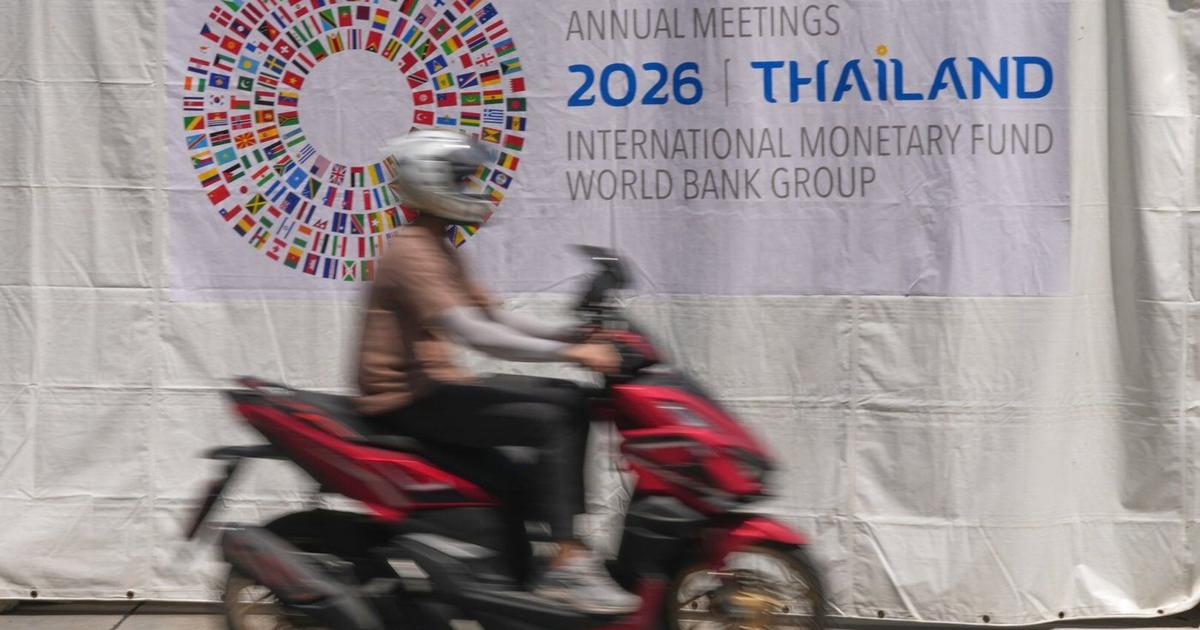
On October 13, 2026, during the International Monetary Fund's Annual Meetings in Bangkok, IMF deputy director of research Petya Koeva Brooks warned that low-income developing countries must cut spending due to the Iran war-induced energy crisis and rising debt levels. The IMF advised these nations to implement narrow subsidies and rebuild fiscal buffers while emphasizing that heavily indebted oil-importing countries face particularly harsh choices, potentially necessitating debt restructuring to avoid further economic distress.
Written locally by qwen2.5:14b on 2026-10-13,
using this article's own text rather than the other coverage of the
same event (that is the story summary below).
Story summary
Finance officials from around the world are gathering in Bangkok for the annual meetings of the International Monetary Fund (IMF) and World Bank, with 18,000 attendees registered, up by 4,000 since the last off-site meeting in Morocco. The events come amid the ongoing US-Israel war on Iran, now entering its eighth month, which has caused significant inflationary pressures globally. IMF Managing Director Kristalina Georgieva noted that rising interest rates, coupled with a severe energy supply shock due to the conflict, pose major risks to global economic growth, currently forecasted at 3.1% for 2026, up slightly from July's projection but still sluggish. The war has exacerbated high energy prices and debt issues in low-income countries, while advanced economies have benefited from increased investment in artificial intelligence (AI). IMF Deputy Director of Research Petya Koeva Brooks stressed that developing nations must cut spending or risk severe fiscal crises due to the compounded effects of debt and inflation, urging them to implement targeted subsidies amidst these challenges.
Written for “IMF Economic Forecasts And Policy Advice” on 2026-10-13,
grounded in this article and the 3 other(s) covering the same event.
Why this leaning score
The model judged this article politically coded and scored it +0.45, but 2 quote(s) could not be found in the article and the other 1 are attributed speech rather than the article's own narration, so the score is not published.
Written under an earlier scoring contract, which gave a paragraph
rather than checkable quotes. Re-analysing this article replaces it.
Leaning score withheld for article 75842: no verified evidence · logged 2026-10-13
The International Monetary Fund warned on Tuesday (October 13, 2026) that while low-income developing countries were dealing with the disproportionate impacts of the Iran war-fuelled energy shock, many had "no choice" but to cut spending or potentially face debt restructuring.
asserted
many → warn → restructuring
Speaking to AFP on the sidelines of the organisation's Annual Meetings in Bangkok, IMF deputy director of research Petya Koeva Brooks said heavily indebted, oil-importing countries were facing the worst of the energy shock, and had difficult choices in helping their citizens through the crisis.
asserted
countries → speak → crisis
"Unfortunately, after years of the global economy being hit by shock after shock, debt levels have increased quite a lot, and at the same time, inflation has become a problem," she said.
asserted
she → hit → time
The U.S. war on Iran has plunged West Asia into conflict and sent global energy prices soaring, as Tehran's retaliatory action targeted Washington's Gulf allies and curtailed oil and gas supplies.
asserted
action → plunge → supplies
Those prices have begun to bleed into other goods, with the crisis also having an effect on crucial fertiliser supplies.
asserted
crisis → begin → supplies
The IMF has called on countries to offer narrow, targeted subsidies in the wake of the crisis, while also recommending all governments work to rebuild fiscal buffers and address rising debt after years of fighting economic shocks since the pandemic.
"Our messages indeed apply to most countries, but again, the trade-offs and the choices that have to be made are much more difficult for the most vulnerable countries," Ms. Koeva Brooks said.
asserted
Brooks → call → countries
The IMF's World Economic Outlook, released on Tuesday (October 13), identified low-income developing countries that are net oil importers and are not exposed to the ongoing artificial intelligence technology investment boom as being the most vulnerable to the shocks from the Iran war.
asserted
that → release → war
"For those countries that are most vulnerable, this is where the consumption basket is heavily weighted towards energy and food, and so indeed it is much much more difficult," she said.
asserted
she → weight → energy
The senior IMF official added that "many" low-income countries were in debt distress, or close to it, and that they should seek debt restructuring if they were not able to address the issue.
asserted
they → add → issue
"Where debt is not sustainable, then resolving that debt and having orderly and timely restructuring is always better than waiting, because then the cost of restructuring down the road is going to be much higher," she said.
asserted
she → resolve → road
In its World Economic Outlook, the IMF raised its forecast for 2026 global growth, largely on the back of advanced economies enjoying a boost from AI-related investments and economic activity.
asserted
IMF → raise → investments
Growth outcomes were highly uneven across economies, depending on their exposure to the war and whether they were integrated into AI supply chains.
asserted
they → depend → chains
The world's advanced economies were forecast to grow 2.1% in 2026, with those in the AI supply chain, such as Taiwan and South Korea, posting significantly higher figures.
asserted
those → forecast → figures
Ms. Koeva Brooks told AFP that if AI investment activity were to slow, the world economy "would see a negative impact on output, not only in advanced countries like the U.S. but again through trade linkages also in Asia".
asserted
economy → tell → Asia
In the IMF's worst-case scenario — of AI not delivering promised productivity gains — global GDP forecasts for 2028 would fall by as much as 0.4%.
asserted
forecasts → deliver → %
Climate-related risks were another key part of the World Economic Outlook this year, and Ms. Koeva Brooks told AFP that some of the effects of a particularly intense El Niño phenomenon had already been taken into account in higher prices for certain food items.
asserted
some → relate → items
The warming phase of a natural climate cycle, El Niño, raises sea temperatures in the tropical Pacific, triggering changes in weather that can increase the risk of drought and flooding, and exacerbate man-made global warming.
asserted
that → warm → warming
"We have a significant increase in beverage prices, in the prices of rice, and so on," said Ms. Koeva Brooks.
asserted
Brooks → have → rice
"Of course, it could turn out that the domino effect is even bigger than what we currently have."
uncertain
we → turn → what
 The Aporia