Claims extracted
17
sentences that state something as happening or true
Uncertain
18%
3 of 17 hedged
("reportedly", "may", "according to")
Leaning
not political
takes no side on a contested political question
Publisher signals
70/100
ABC News (US)'s corrections and
hedging, across everything collected from it. Not a measure of accuracy.
Outlets on this story
1
Politics
Same framing elsewhere
1
articles that frame the event the way this one does
China says it hopes to agree with US on tariff reductions 'at an early date'
asserted
it → say → date
A Chinese government spokesperson says China and the U.S. hope to reach an agreement on lowering import taxes soon
BEIJING --
asserted
China → say → taxes
China and the U.S. hope to reach an agreement on lowering import taxes soon, a Chinese government spokesperson said Thursday, fueling expectations that an announcement could come when the leaders of the two countries meet in two weeks.
uncertain
leaders → hope → weeks
Negotiators are striving to implement reciprocal tariff reductions on $30 billion worth of goods “at an early date,” Commerce Ministry spokesperson Huang Ling said at a weekly briefing.
asserted
Ling → strive → briefing
The $30 billion will be from each side, China's official Xinhua News Agency said.
asserted
Agency → say → side
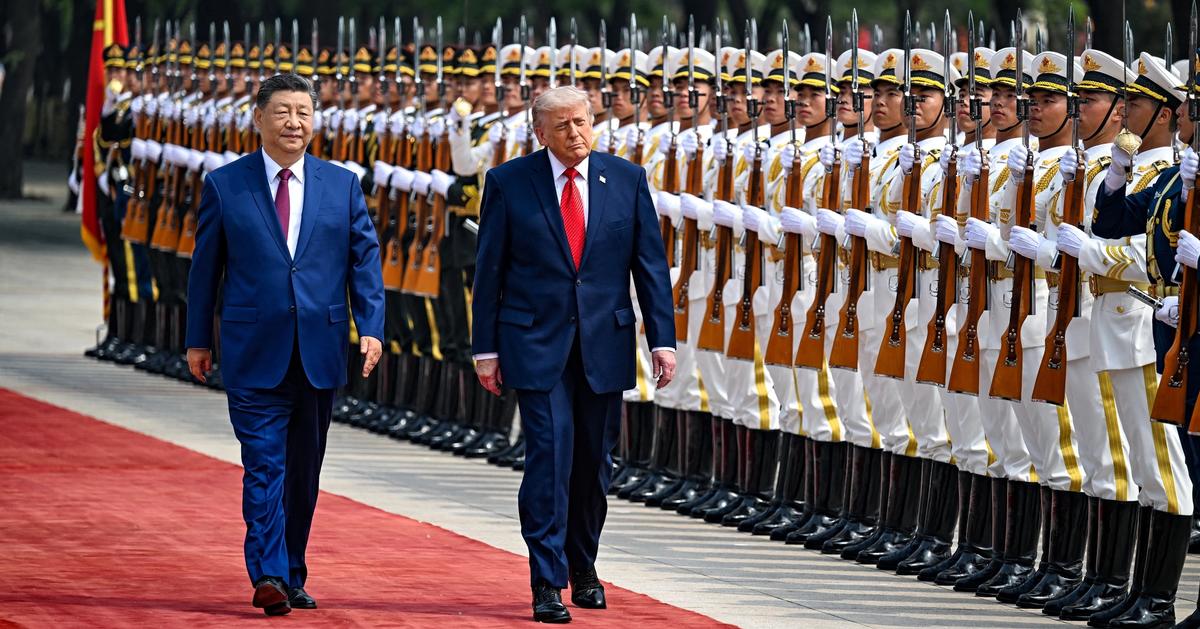
U.S. President Donald Trump and Chinese leader Xi Jinping are expected to meet in Washington on Sept. 24 for what will be their third face-to-face talks in the past year.
asserted
what → expect → year
Both governments characterize the meetings as a way to stabilize relations in an era of competing interests between the world's two largest economies.
asserted
governments → characterize → economies
“Leaders’ diplomacy plays an irreplaceable strategic guiding role in China-U. S. relations,” Chinese Foreign Ministry spokesperson Guo Jiakun said Thursday.
asserted
Jiakun → play → relations
Trump and Xi agreed at their previous meeting in May in Beijing to launch a U.S.-China Board of Trade that would manage trade between the two countries, along with a parallel Board of Investment.
uncertain
that → agree → Investment
The agreements came after a truce was reached in a blistering tariff war in which Trump hiked tariffs on Chinese imports to extremely high levels and China responded in kind.
asserted
China → come → kind
The talks on reciprocal tariff reductions are a central part of the negotiations on creating the Board of Trade.
asserted
talks → create → Trade
The goal is to identify and reduce tariffs on equivalent amounts of “nonsensitive” goods on each side, the U.S. said.
asserted
U.S. → identify → side
“Trade will be front and center at the summit,” Barclays Bank said in a research note this week on the upcoming Trump-Xi meeting, noting that the truce the two countries reached on tariffs expires on Nov. 10.
asserted
countries → say → Nov.
But it cautioned that the scope for a broad trade deal is limited, and that targeted tariff reductions are more likely.
asserted
reductions → caution → deal
But as the U.S. and China have already reduced mutual trade reliance, the “overall trade significance will be more limited than before, given the smaller bilateral volume,” said Gary Ng, a senior economist at French bank Natixis.
asserted
Ng → reduce → Natixis
Chinese exports to the U.S., for example, fell sharply last year, after the U.S. rolled out elevated tariffs.
asserted
U.S. → fall → tariffs
An agreement on reciprocal tariff reductions could likely benefit the U.S. more, as $30 billion is roughly 28% of its exports to China, while it is only around 10% the other way around, Ng said.
uncertain
Ng → benefit → China
 The Aporia