A Strange Sorting Feature On The Supreme Court's Docket

Reason · collected 2026-09-09 · by Josh Blackman
Read the original at Reason ↗

Summary

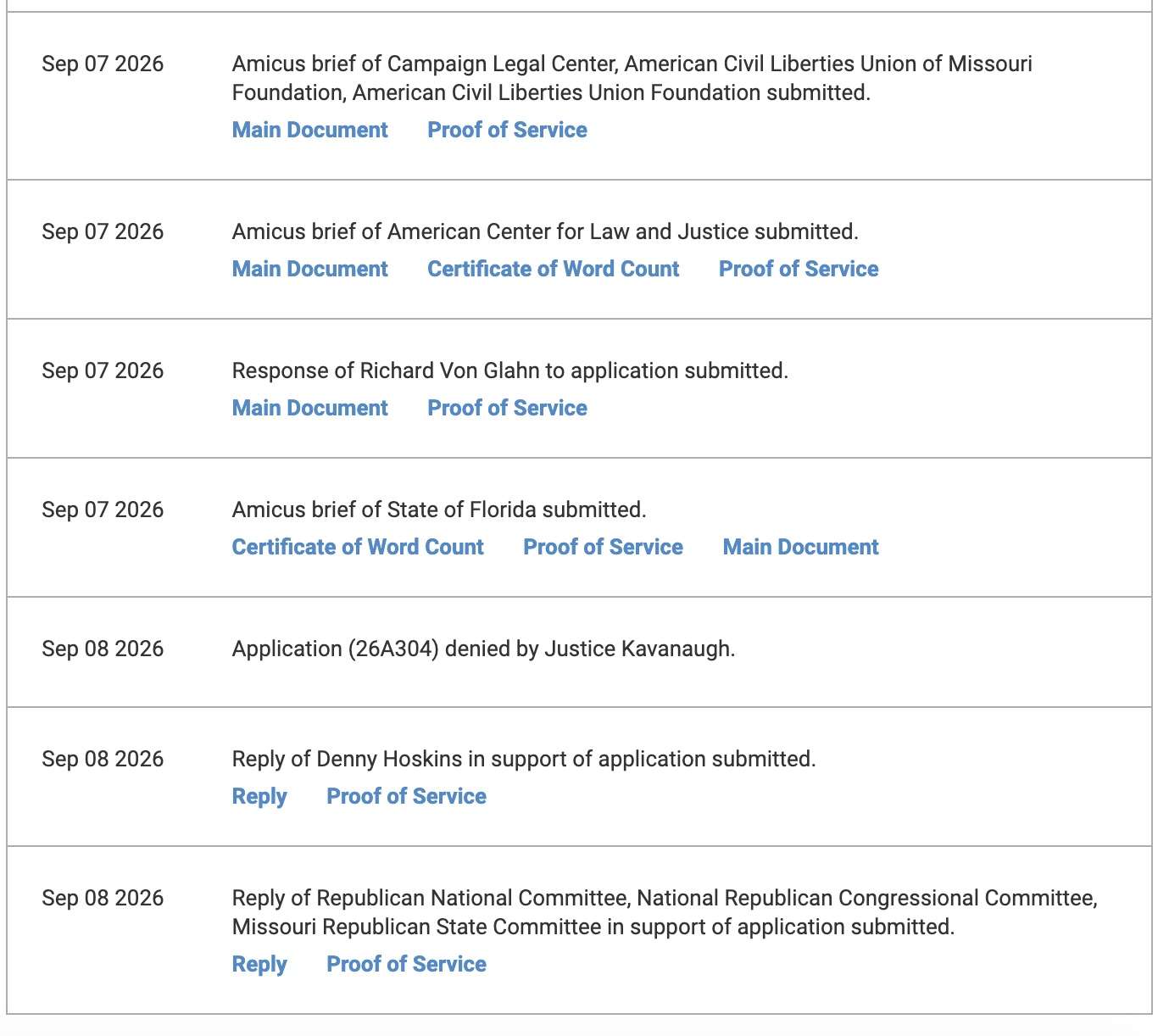
A quirk on the Supreme Court's docket has been noticed, where an order from a Justice appears before reply briefs filed earlier, as seen in Hoskins v. Von Glahn. In one instance, Circuit Justice Kavanaugh's denial of the order was entered after the reply briefs were filed, but his order appears first on the docket. The exact reason for this sorting is unclear, with some speculating that the Justice's order may have precedence at any given time.
Written by the local model on 2026-09-09, using this article's own text rather than the other coverage of the same event (that is the story summary below).

Signals How these are calculated →

Claims extracted
9
claim-shaped sentences
Uncertain
11%
1 of 9 hedged
Leaning
not political
takes no side on a contested political question
Publisher trust
90.4
red-flag proxy, not a credibility rating
Outlets on this story
1
Politics
Narrative spread
1
articles carrying this framing
Analyzed 2026-09-09 · how these are computed

AI analysis (generated at analysis time, not now)

Story summary

A peculiar feature of the Supreme Court's online docket has been observed by law professor and commentator Josh Blackman. In the case of Hoskins v. Von Glahn, which dealt with Missouri's congressional maps, the Circuit Justice Brett Kavanaugh issued an order on September 8 in the evening, but it appears on the docket before the reply briefs that were filed earlier that morning. This unusual sorting feature seems to place a Justice's order ahead of related documents, even if those documents were submitted first. The reasons behind this quirk are unclear, and Blackman speculates that it might be because the Justice's action takes precedence on a given day.
Written for “Supreme Court Justice Process Changes” on 2026-09-09, grounded in this article and the 0 other(s) covering the same event.
Why this leaning score
This article does not take a side on a contested political question, so it has no leaning score. That is an answer rather than a gap: a match report or a rescue can be warmly or critically written without being left or right, and scoring it anyway is how approval of a subject gets recorded as a political position.
No political leaning scored for article 7325 · logged 2026-09-09

Story

📰 Supreme Court Justice Process Changes
Politics · 1 article(s) covering the same event. This is the one the site leads with.

How this is being covered How these are calculated →

Article leaning vs. publisher reliability
Source leaning vs. consistency

Compared with similar articles

Nothing to compare against. No article is close enough to this one for the pipeline to have linked or judged the pair.

Publisher

Reason · 69 article(s) · 1 correction(s) detected
Running correction rate · 1 correction(s)
2026-09-05
Lawyers' Responsibility for Hallucinations in Briefs That They Sign

Who wrote this

Josh Blackman
15 article(s) here · 1 carrying a prediction
🔮 There was no evidence this standard was necessary or would actually improve race relations.
🔮 Often, an order from a Justice will be entered before the notation for reply briefs, even though the reply briefs were filed before the order.
2026-09-09 · assertive framing · A Strange Sorting Feature On The Supreme Court's Docket
🔮 In 1989, William Barr, the Assistant Attorney General for the Office of Legal Counsel, put forward that position in a memorandum opinion for the Attorney General.
🔮 The Log Cabin Republicans will no longer advocate on transgender issues.
2026-08-26 · assertive framing · A Wall Of Separation Between LGB and T
🔮 One would think that a former federal courts professor in the majority would get these cases, but apparently not.
🔮 Thus, any text generated by the AI will be in the same sort of style that the professor has--or perhaps had.
2026-08-24 · assertive framing · AI Freezes The Scholarly Voice
Also by Josh Blackman
Nothing else under this byline is closely related to this article, so these are simply their most recent.
All 15 articles by Josh Blackman →

Topics

Missouri the Supreme Court's

Subjects

Kavanaugh PERSON · 2× Hoskins PERSON · 1× Missouri GPE · 1× the Supreme Court's ORG · 1×

Narrative

Often, an order from a Justice will be entered before the notation for reply briefs, even though the reply briefs were filed before the order.
framing: assertive · carried by 1 article(s) · first seen 2026-09-09
🔮 Often, an order from a Justice will be entered before the notation for reply briefs, even though the reply briefs were filed before the order.
2026-09-09 · Reason
A Strange Sorting Feature On The Supreme Court's Docket · assertive framing

Claims (9 extracted, 1 hedged)

Mostly law professors | Sometimes contrarian | Often libertarian | Always independent I've noticed a quirk on the Supreme Court's docket. asserted
I → notice → docket
Often, an order from a Justice will be entered before the notation for reply briefs, even though the reply briefs were filed before the order. asserted
briefs → enter → order
Such is the case with Hoskins v. Von Glahn, which concerned Missouri's congressional maps. asserted
which → concern → maps
The reply briefs were filed in the early hours of Tuesday, September 8. asserted
briefs → file → Tuesday
Then, around 6:00 in the evening, Circuit Justice Kavanaugh denied the order in chambers. asserted
Kavanaugh → deny → chambers
Yet, on the docket, Kavanaugh's order appears before the reply briefs. asserted
order → appear → briefs
If you were to just look at this docket, you might think that the reply briefs were filed after the Circuit Justice order, which would make no sense. uncertain
which → look → sense
I'm not sure why they are sorted like this. asserted
they → sort → this
Perhaps the Justice's order always takes precedence in a given day? asserted
order → take → day
💬 Give feedback
🕘 History 🎫 Support