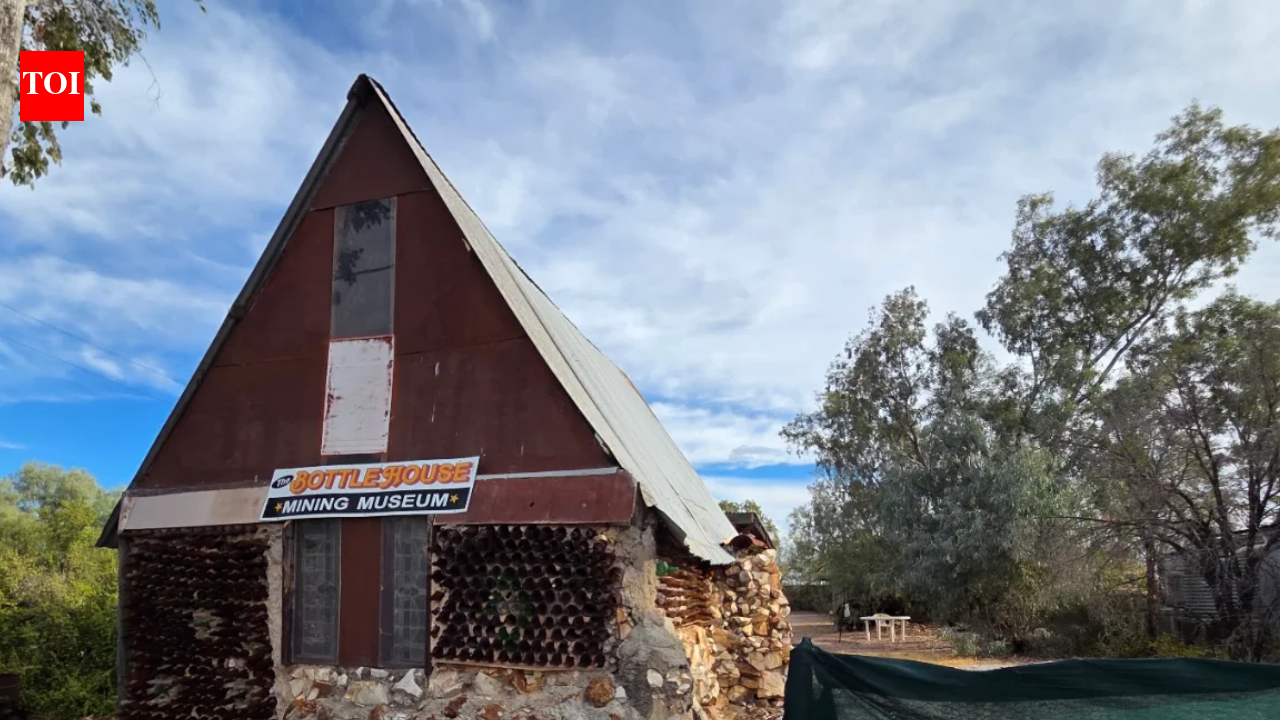
In 1967, Tex Moeckel built a house in Lightning Ridge, New South Wales, using thousands of discarded glass bottles collected from Hebel, Queensland. Now known as the Bottle House and Mining Museum, this unique structure remains standing and serves as both a tourist attraction and a museum displaying opal-mining artifacts and vintage bottles. The building’s walls consist entirely of glass bottles fixed together with clay, creating a distinctive appearance that contrasts sharply with conventional construction materials.
Written locally by qwen2.5:14b on 2026-10-11,
using this article's own text rather than the other coverage of the
same event (that is the story summary below).
Thousands of discarded glass bottles became the building material for an unusual house in the Australian outback in 1967.
asserted
Thousands → discard → 1967
Nearly six decades later, the structure still stands in Lightning Ridge, New South Wales, where it serves as a tourist attraction and a museum displaying opal-mining artefacts, vintage bottles and other historical objects.
asserted
it → stand → artefacts
Known as the Bottle House, the building was constructed by Tex Moeckel.
asserted
building → know → Moeckel
Its walls are made from glass bottles fixed together, while its sharply pitched, almost A-frame roof is covered with corrugated iron.
asserted
roof → make → iron
Inside, the building has several small rooms and a loft.
asserted
building → have → rooms
According to the official
website of the New South Wales government, the Bottle House was built in 1967 and remains one of the town's distinctive landmarks.
uncertain
House → accord → landmarks
It also lists it as the Bottle House and Mining Museum, describing it as an example of unusual architecture and resourcefulness in a former mining camp.
asserted
It → list → camp
How discarded bottles became building material
The building's walls are its most distinctive feature.
asserted
walls → discard → ?
Rows of glass bottles form the structure, giving it an appearance unlike a conventional house made with bricks, timber or concrete.
asserted
Rows → form → bricks
The Bottle House was created using bottles collected from Hebel, a small town across the Queensland border.
asserted
House → create → border
According to the New South Wales Government's official tourism information, the bottles were initially joined using cement.
uncertain
bottles → accord → cement
Moeckel later discovered that local clay was more suitable because it made it easier to replace a bottle if it broke.
asserted
it → discover → bottle
Rows of glass bottles form the structure, giving it an appearance unlike a conventional house made with bricks, timber or concrete.
asserted
Rows → form → bricks
Light passing through the glass creates another visual feature, highlighted in the official tourism website's photo gallery.
asserted
Light → pass → gallery
The available historical records do not specify the exact number of bottles used in the construction.
asserted
records → specify → construction
However, the building's walls are made almost entirely from bottles, making discarded glass the defining element of its design.
asserted
glass → make → design
From a miner's camp to a museum
Today, the building houses a small museum featuring objects linked to opal mining and minerals.
asserted
building → house → mining
The Bottle House was originally associated with a miner's camp, reflecting Lightning Ridge's history as an opal-mining settlement.
asserted
House → associate → settlement
The town, in northern New South Wales, is widely known for its black opals and has a long history of mining and small-scale settlement.
asserted
town → have → mining
As reported by The Lightning Ridge Historical Society, Dave Martin operated the Bottle House for a period during the 1970s.
asserted
Martin → report → 1970s
An advertisement for the attraction appeared in the local Lightning Flash newspaper in September 1969, indicating that it was being promoted to visitors soon after it was built.
asserted
it → appear → visitors
Today, the building houses a small museum featuring objects linked to opal mining and minerals.
asserted
building → house → mining
Visitors can also see a collection of vintage bottles, artworks and other old items.
asserted
Visitors → see → bottles
The collection extends beyond the bottles incorporated into the walls, giving the attraction a broader connection to local history.
asserted
collection → extend → history
Where visitors can see the Bottle House
asserted
visitors → see → House
The attraction offers a look at both the region's mining heritage and an unusual approach to construction.
asserted
attraction → offer → construction
The Bottle House and Mining Museum is located on Opal Street in Lightning Ridge, New South Wales, postcode 2834.
asserted
House → locate → Ridge
According to the New South Wales Government's website, the listed admission price ranges from 2 to 10 Australian dollars (AUD).
uncertain
price → accord → dollars
Visitors who need accessibility information are advised to contact the venue before visiting.
asserted
who → need → venue
The attraction offers a look at both the region's mining heritage and an unusual approach to construction.
asserted
attraction → offer → construction
Its glass-bottle walls remain the main draw, while the mining artefacts and vintage objects provide additional context about the area.
asserted
artefacts → remain → area
Built in 1967 by Tex Moeckel, the Bottle House has survived as a reminder of a time when discarded materials were used to create a distinctive local building.
asserted
materials → build → building
It now serves a different purpose from its early days as part of a miner's camp: preserving and displaying pieces of Lightning Ridge's history for visitors.
asserted
It → serve → visitors
 The Aporia