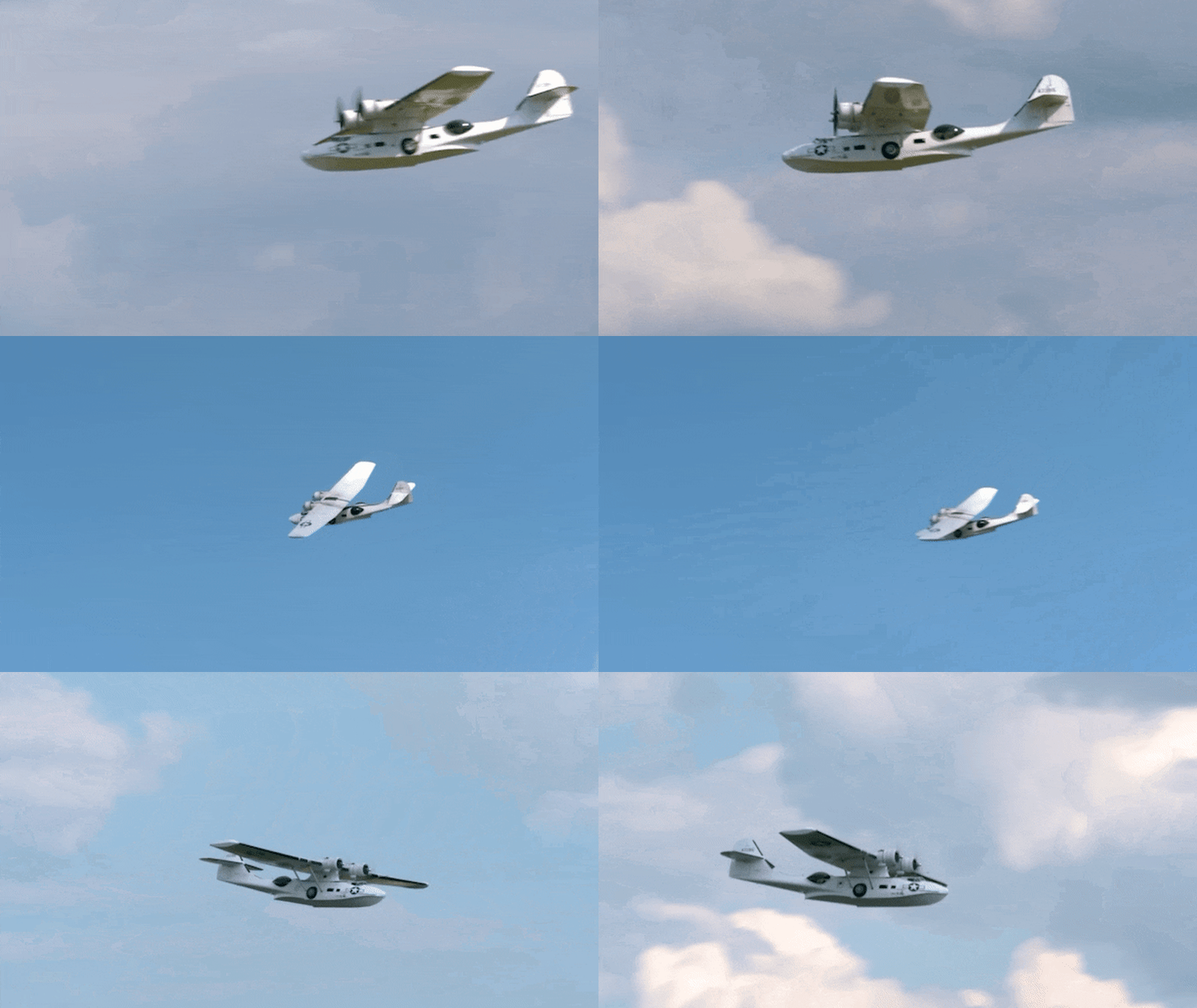
On a warm January day in Hawaii in early 1941, a flying boat appeared on the horizon over the sea, and landed in the water outside Honolulu.
asserted
boat → fly → Honolulu
The plane - a Consolidated PBY Catalina – made its landing on January 27, it had departed from San Diego, where it was built, and it had just accomplished a rare feat.
asserted
it → make → feat
It had spent “almost a full day in the air” traversing 4392km to get to Hawaii.
asserted
It → spend → Hawaii
Waiting in Honolulu was a Qantas crew.
asserted
crew → wait → Honolulu
Honolulu is where Qantas took its first delivery of the long-range planes that the “Flying Kangaroo” would later enable the Double Sunrise flights - at a distance of 6480 km between Perth and Ceylon, keeping Australia connected with the UK during World War II.
asserted
Kangaroo → take → II
Within months of the first plane’s delivery, the Imperial Japanese Navy would stage its infamous surprise attack on US military bases in Hawaii, and the US would declare war on Japan and Germany.
asserted
US → stage → Japan
But in early 1941, when the first Catalina plane was to be delivered to Qantas, the US was still neutral, while Australia, with links to the UK, was already at war.
asserted
Australia → deliver → war
As a result, the delivery flight “had to be flown by an American crew and that legal title would be transferred to Qantas in Honolulu,” according to academic Silvano Jung.
uncertain
title → have → Jung
Despite the RAAF pilots being seconded to Qantas, “the aircraft also had to be marked with civilian registration”.
asserted
aircraft → second → registration
Designated VH-AFA, the Australian crew included famed aviator Captain P.G. Taylor.
asserted
crew → designate → Taylor
Two days later, the plane left for Canton Island - roughly between Hawaii and Fiji.
asserted
plane → leave → Hawaii
VH-AFA arrived at Rose Bay, Sydney on February 2, 1941.
asserted
AFA → arrive → February
The delivery flight from Hawaii to Sydney was only the third time the Pacific had been crossed by air.
asserted
Pacific → cross → air
To get from Hawaii to Sydney safely in 1941 required flight crews to use a combination of dead reckoning (calculating location from fixed points), radio direction finding and astronomical navigation, with the Catalina’s blister bubble on top, designed for this purpose.
asserted
get → get → purpose
But these three methods themselves had to be continually cross-checked to ensure reliability.
asserted
methods → have → reliability
The Catalina was made for the original Double Sunrise route, connecting Western Australia to Ceylon (Sri Lanka) and onwards to London.
asserted
Catalina → make → London
The Double Sunrise flights began in 1943, as Japanese forces advanced through South-East Asia, towards Australia.
asserted
forces → begin → Australia
Today, the legacy of those flights lives on in Qantas’ upcoming Project Sunrise project, which is poised to redefine long-haul travel, even as, like in the 1940s, geopolitical uncertainty returns.
asserted
uncertainty → live → 1940s
Finding the right aircraft for the mission is a recurring theme of the displays at Honolulu’s Pearl Harbour Aviation Museum, home to iconic planes like the B-25 Mitchell and Japanese Mitsubishi A6M “Zero.
asserted
Finding → find → Mitchell
The museum recounts Japan’s surprise attack and the Pacific War that followed.
asserted
that → recount → attack
Ultimately, World War II came down to the right equipment in the right hands – and the PBY Catalina was a prime example – in its use by Qantas, but also the RAAF, and the US Navy.
asserted
Catalina → come → Qantas
Beyond civilian transport in Qantas livery, the Catalina military planes played a vital role in patrolling Australia’s vast borders, and they operated across the Pacific as an observation and reconnaissance aircraft.
asserted
they → play → aircraft
The RAAF ordered 253 of them.
asserted
RAAF → order → them
As a museum docent, Scott Mensen explained to me, the Catalinas made up patrol fleets in the Pacific during World War II “so they could operate from remote locations because they didn’t need a runway.
uncertain
they → explain → runway
“Since they could land in the water at any small island they could easily fly to them, and they could fly missions out of those islands.
uncertain
they → land → islands
“They were based all over the Pacific, and they had units that basically took care of the servicing of the aircraft that they could return to.”
uncertain
they → base → that
Recognising their role as the “eyes of the fleet”, the Japanese targeted the Catalinas parked at Pearl Harbour during the attack on December 7 1941.
asserted
Japanese → recognise → December
By the time the attack had finished, only 11 of the 61 Catalinas across the island of Oahu were airworthy.
asserted
Catalinas → finish → Oahu
One patrol squadron of 12 saw seven of its planes destroyed.
asserted
seven → see → planes
US military commanders had grouped them together to guard against potential sabotage by local Japanese spies, which inadvertently made the planes easier targets.
asserted
planes → group → spies
Even today in Australia, the legacy of the PBY is evident, as the plane is featured in museums nationwide – from the Qantas founder museum to the Aviation Heritage Museum in Perth.
asserted
plane → feature → Perth
There is a cluster of Catalina wrecks in Broome that can be visited.
asserted
that → be → Broome
The hybrid fuselage-hull, dual prop engines mounted over the massive wings and the bulging blister windows out the side are a reminder of how design is shaped by needs.
asserted
design → mount → needs
In the museum, the individual stories of planes correlate to specific battles.
asserted
stories → correlate → battles
The Battle of Midway turned the tide against the Japanese, the Battle of the Coral Sea relieved the threat to the supply lines between the US and Australia.
asserted
Battle → turn → US
The museum also highlights how in a crunch, militaries and economies had to scramble to innovate, and – to use a contemporary word – iterate new versions of aircraft.
asserted
militaries → highlight → aircraft
The B-25 Mitchell had to be stripped down and lightened to allow it to conduct the first US bombing raid on Japan, for example.
asserted
it → have → example
Designers, engineers, and welders worked non-stop to make the changes needed for a mission.
asserted
Designers → work → mission
Some planes would succeed, while others got consigned to history books (The Brewster F2A Buffalo fighter, anyone?)
asserted
others → succeed → books
Radar transformed war in both the Pacific and Europe.
asserted
Radar → transform → Pacific
…and 24 more, not listed.
 The Aporia