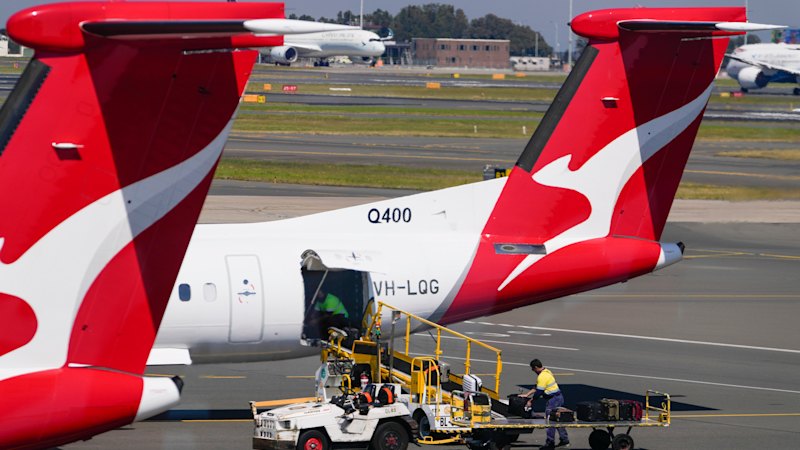
When Melbourne traveller Mike Stow flew back from the UK via Abu Dhabi in July, despite tensions continuing to flare up in the Middle East, his flights were full.
asserted
flights → fly → East
While some people were avoiding the region because of war, the frequent flyer remained unconcerned.
asserted
flyer → avoid → war
it never makes a long-term impact on travel,” Stow says.
asserted
Stow → make → travel
Yet, Stow admits that, for nervous passengers, the fear of travelling via areas close to a conflict zone isn’t unwarranted.
asserted
fear → admit → zone
“Some people are more risk-averse rather than risk-aware,” he says.
asserted
he → say → ?
That divide is reshaping long-haul travel to Europe.
asserted
divide → reshape → Europe
Amid recent military conflicts in the Middle East, airlines have been forced to alter flight paths, rerouting tens of thousands of passengers.
asserted
airlines → force → passengers
Data from analytics firm OAG reveals connecting bookings through Doha plunged 52 per cent following the Iran conflict, while Dubai dropped 44 per cent.
asserted
Dubai → reveal → conflict
In contrast, Asian hubs absorbed the overflow – with European transit traffic through Singapore rising 32 per cent and Hong Kong surging 48 per cent.
asserted
Kong → absorb → Singapore
The escalating regional conflicts and security risks are fragmenting global airspace, forcing airlines into longer, costlier detours.
asserted
conflicts → escalate → detours
They have redirected passenger traffic away from the Middle East to Asian hubs and driven up the technical complexity and cost of air travel.
asserted
They → redirect → travel
Australian Travel Industry Association’s Dean Long says: “One of the things we’ve definitely found is that the cheapest fare will be putting you into different airspace at a different level of risk.
asserted
fare → say → risk
“It’s no longer just about the pitch of the seat.
asserted
It → ’ → seat
Different air corridors are going to cost different amounts of money [driven] by what is occurring around them.
asserted
what → go → them
“And so people need to be aware of that, particularly if they’re just booking on price,” he says.
asserted
he → need → price
The relatively easy-to-access open airspace of past decades is becoming a patchwork with different rules and variable conditions.
The avoidance of routes near Iran and the Persian Gulf means more Asia-Europe flights cross a narrow corridor over Azerbaijan, or fly south across Saudi Arabia, Egypt and the Mediterranean.
asserted
flights → access → Arabia
Long says the air corridors to Europe have always been relatively narrow, but adds: “They are very narrow now.”
There really are now two directions – one through Africa, and one through Asia – for these trips.
“It is something people are definitely going to have to be aware of – and make sure they’re asking the right questions when they’re booking those carriers,” Long says.
asserted
Long → say → carriers
Brisbane-based Tony and Marie Steele are an example of travellers who opted out of flying via the Middle East due to the conflict in the region.
asserted
who → base → region
They had a trip to Athens booked for June via Virgin/Qatar, but as the days ticked down and uncertainty over the situation in the Middle East increased, they visited a travel agent to see what options were available.
asserted
options → have → agent
“We were not comfortable travelling through that region,” says Tony.
asserted
Tony → travel → region
When Virgin/Qatar cancelled their flight in early April, allowing them to get a refund for the return trip, the couple immediately booked directly with Singapore Airlines.
asserted
couple → cancel → Airlines
“We have friends that booked for 2027 going to Europe via Dubai.
asserted
that → have → Dubai
For us, though, we would rather have peace of mind and won’t transit through that region until it is pretty much certain that hostilities won’t reignite again.”
For that reason, they have booked for 2027 to Europe directly with Singapore Airlines.
asserted
they → have → Airlines
Iran is only the latest conflict to unsettle global aviation.
asserted
Iran → unsettle → aviation
Only four years ago, Russia’s invasion of Ukraine gave an advantage to Middle East and Chinese airlines.
asserted
invasion → give → airlines
They could continue to fly over Russian airspace on more direct routes to Europe.
uncertain
They → continue → Europe
Western airlines, meanwhile, had to avoid Russian airspace and were forced to fly longer – sometimes for hours – to avoid it.
asserted
airlines → have → it
Finnair, for example, once offered some of the quickest trips from Europe to Asia.
asserted
Finnair → offer → Asia
After 2022, it had to fly a route four hours longer around Russia to connect to Asia afterwards.
asserted
it → have → Asia
Finnair launches flights from Melbourne to Helsinki next month.
asserted
Finnair → launch → Helsinki
In a sign of how fluid airspace conditions have become, Middle Eastern and Chinese airlines are now being warned by Ukraine about the risks of continuing to fly over Russia.
asserted
airlines → become → Russia
In August, Ukraine - whose airspace has been closed by war since 2022 – warned the International Civil Aviation Organisation that Russian airspace should no longer be considered safe, as the ongoing drone assault between Russia and Ukraine continues.
asserted
assault → close → Russia
The rapid changes in airspace require airlines to rethink their plans quickly, including recalculating fuel costs, flight times and staffing.
asserted
changes → require → costs
The upshot of all these changes is that more planes are being crammed into some of the highways that allow thousands of planes to travel across the planet.
asserted
thousands → cram → planet
Which routes airlines fly affects the system that the aviation sector has perfected over the years to fill the sky more efficiently with the 30,000 commercial aircraft in active service.
asserted
sector → fly → service
What is known as the semicircular rule (or hemispheric rule) is designed to make sure two planes flying in opposite directions never end up at the same altitude.
asserted
planes → know → altitude
Planes at cruising altitude can actually fly closer vertically to each other, a mere 1000 feet or about 300 metres below or above another plane.
asserted
Planes → fly → plane
This is called the “Reduced Vertical Separation Minimum”.
asserted
This → call → ?
This increases airspace capacity while maximising traffic flows.
asserted
This → increase → flows
Every type of plane has a peak efficiency at specific altitudes – usually above 29,000 feet – where air density, temperature and drag require less fuel to burn.
asserted
density → have → fuel
…and 15 more, not listed.
 The Aporia