Harvard Law School bought a stained and faded parchment in 1946 for just $27.50, believing it was an ordinary later copy of the Magna Carta.
asserted
it → buy → Carta
The document was catalogued as dating from 1327 and remained in the library for decades.
asserted
document → catalogue → decades
Nearly 80 years later, medieval historians examining a digital image noticed that something about it did not fit that description.
asserted
something → examine → description
Further research and specialist imaging eventually showed that the parchment was an original version issued by King Edward I in 1300, making it one of only seven surviving copies of that edition.
asserted
it → show → edition
Harvard’s $27.50 Magna Carta remained unrecognised for decades
The document, identified as HLS MS 172, had long been treated as an unremarkable copy.
asserted
document → remain → copy
Harvard Law School’s records show that the library bought it in 1946 for $27.50 after it had been sold through a London book dealer.
asserted
it → show → dealer
The auction catalogue described it as a copy made in 1327 that was somewhat rubbed and damp-stained, a description that helped keep its true age hidden for generations.
asserted
that → describe → generations
Smithsonian Magazine reported that the London dealer Sweet & Maxwell had bought the parchment at Sotheby’s for £42 only about a month before Harvard acquired it.
asserted
Harvard → report → it
The parchment measures about 489 by 473 millimetres, or roughly 19 inches by 19 inches.
asserted
parchment → measure → inches
It was part of Harvard Law School Library’s collection of historic documents and had even been placed on display.
asserted
It → place → display
Digital images were also available online, meaning the document was not completely hidden from researchers.
asserted
document → mean → researchers
Its significance, however, remained unnoticed until a medieval historian happened to examine those images.
asserted
historian → remain → images
ABC News reported that library staff had continued to regard it as a cheap copy even while it was on display.
asserted
it → report → display
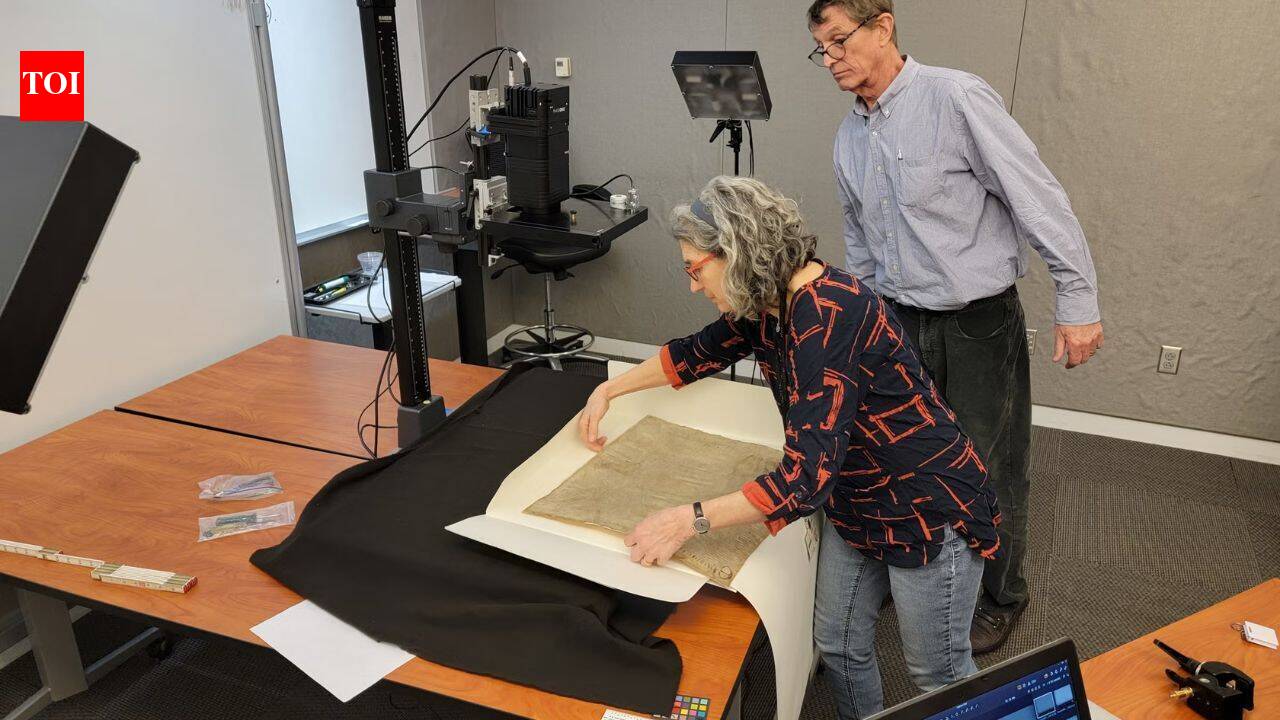
Magna Carta scholar David Carpenter of King's College London examines the digitised document.
asserted
Carpenter → examine → document
Image Credit: Isobel Sheeran, King's College London/Harvard Law Today
What first revealed the document’s true identity
David Carpenter, a professor of medieval history at King’s College London, was studying digitised Magna Carta material in December 2023 when he came across HLS MS 172 on Harvard’s website.
asserted
he → reveal → website
The handwriting, layout and overall appearance immediately suggested to him that the parchment could be an original from 1300 rather than the later copy recorded in the catalogue.
uncertain
parchment → suggest → catalogue
He then contacted Nicholas Vincent, a medieval historian at the University of East Anglia, to help investigate.
asserted
He → contact → Anglia
The researchers had several clues to examine.
asserted
researchers → have → clues
Harvard Law School reported that the document’s dimensions matched those of the 6 previously known originals from 1300.
asserted
dimensions → report → 1300
Its handwriting also showed distinctive features, including a large capital E at the beginning of Edwardus and elongated letters in the opening line.
asserted
handwriting → show → line
Those details were consistent with the other surviving originals.
asserted
details → survive → originals
The researchers then faced a more difficult problem.
asserted
researchers → face → problem
Much of the writing had faded, making a direct comparison challenging.
asserted
comparison → fade → writing
Harvard librarians used ultraviolet light and spectral imaging to reveal details that could not be seen clearly with the naked eye.
uncertain
that → use → eye
The scans made it possible to examine the faded writing and compare the document closely with the other known originals from 1300.
asserted
it → make → 1300
Why the edition from 1300 was so important
The Magna Carta had first been issued in 1215 under King John and established a lasting principle that the monarch was subject to the law.
asserted
monarch → issue → law
The charter later became an important influence on constitutional traditions in Britain and elsewhere, including the development of the United States’ founding documents.
asserted
charter → become → documents
ABC News noted that several updated editions followed the original, including the version issued by Edward I in 1300.
asserted
editions → note → 1300
That 1300 edition is particularly significant because it was the last time the full Magna Carta was set out and authorised by the king’s seal.
asserted
Carta → set → seal
According to PBS NewsHour, it was the 6th and final version in a sequence of editions issued after the original, while Smithsonian Magazine described Edward I’s 1300 reissue as the last time an English king confirmed the Magna Carta.
uncertain
king → accord → Carta
Before Harvard’s discovery, six original copies from the 1300 issue were known.
asserted
copies → know → issue
The identification of HLS MS 172 therefore increased that number to 7.
asserted
identification → increase → 7
Harvard Law School said the document is now recognised as one of only seven surviving originals from that particular issue.
asserted
document → say → issue
How did scholars confirm the parchment was genuine
Carpenter and Vincent did not rely simply on its appearance.
asserted
Carpenter → confirm → appearance
They compared the text against the other originals and found that it matched the authorised wording.
asserted
it → compare → wording
Harvard Law School reported that the seven documents were examined alongside one another and that the clerks who produced them had been instructed to follow a prepared text closely.
asserted
who → report → text
Any significant difference could therefore have raised doubts about the Harvard parchment.
uncertain
difference → raise → parchment
Instead, the document passed the comparison with extremely strong results.
asserted
document → pass → results
Ultraviolet and spectral images helped reveal writing that had become difficult to see over time, allowing the researchers to compare the wording closely.
asserted
researchers → help → wording
PBS reported that the scholars also examined the handwriting and the physical dimensions, finding them consistent with the known originals.
asserted
them → report → originals
…and 12 more, not listed.
 The Aporia