How Sudan’s civil war is erasing thousands of years of cultural memory
asserted
war → erase → memory
-
Click here to listen to this article -
- Sudan’s civil war turned its national museum into a battlefield and crime scene, with ancient statues shattered, skeletal remains scorched and vaults of gold looted.
- Archaeological treasures have been sold on the black market to power a war machine that has killed hundreds of thousands and displaced some 14 million people.
asserted
that → click → people
- ‘These artifacts and sites, they’re part of us,’ says one museum staffer.
asserted
staffer → ’re → us
‘Your lose them, you lose your identity.’
asserted
you → lose → identity
The ancient statues of the deities Heket and Beset, too heavy to move, were used for target practice.
asserted
statues → move → practice
The 4,000-year-old skeletal remains from the bio-archaeology lab? Scattered or scorched.
asserted
remains → scatter → lab
The gold vault lays ransacked, the storage rooms firebombed.
asserted
rooms → lay → ?
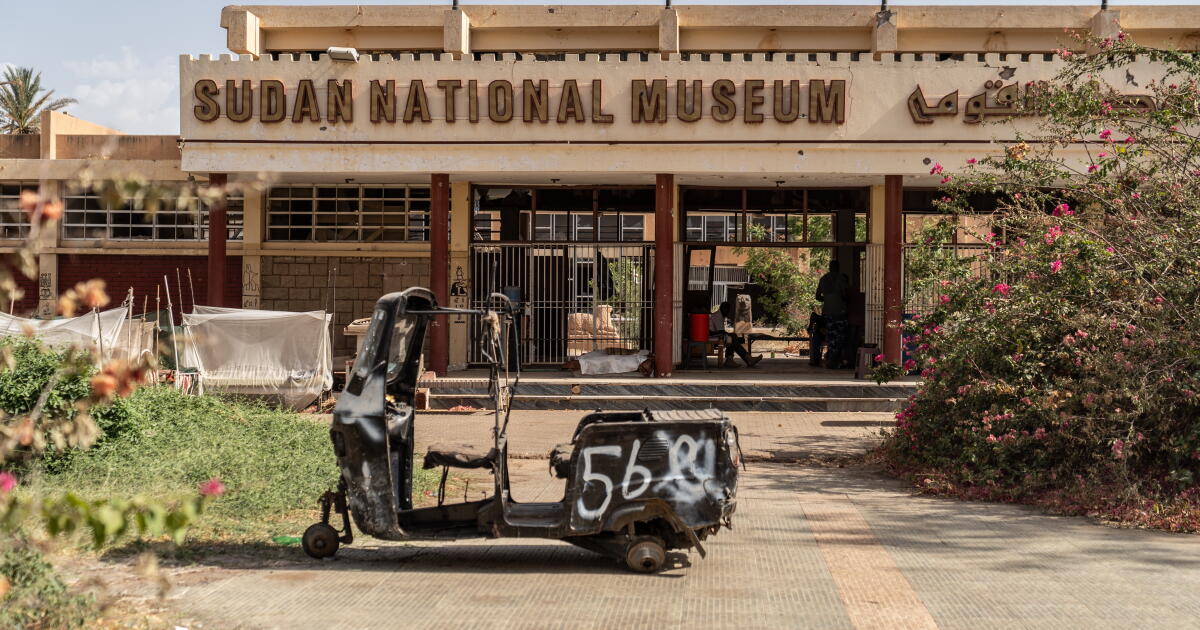
Walk through the grounds of the Sudan National Museum and the reminders of the civil war’s devastating impact on this country’s cultural history seem everywhere.
asserted
reminders → walk → history
They entered the depots and stole everything they could,” said Umaima Abdul-Rahman Al-Sanusi, one of the museum’s curators, as her eyes scanned a shattered display case.
uncertain
eyes → enter → case
She was referring to the Rapid Support Forces, or RSF, a paramilitary group that controlled the capital — and the museum with it — from April 2023 until government forces dislodged them in March of last year.
asserted
forces → refer → year
When Al-Sanusi first saw the level of destruction in the museum — where she’s been employed around 15 years — she cried.
asserted
she → see → museum
Even now, more than a year after she and her colleagues returned to the museum, her voice was tight with not-quite-resigned frustration.
asserted
voice → return → frustration
“These artifacts and sites, they’re part of us,” she said, her fingers giving a reassuring touch to a statue of the Nubian god Apademak — a lone survivor standing in a courtyard strewn with shattered stone shards and the occasional bullet casing — as she walked past.
“You lose them, you lose your identity.”
asserted
you → ’re → identity
Sudan’s civil war, a conflict credibly described as the world’s worst humanitarian crisis, has seen violence matched only by the belligerents’ rapacity in pillaging the country’s riches.
asserted
violence → describe → riches
Like gold, oil, gum arabic and other resources, Sudan’s archaeological treasures, a legacy of the successive kingdoms that flourished and died in the Nile Valley over millennia, have been commandeered to power a war machine that has killed hundreds of thousands and displaced some 14 million people.
asserted
that → flourish → people
At least 76 heritage sites and 20 museums have been ransacked by the RSF and run-of-the-mill thieves, officials say, carting off an archaeological haul worth more than $150 million.
asserted
officials → ransack → haul
One museum was turned into a barracks.
asserted
museum → turn → barracks
The National Museum alone lost almost two-thirds of its inventory, comprising nearly 100,000 artifacts that covered Sudan’s prehistoric age through its Nubian era, the Kingdom of Kush, the Christian era and its Islamic period.
asserted
that → lose → Kush
Sudanese visitors walk past examples of 10th century Christian art work at the national museum in the capital Khartoum on June 25, 2008.
asserted
visitors → walk → June
2. Haitem el-Nour, new director of the national corporation of antiquities and museums looks at a collection of antiquities at the Sudan National Museum in the capital Khartoum on August 12, 2020.
asserted
Nour → look → August
Some items were smashed and shattered when the museum’s grounds became a run-and-gun battlefield.
asserted
grounds → smash → ?
The museum was undergoing renovations before the war, so most of the collections were packed in the main warehouse.
asserted
most → undergo → warehouse
The RSF stole the artifacts in the same boxes where they were stored, said Jamal Zaid Al-Abideen, a veteran official at the National Corp. for Antiquities and Museums.
asserted
Abideen → steal → Antiquities
“They didn’t even need to break into the strongroom,” Al-Abideen said bitterly, looking at a heavy metal door secured with multiple bolts.
asserted
Abideen → need → bolts
Behind it was the vault that once contained almost 2,000 objects of 24-carat gold, gem-ornamented Nabatean funerary figures and ancient jewelry from the Kingdom of Kush.
asserted
that → contain → Kush
All gone.
asserted
All → go → ?
“They had the time to go through the museum director’s desk and find the key.
asserted
They → have → key
They could loot it all at their leisure.”
uncertain
They → loot → leisure
Al-Abideen, who was the first civilian to enter the museum after the Sudanese army clawed back Khartoum, walked to a room where staff had gathered all the ordnance found when bomb experts came and sanitized the museum of explosive materials.
asserted
experts → enter → materials
Lined on the floor was box after box of ballpoint-pen-sized .50-caliber rounds; beside them lay a mound of bullet casings and a half-destroyed drone.
asserted
mound → line → casings
Al-Sanusi joined, and with Al-Abideen continued their macabre tour of the museum’s grounds.
asserted
tour → join → grounds
They headed to the backyard, where a dozen containers lay in the sun, one for each of the international archaeological missions that had been working in Sudan before the war’s start.
asserted
that → head → start
“Everything was packed here for when the research missions were supposed to come back,” Al-Sanusi said, as Al-Abideen heaved a jammed container door open.
asserted
Abideen → pack → door
Inside was a maw of fire-roasted boxes, shards of pottery spilling across the floor, a skull and a scorched femur.
asserted
maw → roast → floor
“Now all of it — excavation equipment, notes, samples — it’s all burned.
asserted
it → burn → it
And we don’t even have records for them,” Al-Sanusi said.
asserted
Sanusi → have → them
“The metal pieces were burned because they thought they could melt them down and find gold in them,” Al-Abideen added.
uncertain
Abideen → burn → them
The ravaging of the museum reflects the destruction seen across Khartoum.
asserted
ravaging → reflect → Khartoum
The neighborhood where the museum is located — once a well-appointed Nile-side quarter of luxury hotels, architecturally adventurous towers and botanical gardens — became a prime target for the RSF.
asserted
museum → locate → RSF
The group evolved from the government-supported Janjaweed militias of the 2000s to become the army’s most powerful ally before turning on it in 2023.
asserted
group → evolve → 2023
…and 28 more, not listed.
 The Aporia