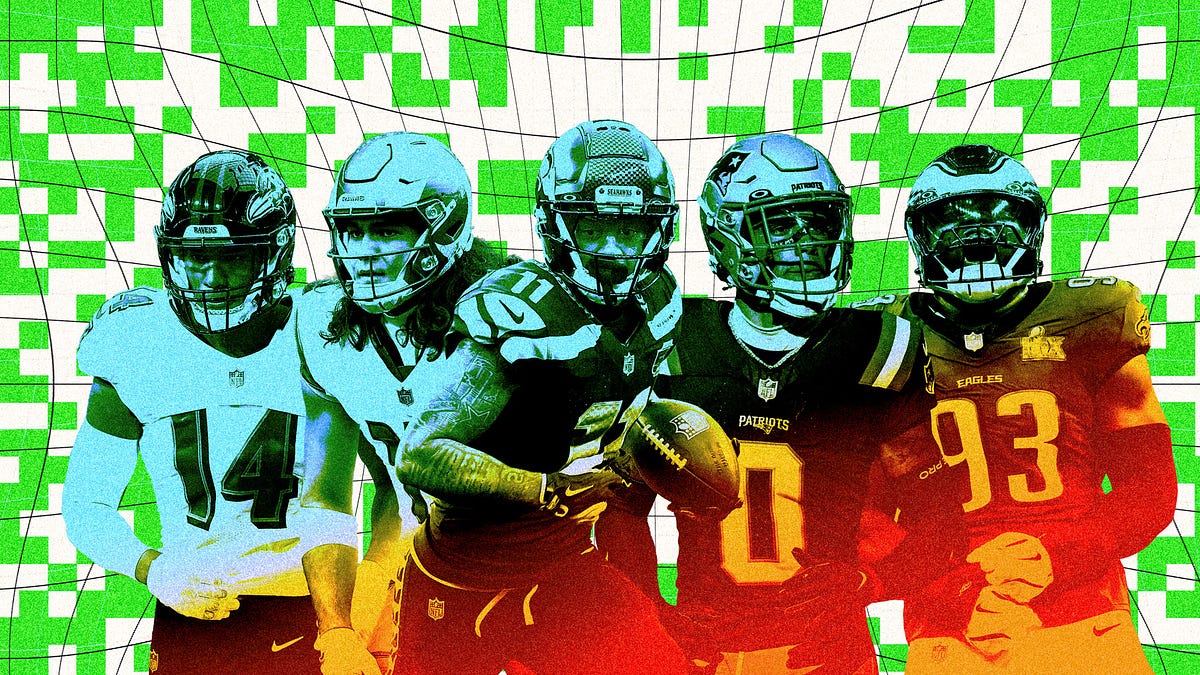
Our ELWAY forecasts have relaunched for the 2026 NFL season!
asserted
forecasts → relaunche → season
ELWAY has been updated with injury information as of Tuesday night, though there aren’t too many differences from when we launched ELWAY on Monday.
asserted
we → update → Monday
We’ve also just published a Model Talk that compares ELWAY to Vegas with some bonus season preview content.
asserted
that → publish → content
We’ll use this space to provide short narrative updates once the season is underway.
asserted
season → use → updates
Expect ELWAY and QBERT to be updated once per week until the midterm elections and then we’ll investigate the possibility of more frequent updates.
asserted
we → expect → updates
Because of our extensive interactive charts and tables, ELWAY is best viewed on the web rather than over email or in your Substack client.
asserted
ELWAY → view → client
The text and data on this page will change frequently.
asserted
text → change → page
But it can take a bit of creativity to use that data effectively.
asserted
it → take → data
Most NFL ratings in the public domain are based on only a minimal amount of information, often just the final scores.
asserted
ratings → base → information
ELWAY considers a lot more than that.
asserted
ELWAY → consider → that
We account extensively for quarterback play through ELWAY’s sister model, QBERT.
asserted
We → account → model
QBs literally account for almost a third of overall player value in the NFL, based on our analysis.
asserted
QBs → account → analysis
We’ve made some changes this year that better separate out QB performance from wide receiver skill and team context.
asserted
that → make → skill
ELWAY accounts for component stats showing repeatable performance, not just points and wins.
asserted
ELWAY → account → performance
We assign each team a series of game scores based on a comprehensive assessment of its performance.
asserted
We → assign → performance
Efficiency measures, such as yards per play and first downs gained, are generally more predictive than scoring alone.
asserted
measures → gain → scoring
Factors like turnovers and special teams decide many games but are noisier and harder to replicate.
asserted
Factors → decide → games
And it’s important to account for the game script.3
asserted
it → ’ → script.3
The result is a series of rolling ratings that update for each team after each game, the most important of which are offensive and defensive efficiency ratings.4
ELWAY factors in offseason roster movement.
asserted
ELWAY → update → movement
We project value above replacement level (WAR) for each player on the roster based on QBERT for QBs and Pro-Football-Reference.com Approximate Value for other positions, accounting for different aging curves at different positions.
asserted
We → project → positions
ELWAY extensively accounts for injuries, including both the resolution of current injuries and the potential for new injuries.
asserted
ELWAY → account → injuries
Because we calculate a WAR for each player, we can translate it directly into effects on point spreads, game totals, and win probabilities.
asserted
we → calculate → spreads
The injury system has been overhauled this year, and future QB injuries are now predicted by the model rather than using subjective injury grades.
asserted
injuries → overhaul → grades
ELWAY adjusts its forecast for many contextual factors, including an extensive system for evaluating home-field advantage (the Packers gain much more from playing at home than the Chargers), plus rest, coaching changes and even the weather.
asserted
Packers → adjust → Chargers
Finally, ELWAY uses a simulation engine to produce realistic game scores: 24-21 games occur much more often in ELWAY than 25-20, for example.
asserted
games → use → example
This allows for more precision when calculating point spreads, totals, and the handling of ties and overtime games.5
The best (and worst) teams in the NFL
But let’s start with our topline team ratings.
asserted
’s → allow → ratings
A team’s offensive and defensive ratings represent, respectively, their projected number of points scored and allowed on a neutral site against an average opponent6 and can be combined to form a net rating.
asserted
ratings → represent → rating
The Bills’ net rating of +4.7 means that we’d expect them to outscore an average opponent by roughly 5 points in Week 1, for example.
asserted
them → mean → example
Actually it’s more complicated than that.
asserted
it → ’ → that
The default version of the ratings you see in that table includes injury adjustments, and some teams are starting out the season with a higher injury burden than others.
asserted
teams → see → others
You can click over to the “Healthy QB1” tab to see ELWAY’s injury-free ratings.
asserted
You → click → ratings
As we’ll discuss in our season preview, however, there’s an unusually high degree of parity in the NFL this year, and sharing a division particularly hurts the Rams and Seahawks.
asserted
sharing → discuss → Rams
The relationship between offense and defense is complicated in the NFL because efficient offenses not only score more but leave their opponents with worse field position and take more time off the clock.
asserted
offenses → score → clock
Put another way, “the best defense is a good offense”.
asserted
defense → put → way
This means that teams that score more points tend to allow fewer points, and vice versa.
asserted
that → mean → points
The Texans’ strengths are particularly concentrated on defense, whereas the Cowboys have a great offense behind Dak Prescott but really struggle on the other side of the ball.
asserted
Cowboys → concentrate → ball
The rest of this page contains:
Projected W-L records for each team, including a new, detailed chart that shows the probability distribution of each team’s win totals (how likely is it that the Broncos win 11 or more games?) across 20,000 simulations.
Playoff, division title and Super Bowl odds, including conditional odds showing the effect on a team’s playoff chances from winning or losing its next game.
Detailed projections for every game of the regular season, with projected point spreads, totals (i.e. over/unders) and win probabilities for each game.
asserted
Broncos → contain → game
There’s also a separate chart showing a distribution of simulated margins: 3-point wins and 7-point wins are particularly common, for instance.
asserted
wins → ’ → instance
Finally, we’ll add a series of graphs that track each team’s ELWAY rating from week to week, though we’ve left these off for Week 1 since the season hasn’t started yet.
asserted
season → add → Week
The remaining features are for paid subscribers.
asserted
features → remain → subscribers
…and 4 more, not listed.
 The Aporia