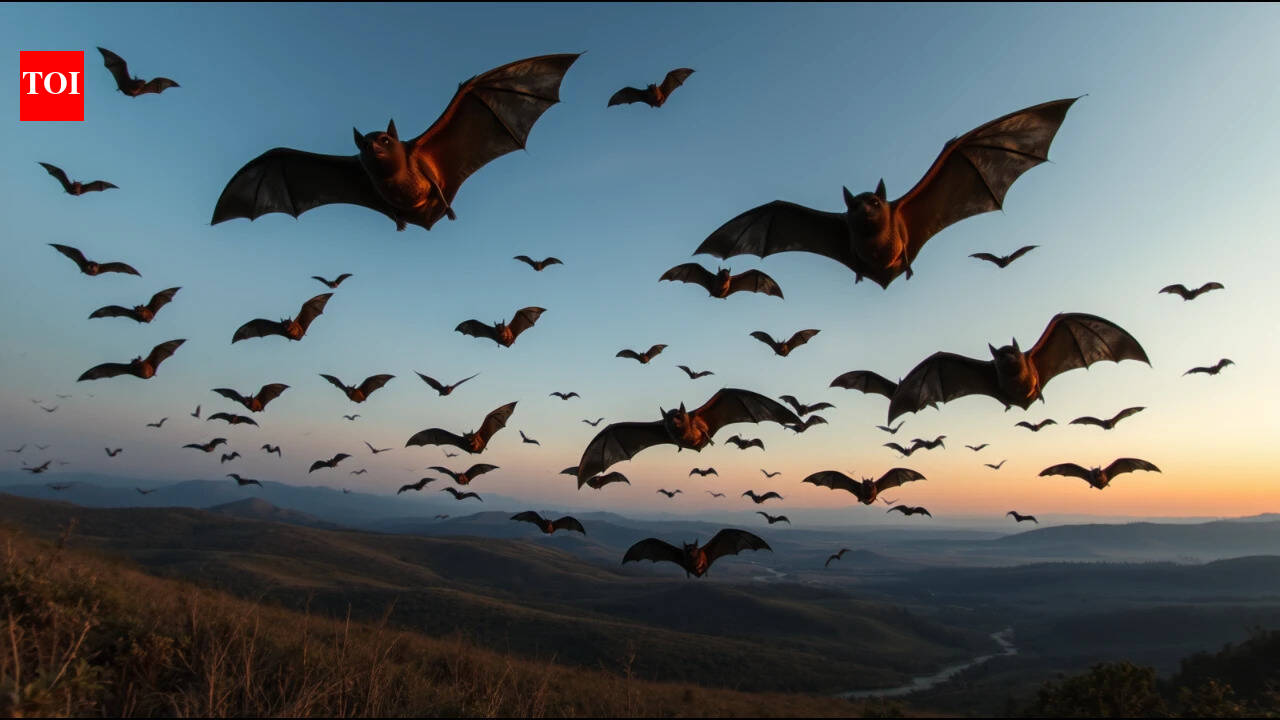
For decades, scientists have debated where bats first evolved, with Africa, Asia and North America among the proposed origins of the only mammals capable of powered flight.
asserted
bats → debate → flight
A study published in Nature offers new evidence for a different answer: Europe.
asserted
study → publish → answer
According to the research, an international team analysed genomes from 103 bat species and combined genetic evidence with a dataset containing 44 fossil bats.
uncertain
team → accord → bats
The results suggest that bats most likely originated in Europe during the late Paleocene.
asserted
bats → suggest → Paleocene
University announcements about the research have described the origin as approximately 65 million years ago, but that figure should not be paired with the late Paleocene date unless the paper’s root-age estimate confirms it.
asserted
estimate → describe → it
The work was carried out through the Bat1K consortium, a global initiative to generate high-quality reference genomes for living bat species.
asserted
work → carry → species
The researchers also reconstructed how early bat lineages spread into other regions, offering a revised picture of the evolutionary history of one of the most distinctive groups of mammals.
asserted
lineages → reconstruct → mammals
Bat origins in Europe: how 103 genomes and 44 fossils reveal where bats originated
asserted
bats → reveal → Europe
The researchers analysed genomes from 103 bat species, including 42 newly generated chromosome-level assemblies, representing all 21 currently recognised bat families.
asserted
researchers → analyse → families
They combined this genomic evidence with a morphological dataset containing 44 pre-Quaternary fossil taxa.
asserted
They → combine → taxa
The paper, titled
Reference genomes and fossils revise bat family phylogeny and biogeography,
asserted
genomes → title → phylogeny
The researchers used these combined datasets to address long-standing disagreements about how bat families are related and where their ancestors lived.
asserted
ancestors → use → disagreements
Earlier studies proposed different origins for bats using different approaches.
asserted
studies → propose → approaches
Some analyses favoured North America by combining fossil and molecular evidence, others pointed to Africa through early biogeographical models, while studies relying on living species alone supported an Asian origin.
asserted
studies → favour → origin
These differences reflect, in part, the limitations of individual methods and the scarcity of fossils that can clarify the earliest stages of bat evolution.
asserted
that → reflect → evolution
By incorporating fossils into their evolutionary and biogeographical models, the team estimated that the ancestral bat lineage originated in Europe during the late Palaeocene.
asserted
lineage → incorporate → Palaeocene
The analysis assigned a 99.2% posterior probability to Europe as the origin of bats under the study’s model.
asserted
analysis → assign → model
This is strong support within the analysis, rather than proof that every aspect of bat origins has been settled.
asserted
aspect → settle → origins
The researchers inferred that descendants of this European ancestor most probably dispersed to Africa.
asserted
descendants → infer → Africa
From the Europe–Africa region, separate lineages subsequently expanded into the Americas, Asia and Australia as modern bat groups diversified.
asserted
groups → expand → Americas
The study therefore suggests a more complex history of dispersal than a single migration route across continents.
uncertain
study → suggest → continents
Bat1K consortium study in Nature: a revised bat family tree
Reconstructing the bat family tree presented a substantial challenge.
asserted
Reconstructing → revise → challenge
Different regions of a genome can preserve conflicting signals about evolutionary relationships, and the history of bat lineages is more complicated than a straightforward branching pattern.
asserted
history → preserve → pattern
The researchers used large-scale genomic comparisons and additional analyses to investigate these conflicting signals and revise relationships among bat families.
asserted
researchers → use → families
The resulting phylogeny resolves several contested relationships among major bat groups.
asserted
phylogeny → result → groups
It also places the family Myzopodidae, which includes bats native to Madagascar, as the earliest branch within the superfamily Vespertilionoidea.
asserted
which → place → Vespertilionoidea
These results help explain why earlier genomic studies reached different conclusions about parts of the bat family tree.
asserted
studies → help → tree
The research forms part of Bat1K, an international effort to generate chromosome-level reference genomes for all living bat species.
asserted
research → form → species
The 103-species dataset includes 42 new assemblies produced for this study, with representatives from every currently recognised bat family.
asserted
dataset → include → family
Such reference genomes allow researchers to compare DNA across species and investigate the genetic changes associated with the evolution of distinctive bat characteristics.
asserted
researchers → allow → characteristics
Beyond this study, bats are known to perform important ecological roles, although these vary by species.
asserted
these → know → species
Many consume insects, while fruit-eating and nectar-feeding species can contribute to seed dispersal and pollination.
asserted
species → consume → dispersal
Some bats are exceptionally long-lived relative to their body size, and research has identified unusual features of bat immunity.
asserted
research → live → immunity
The new phylogeny provides a framework for investigating how these characteristics evolved across different lineages; it does not, by itself, establish the biological mechanisms behind them.
asserted
it → provide → them
Flight, echolocation and what ancient bat fossils reveal
The study also examines the evolutionary history of powered flight and laryngeal echolocation.
asserted
study → reveal → flight
Bats are the only mammals capable of powered flight, while many species use echolocation, producing sounds and interpreting returning echoes to navigate and locate prey.
asserted
species → use → prey
The researchers’ biogeographical analysis indicates that bats, and therefore powered flight, most likely originated in Europe during the late Palaeocene.
asserted
bats → indicate → Palaeocene
Fossil evidence also helped the team investigate when echolocation appeared.
asserted
echolocation → help → ?
The researchers placed the fossil bat Vielasia within the oldest “Eochiroptera” clade in their analysis, although this placement had a posterior probability of 68%, which the authors characterised as medium support.
asserted
authors → place → support
The result is consistent with laryngeal echolocation having evolved before the diversification of crown-group bats, but the uncertainty in the fossil’s placement should be kept in mind.
asserted
uncertainty → evolve → mind
…and 5 more, not listed.
 The Aporia