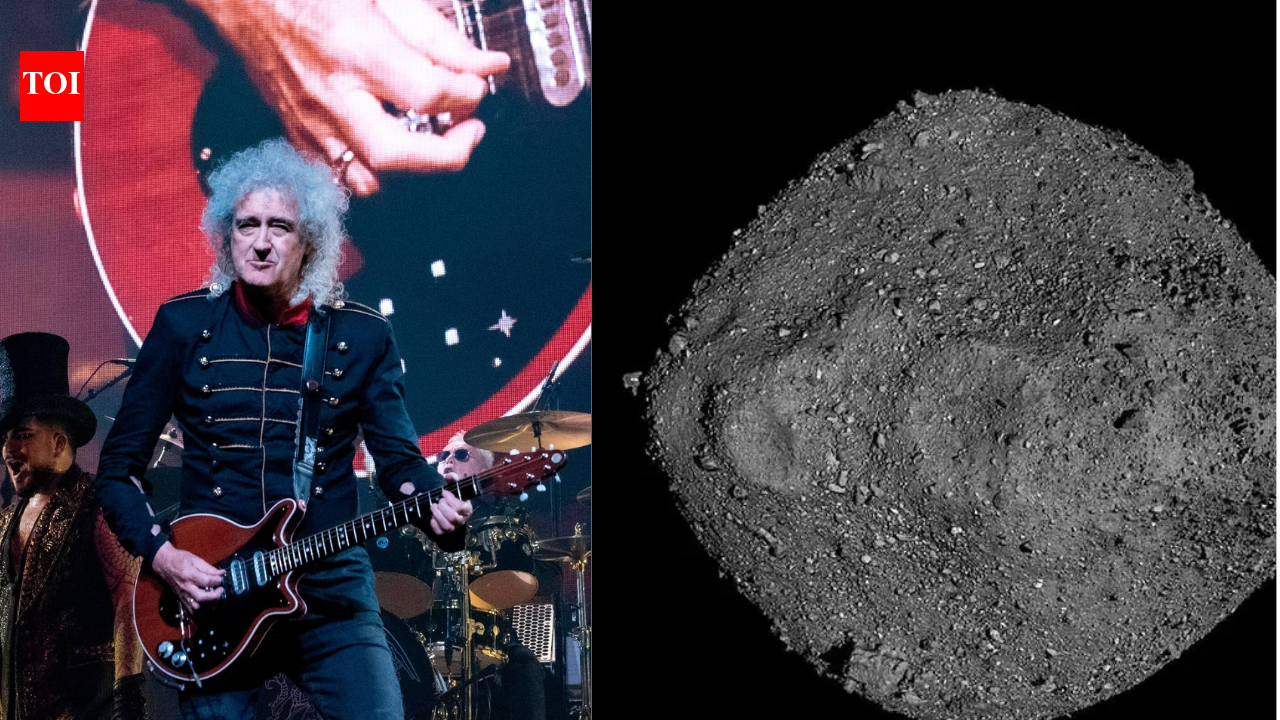
A rock musician working at a computer might seem an unlikely figure in an asteroid-sampling mission, but Brian May brought a specialist skill to Nasa’s search for a place to land on Bennu.
uncertain
May → work → Bennu
The Queen guitarist, who also holds a doctorate in astrophysics, helped scientists turn spacecraft photographs into three-dimensional views of the asteroid’s rough surface.
asserted
scientists → hold → surface
The work became particularly useful when the images revealed a landscape far more crowded with boulders than mission planners had anticipated.
asserted
planners → become → boulders
May’s contribution, made alongside planetary scientist Claudia Manzoni, later became part of a book documenting Bennu’s unusual terrain and the challenges faced by Nasa’s OSIRIS-REx mission.
uncertain
contribution → make → mission
How Brian May turned spacecraft photographs into 3D views
May joined the OSIRIS-REx science team in January 2019, several months after the spacecraft arrived at Bennu.
uncertain
spacecraft → turn → Bennu
His involvement grew from an existing friendship with Dante Lauretta, the mission’s principal investigator, and a shared interest in astronomy.
asserted
involvement → grow → astronomy
Lauretta was also a Queen fan, though the guitarist was expected to contribute scientific expertise rather than simply lend his name to the project.
asserted
guitarist → expect → project
May had spent years developing an interest in stereoscopic photography, a technique that allows viewers to perceive depth by combining two images taken from slightly different viewpoints.
uncertain
viewers → spend → viewpoints
With the right image pairs, the brain interprets the differences between them as a three-dimensional scene.
asserted
brain → interpret → scene
May had used this approach to produce views of Pluto from Nasa’s New Horizons mission and of Comet 67P/Churyumov–Gerasimenko, which was visited by the European Space Agency’s Rosetta spacecraft.
uncertain
which → use → spacecraft
OSIRIS-REx did not carry a dedicated stereo camera.
asserted
REx → carry → camera
That did not prevent May from applying the technique.
uncertain
That → prevent → technique
By identifying suitable photographs captured at different angles and carefully aligning them, he could create three-dimensional representations from images that were originally recorded by a single camera.
uncertain
that → identify → camera
These views gave the mission team a better sense of the height, depth and relative positions of features scattered across Bennu.
asserted
views → give → Bennu
Why Nasa struggled to find a suitable landing site
When OSIRIS-REx reached the asteroid, scientists had anticipated finding relatively open areas that might accommodate the spacecraft’s sampling manoeuvre.
uncertain
that → struggle → manoeuvre
The mission had been designed around the possibility of landing in a comparatively smooth patch of ground.
asserted
mission → design → ground
The images told a different story.
asserted
images → tell → story
Bennu, which measures approximately 500 metres in diameter, was covered with rocks and boulders, leaving little of the open terrain that engineers had expected.
asserted
engineers → measure → that
Some formations rose tens of feet above the surface.
asserted
formations → rise → surface
From conventional two-dimensional photographs, judging the precise shape of the ground and the distance between obstacles was difficult.
asserted
judging → judge → obstacles
May worked through the incoming photographs with Manzoni, searching for image pairs that could reveal the terrain more clearly.
uncertain
that → work → terrain
The task involved examining numerous craters and assessing whether any contained a sufficiently large, accessible patch of ground.
asserted
any → involve → ground
May later recalled that he had spent so much time on the work that his musical activities took a back seat.
uncertain
activities → recall → seat
In the book
Bennu 3-D: Anatomy of an Asteroid, Lauretta described how the resulting images helped the team appreciate the difficulty of operating on the asteroid.
asserted
team → describe → asteroid
The three-dimensional views made its uneven surface easier to understand and helped scientists and engineers assess possible sampling locations with greater confidence.
asserted
scientists → make → confidence
Nasa narrowed its search to two potential landing sites
The search eventually narrowed to two candidates: Osprey and Nightingale.
asserted
search → narrow → candidates
Neither offered the broad, uncomplicated landing area originally envisaged.
asserted
Neither → offer → area
Osprey measured roughly six metres across, while Nightingale was around eight metres wide, making both considerably smaller than the 25-metre target area in the original mission design.
asserted
both → measure → design
Each site had its advantages.
asserted
site → have → advantages
Osprey appealed to the engineering team because there were fewer potentially hazardous rocks around its rim.
asserted
Osprey → appeal → rim
Nightingale attracted the scientists, who believed its surface material might preserve a useful record of Bennu’s history.
uncertain
material → attract → history
The colour and composition of the regolith, the loose material covering the asteroid, made the crater an especially interesting place to collect a sample.
asserted
crater → cover → sample
The decision meant accepting a difficult approach, with a large boulder near the crater’s edge adding to the hazards.
asserted
boulder → mean → hazards
The team had to work out how the spacecraft could descend through the surrounding terrain and reach the sampling point without striking nearby rocks.
uncertain
spacecraft → have → rocks
The sampling attempt revealed another surprise
OSIRIS-REx touched down at Nightingale in October 2020.
asserted
REx → reveal → October
The spacecraft used its sampling mechanism to contact the surface and collect material before moving away from the asteroid.
asserted
spacecraft → use → asteroid
The operation exposed another mistaken assumption about Bennu.
asserted
operation → expose → Bennu
Scientists had expected the surface to behave more like a firm layer of gravel, with some dust and small particles disturbed by contact.
asserted
surface → expect → contact
Instead, images recorded during the manoeuvre showed a substantial quantity of debris moving around the spacecraft.
asserted
quantity → record → spacecraft
Bennu’s surface offered far less resistance than expected.
asserted
surface → offer → resistance
…and 21 more, not listed.
 The Aporia