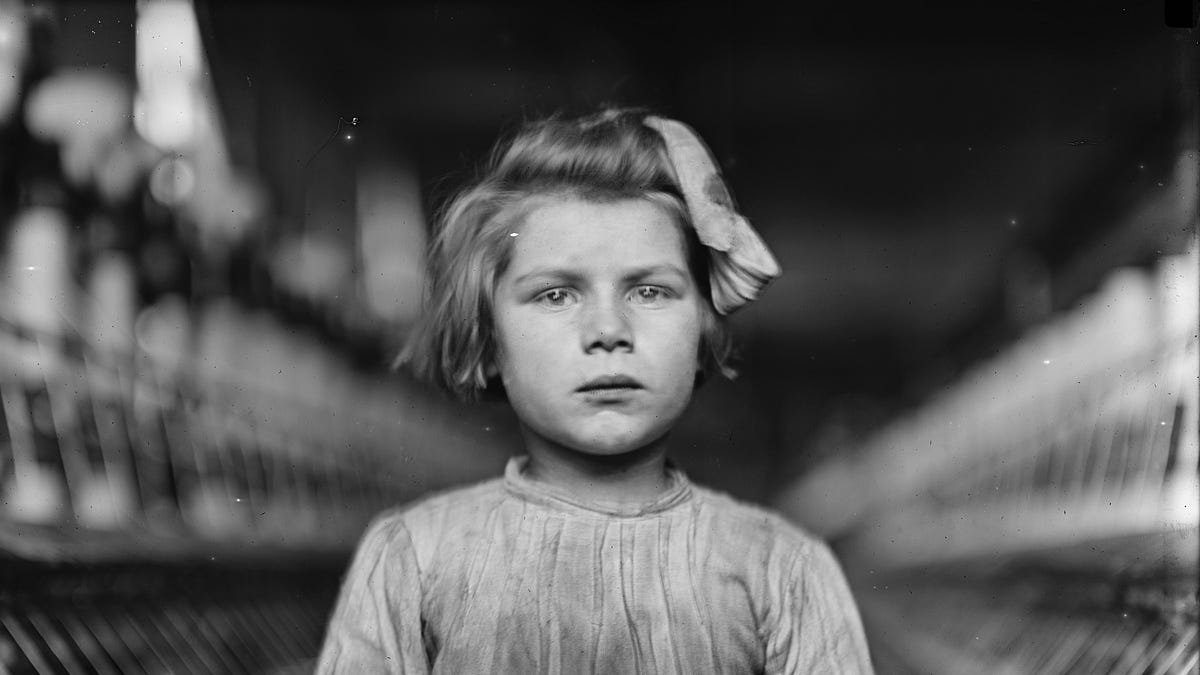
[The tenth chapter of The Autobiography of Mother Jones—a 1925 collection of sketches from the life and career of labor organizer and urban reformer Mary G. Harris “Mother” Jones—offers this account of the “March of the Mill Children” she led from Philadelphia to President Theodore Roosevelt’s Long Island summer home.
asserted
she → offer → home
]
IN THE SPRING OF 1903 I went to Kensington, Pennsylvania, where seventy-five thousand textile workers were on strike.
asserted
workers → go → strike
The workers were striking for more pay and shorter hours.
asserted
workers → strike → pay
Every day little children came into Union Headquarters, some with their hands off, some with the thumb missing, some with their fingers off at the knuckle.
asserted
some → come → knuckle
Many of them were not over ten years of age, the state law prohibited their working before they were twelve years of age.
asserted
they → prohibit → age
The law was poorly enforced and the mothers of these children often swore falsely as to their children’s age.
asserted
mothers → enforce → age
In a single block in Kensington, fourteen women, mothers of twenty-two children all under twelve, explained it was a question of starvation or perjury.
asserted
it → explain → starvation
That the fathers had been killed or maimed at the mines.
asserted
fathers → kill → mines
I asked the newspaper men why they didn’t publish the facts about child labor in Pennsylvania.
asserted
they → ask → Pennsylvania
They said they couldn’t because the mill owners had stock in the papers.
asserted
owners → say → papers
“Well, I’ve got stock in these little children,” said I, “and I’ll arrange a little publicity.”
asserted
I → get → publicity
We assembled a number of boys and girls one morning in Independence Park and from there we arranged to parade with banners to the court house where we would hold a meeting.
asserted
we → assemble → meeting
A great crowd gathered in the public square in front of the city hall.
asserted
crowd → gather → hall
I put the little boys with their fingers off and hands crushed and maimed on a platform.
asserted
hands → put → platform
I held up their mutilated hands and showed them to the crowd and made the statement that Philadelphia’s mansions were built on the broken bones, the quivering hearts and drooping heads of these children.
asserted
mansions → hold → children
That their little lives went out to make wealth for others.
asserted
lives → go → others
That neither state or city officials paid any attention to these wrongs.
asserted
officials → pay → wrongs
That they did not care that these children were to be the future citizens of the nation.
asserted
children → care → nation
The officials of the city hall were standing the open windows.
asserted
officials → stand → windows
I held the little ones of the mills high up above the heads of the crowd and pointed to their puny arms and legs and hollow chests.
asserted
I → hold → arms
They were light to lift.
asserted
They → lift → ?
I called upon the millionaire manufactures to cease their moral murders, and I cried to the officials in the open windows opposite, “Some day the workers will take possession of your city hall, and when we do, no child will be sacrificed on the altar of profit.”
asserted
child → call → profit
The officials quickly closed the windows, as they had closed their eyes and hearts.
asserted
they → close → eyes
The reporters quoted my statement that Philadelphia mansions were built on the broken bones and quivering hearts of children.
asserted
mansions → quote → children
The Philadelphia papers and the New York papers got into a squabble with each other over the question.
asserted
papers → get → question
The universities discussed it.
asserted
universities → discuss → it
Preachers began talking.
asserted
Preachers → begin → ?
That was what I wanted.
asserted
I → want → what
The matter quieted down for a while and I concluded the people needed stirring up again.
asserted
people → quiet → while
The Liberty Bell that a century ago rang out for freedom against tyranny was touring the country and crowds were coming to see it everywhere.
asserted
crowds → ring → it
That gave me an idea.
asserted
That → give → idea
These little children were striking for some of the freedom that childhood ought to have, and I decided that the children and I would go on a tour.
asserted
children → strike → tour
I asked some of the parents if they would let me have their little boys and girls for a week or ten days, promising to bring them back safe and sound.
asserted
me → ask → them
They consented.
asserted
They → consent → ?
A man named Sweeny was marshal for our “army.”
asserted
man → name → army
A few men and women went with me to help with the children.
asserted
men → go → children
They were on strike and I thought, they might well have a little recreation.
uncertain
they → think → recreation
The children carried knapsacks on their backs which was a knife and fork, a tin cup and plate.
asserted
which → carry → backs
We took along a wash boiler in which to cook the food on the road.
asserted
We → take → road
One little fellow had drum and another had a fife.
asserted
another → have → fife
…and 120 more, not listed.
 The Aporia