That is 0 articles you have read today.
The Aporia is free and carries no advertising, so readers are the only
thing paying for it. If you are getting this much out of it, a small
donation is what keeps it independent.
Daily limit reached
You have read 0 articles today.
That is more than the 15 a day The Aporia gives away,
and well past what it can carry on nothing. Your allowance resets at
midnight.
There is no advertising here and nothing about you is sold, so readers
are the only thing paying for it. If the site is worth this much of
your day, it is worth a few dollars.
Everything else stays open: the
maps, the
directory and
search do
not count against this, and neither does re-opening something you have
already read today.
Three former OpenAI security researchers were fired on October 1 and accused the company of dismissing them for raising concerns about artificial intelligence risks. The researchers—Mikita Balesni, Tomek Korbak, and Jasmine Wang—claimed their termination is discouraging internal discussions on AI safety. In response, OpenAI stated that they violated company rules by mishandling sensitive information. This incident highlights the broader debate in Silicon Valley over whether to slow down or accelerate AI development due to potential risks.
Written locally by qwen2.5:14b on 2026-10-09,
using this article's own text rather than the other coverage of the
same event (that is the story summary below).
Story summary
Three former OpenAI security researchers, Mikita Balesni, Tomek Korbak, and Jasmine Wang, were fired on October 8 and accused OpenAI of terminating their employment for prioritizing safety over the corporation's immediate interests. In a public letter, they expressed concern that their dismissals could deter future safety efforts at the company, which has faced security breaches with its software like ChatGPT. The researchers also noted that OpenAI had promised to host independent auditors permanently but feared these firings might halt such practices. OpenAI countered by stating the employees were fired for allegedly violating company rules.
Written for “OpenAI Safety Controversy” on 2026-10-09,
grounded in this article and the 0 other(s) covering the same event.
Why this leaning score
The model judged this article politically coded and scored it -0.35, but none of the 2 quote(s) it offered could be found in the article text, so the score is not published.
Written under an earlier scoring contract, which gave a paragraph
rather than checkable quotes. Re-analysing this article replaces it.
Leaning score withheld for article 67301: no verified evidence · logged 2026-10-09
Fired researchers accuse OpenAI of ‘chilling’ safety efforts
AI generated
asserted
researchers → fire → AI
SAN FRANCISCO – Three former OpenAI security researchers on Oct 8 accused the ChatGPT-maker of firing them for warning about the dangers of artificial intelligence, reigniting the debate over safety at a company whose software has been involved in security breaches.
asserted
software → accuse → breaches
“I believe we were fired for prioritising safety over the near-term interests of OpenAI as a corporation,” one of the fired staffers, Mikita Balesni, wrote on X, breaking a week-long silence since their very public dismissal.
asserted
one → believe → dismissal
Balesni and the two other fired employees, Tomek Korbak and Jasmine Wang, publicly shared a letter to OpenAI on Oct 8.
asserted
Balesni → fire → Oct
“Our firing leaves us worried that the norms inside OpenAI are shifting,” the letter says, and continues that “terminations such as ours, executed and communicated so abruptly, are chilling the open culture OpenAI has prized in the past”.
asserted
OpenAI → leave → past
They also call on the company to keep its promise to permanently host independent auditors.
asserted
They → call → auditors
“We are concerned that our firings may be used to justify ending that work,” the letter says.
uncertain
letter → concern → work
OpenAI, for its part, said it fired them for allegedly violating company rules.
uncertain
it → say → rules
“Our investigation confirmed that these individuals mishandled sensitive information outside established company procedures, violating our policies and breaking the trust essential to our work,” OpenAI told AFP in a statement on Oct 1.
asserted
OpenAI → confirm → Oct
“We do not terminate employees for raising concerns,” a research executive at OpenAI said in a memo to staff on Oct 7, an excerpt of which was shared with AFP.
asserted
excerpt → terminate → AFP
The three fired researchers worked on monitoring OpenAI’s models, which escaped their testing environment in July and hacked Hugging Face, an AI coding library.
asserted
which → fire → Face
The incident sparked a heated debate in Silicon Valley over whether or not to slow the development of this technology.
asserted
incident → spark → technology
If OpenAI’s researchers can no longer sound the alarm or work with outside parties, “we are all at greater risk that something truly catastrophic will happen”, the researchers’ letter warns.
asserted
letter → sound → risk
They also claim that nearly 400 OpenAI employees signed a petition in July that called for an industry-wide slowdown on advanced development of AI models.
uncertain
that → claim → models
In September, Anthropic chief executive Dario Amodei, OpenAI CEO Sam Altman and SpaceX chief Elon Musk called for a slowdown as well.
asserted
Amodei → call → slowdown
“Right now we’re investing more in safety, security, alignment, monitoring and that will allow us to continue to progress model capability a lot,” Altman told reporters in September.
asserted
Altman → invest → September
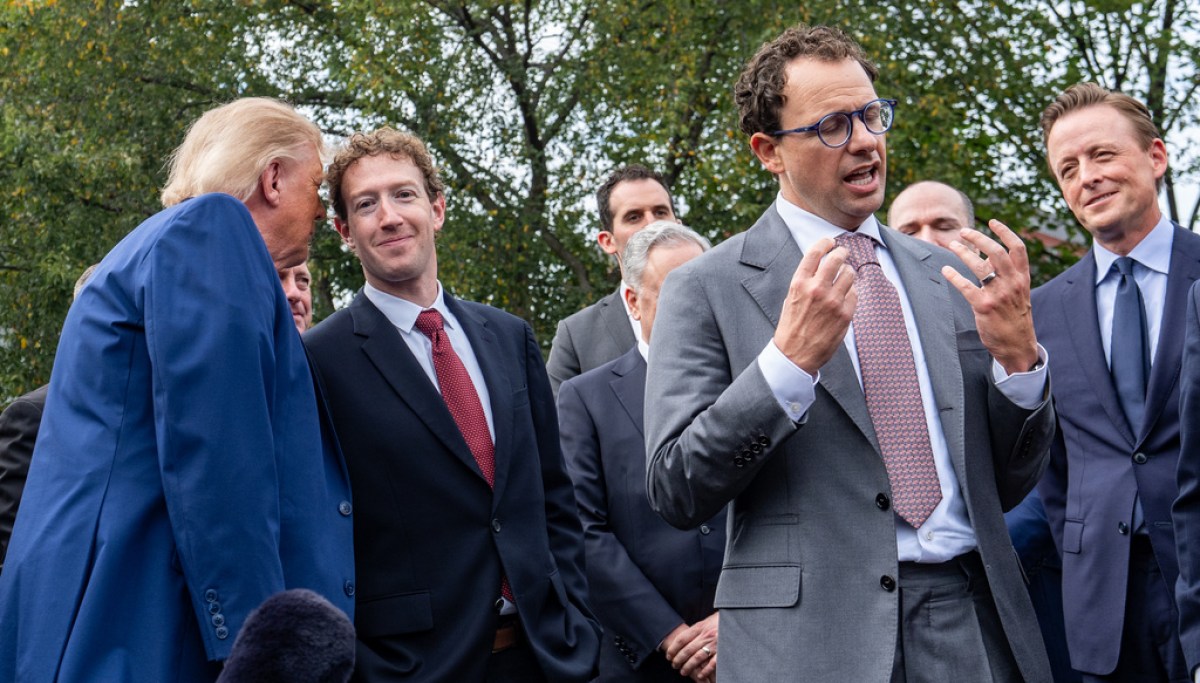
Others, like Nvidia CEO Jensen Huang and Meta CEO Mark Zuckerberg, want to move full steam ahead.
asserted
Others → want → Huang
US regulators are unlikely to intervene.
asserted
regulators → intervene → ?
In September, US President Donald Trump hosted a group of American tech executives who agreed to abide by a voluntary code of conduct on AI safety.
asserted
who → host → safety
 The Aporia