- Published
Sharp falls in the value of chip makers have stoked investor concerns that the euphoria around artificial intelligence (AI) related companies is fading.
asserted
euphoria → stoke → companies
The AI revolution has promised to reshape the way we work and live and has created vast wealth for investors in a handful of companies predominantly in the US and Asia.
asserted
we → promise → US
Companies are desperate to be the winners of a transformative technology that many have compared to the advent of the internet, the telephone, even electricity itself.
asserted
many → compare → internet
As Sir Demis Hassabis, founder of UK company Deepmind, which was eventually bought a decade ago by US giant Google, has commented that Artificial Intelligence "cannot be compared to standard technological breakthroughs, not even ones as consequential as the internet or mobile.
asserted
Intelligence → buy → internet
It is much more akin to the discovery of electricity or fire."
Referring to the fact that many chips are made of silicon, which is essentially sand, he added "we've essentially found a way to make sand think.
asserted
sand → refer → way
The euphoria for this technology has boosted the value of some world's biggest companies even as they spend hundreds of billions of dollars on the building blocks of the technology.
asserted
they → boost → technology
But over the last few weeks, the value of some of the companies that make those building blocks has plummeted - prompting some to question whether what some have dubbed "the AI bubble" is about to burst.
asserted
dubbed → make → what
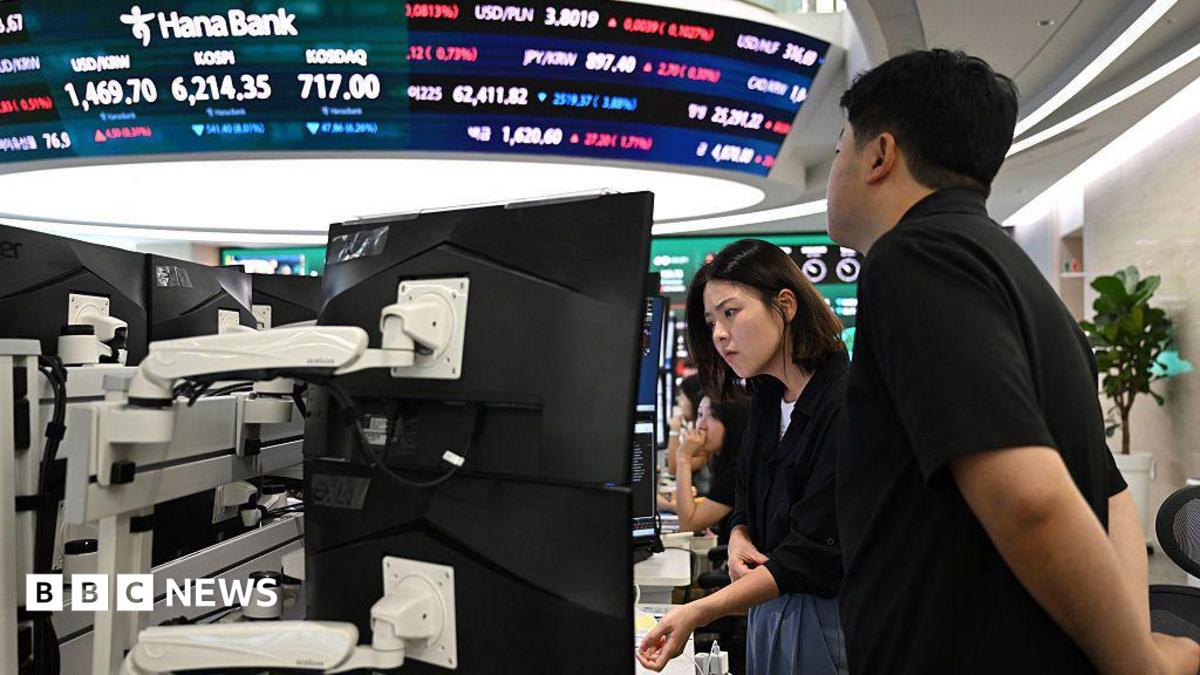
Some of the sharpest falls have been in Asia, with shares in Korean chip makers such as SK Hynix and Samsung down 46% and 35% respectively over the last month as investors worry the recent boom in demand for the chips that power AI is unsustainable.
Yet these shares still are up threefold and fivefold respectively over the last year, leading many to conclude that some caution and profit taking after such massive gains was inevitable – and indeed healthy.
asserted
caution → worry → gains
The South Korean stock market is notoriously volatile, but concerns have spilled over into the big US companies.
asserted
concerns → spill → companies
Shares in Google and Tesla plunged briefly before recovering last week after both firms pledged to spend billions more on AI in the months and years to come despite so far it losing them money.
asserted
it → plunge → money
And with other big names such as Meta, Microsoft and Amazon reporting their latest financial results this week, investors have the opportunity to scrutinise just how much these companies are now betting on AI.
asserted
companies → report → AI
On Wednesday, the tech-heavy Nasdaq ended the trading day about 9% below its June record high, driven down in part by worries over heavy AI spending.
"There is still a healthy degree of scepticism about the ability of these investments to generate a commensurate level of return," Russ Mould, an investment director at AJ Bell, said.
asserted
Mould → end → Bell
The AI bubble hasn't burst but it's letting out air," she told the BBC.
asserted
she → burst → BBC
One of the other triggers for the concerns has been a reported breakthrough in the manufacturing process by a Chinese company, potentially making China more self-sufficient in chip design and production.
asserted
China → report → design
That has added to lingering concerns that the big AI companies – Meta, Alphabet, Open AI, Anthropic – will find it hard to charge end users enough to justify the hundreds of billions being spent on buying the chips and building the data centres that power the technology.
asserted
that → add → technology
As a result, firms that have announced big increases in spending on AI have not always been welcomed with the same enthusiasm by investors.
asserted
that → announce → investors
For example, SpaceX – which is predominantly an AI company - has seen its shares fall 14% from its much-hyped debut on the stock market and nearly 50% from its peak in June.
asserted
shares → see → June
Apple – which has largely sat out the AI arms race – has seen its shares rise 21% over the last month to reclaim its title as the world's most valuable company from chip maker Nvidia.
asserted
shares → sit → Nvidia
Meanwhile London's benchmark FTSE 100 index which have some have dubbed the "anti-tech index", briefly touched a record high - one of the few periods in recent years where it has benefited from not being tech-heavy.
asserted
it → dub → years
Growing concerns
Historically it is possible for investors to lose money even if the technology they are backing succeeds.
asserted
they → grow → money
For example, while railways transformed economies – particularly in the US – plenty of people lost money along the way.
asserted
plenty → transform → way
Unlike rail tracks – which once built are good for decades – data centres are likely to need upgrading frequently to include the latest and fastest processors.
asserted
centres → build → processors
Add to that lot, concerns that some of the big AI companies have taken big stakes or lent money to each other leading to circular funding that means that any potential failures could have a damaging impact on the fortunes of others.
uncertain
failures → add → others
A growing number of national, state or local governments are pausing, banning or restricting new data centre construction on environmental grounds thanks to their vast water and energy needs.
Meanwhile, high profile AI advocates have found themselves booed by students who fear that AI will replace many graduate level jobs.
asserted
AI → grow → jobs
"I see the glass half full - if you bought shares in chip makers a year ago you are feeling pretty good right now.
asserted
you → see → makers
But there is no doubt that investors are watching companies plans for spending and their projections for when they get paid back with post euphoric scrutiny.
asserted
they → be → scrutiny
 The Aporia