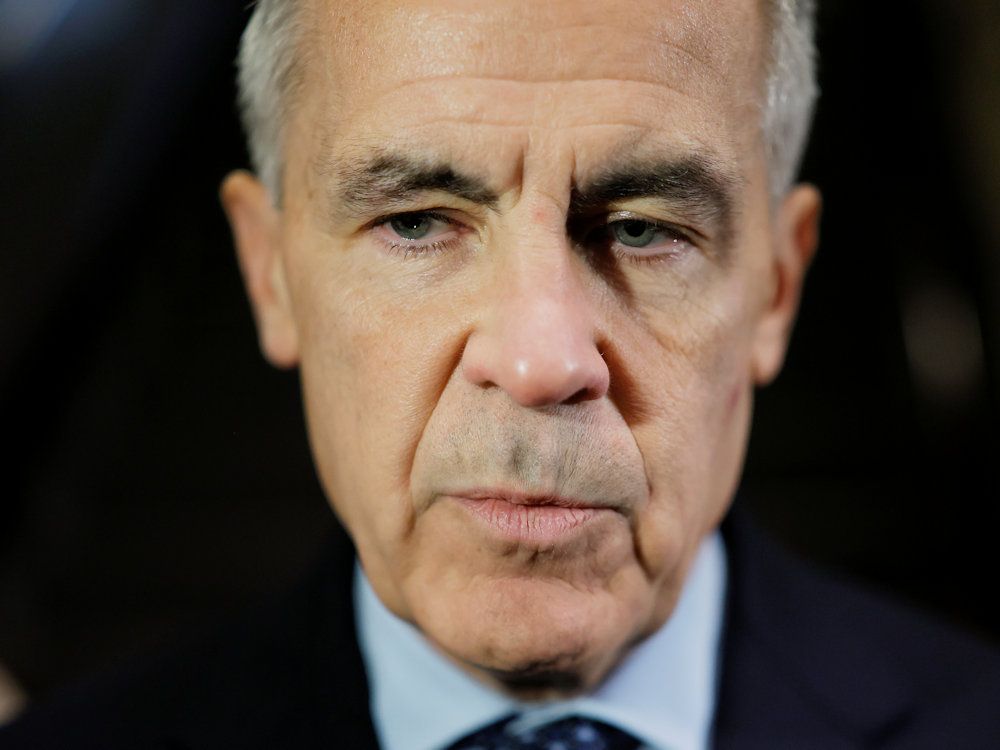
Chief Justice Richard Wagner opened the new session of the Supreme Court of Canada by describing a world marked by uncertainty and polarization, echoing Prime Minister Mark Carney's frequent use of the phrase "dangerous and divided world." Since entering office, Carney has used this theme in nearly 100 statements or speeches. The term now appears increasingly in Parliament, beyond just Carney himself, with other Liberal MPs also adopting it to justify various government initiatives.
Written locally by qwen2.5:14b on 2026-10-08,
using this article's own text rather than the other coverage of the
same event (that is the story summary below).
TOP STORY
Recommended Videos
In his speech opening the new session of the Supreme Court of Canada this week, Chief Justice Richard Wagner spoke of a world that seems “increasingly uncertain” and plagued with “unrelenting pressures.”
asserted
that → open → pressures
“Polarization is deepening, events unfold at a relentless pace,” he said.
asserted
he → deepen → pace
It may sound like standard Ottawa boilerplate, but the rhetoric is eerily similar to one of the preferred themes of Prime Minister Mark Carney, who is similarly known to begin speeches with a description of the planet being plagued by division and uncertainty.
uncertain
who → sound → division
In perhaps the most obvious example, in just the last 16 months Carney has produced nearly 100 statements, letters or speeches that contained some variant of the term “dangerous and divided world.”
asserted
that → produce → term
When LNG Canada announced a $33 billion expansion last week, a release from the Prime Minister’s Office called it good news for a more “dangerous and divided world.”
asserted
release → announce → world
“In a more dangerous and divided world, the members of our Canadian Armed Forces (CAF) continue to answer the call to defend our sovereignty, protect our communities, and keep Canada strong,” Carney said in a June statement marking Canadian Armed Forces Day.
asserted
Carney → divide → Day
The term even shows up in press briefing announcing routine appointments.
asserted
term → show → appointments
When Carney hired John Hannaford to act as his personal envoy to the European Union, Hannaford was sent off with the hope that he could reinforce “transatlantic security as we face a more divided and dangerous world.”
uncertain
we → hire → world
Prior to Carney’s entry into the House of Commons, there was just one recorded instance of the term “dangerous and divided” being spoken by a sitting MP.
asserted
term → be → MP
It came in 2006, and was spoken by then Indian Affairs Minister Jim Prentice.
asserted
It → come → Prentice
The occasion was a lengthy speech denouncing the Bloc Québécois, and their tabling of a motion stating that Quebecers “form a nation” within Canada.
asserted
Quebecers → denounce → Canada
In singing the praises of a Canada that Prentice accused the Bloc of trying to destroy, he said it is “a symbol of hope to a very dangerous and divided world.”
asserted
it → sing → world
Under the Carney government, the term has been mentioned in Parliament not only by Carney, but increasingly by other Liberal MPs.
asserted
term → mention → MPs
During a debate over finances in June, for instance, the term appeared twice in only a few minutes.
asserted
term → appear → minutes
Liberal MP Taleeb Noormohamed began a speech by saying “we all know we are living through one of the most dangerous and divided moments the world has seen in generations.”
asserted
world → begin → generations
This was followed shortly after by Liberal MP Shannon Miedema, who used the term to defend the military budget.
asserted
who → follow → budget
“In a more dangerous and divided world, Canada is taking full responsibility for defending our sovereignty and building our strength as a reliable partner and ally,” she said.
asserted
she → divide → partner
IN OTHER NEWS
Canada finally seems to have reached some kind of political consensus on when assisted suicide shouldn’t be allowed.
asserted
suicide → seem → consensus
When MAID was first legalized in Canada, it was initially only permitted for terminally ill patients.
asserted
it → legalize → patients
Then, following a Quebec court challenge, in 2021 the government of Prime Minister Justin Trudeau expanded the eligibility to include anyone with a “grievous or irremediable” illness (the so-called “track two” qualification).
asserted
government → follow → illness
MAID eligibility expanded again in 2024 when Quebec declared that it would no longer require patients to be conscious in order to give consent for assisted suicide; only a written “advance directive” would be required.
asserted
directive → expand → suicide
Although it was technically asking doctors to commit homicide, it continued in large part because of a federal refusal to challenge the new measure.
asserted
it → ask → measure
Although the “track two” legislation in 2021 had included a provision for MAID to eventually be extended to Canadians whose only underlying condition was a mental illness, the Carney government has just pledged to exclude psychiatric conditions from MAID eligibility.
asserted
government → include → eligibility
The pledge just so happened to come on the same day that the Liberal caucus helped defeat a Conservative private member’s bill on just this subject.
asserted
caucus → happen → subject
There is a catch, however: The Liberals are also planning to use the legislation to codify the Quebec-style “advance directive” measure, meaning it would become legal to prescribe a doctor-assisted death to a patient who is unconscious, unresponsive or confused by dementia.
asserted
who → be → dementia
All that would be needed is a prior, written request for MAID.
asserted
that → need → MAID
If Canada is drawing the line at administering MAID for illnesses such as depression or bipolar disorder, it’s far short of where Dying With Dignity, Canada’s leading pro-MAID advocacy group, probably might have taken it.
uncertain
Dying → draw → it
The group has pushed hard for the mental illness provision to be enacted.
asserted
provision → push → ?
And in an interview with The Walrus in 2024, a Dying With Dignity spokesperson was asked if they would ever endorse assisted suicide for children whose only condition was psychiatric.
asserted
condition → ask → children
“I mean that’s so far down the road.
asserted
that → mean → road
I don’t know,” was the reply.
asserted
reply → know → ?
 The Aporia