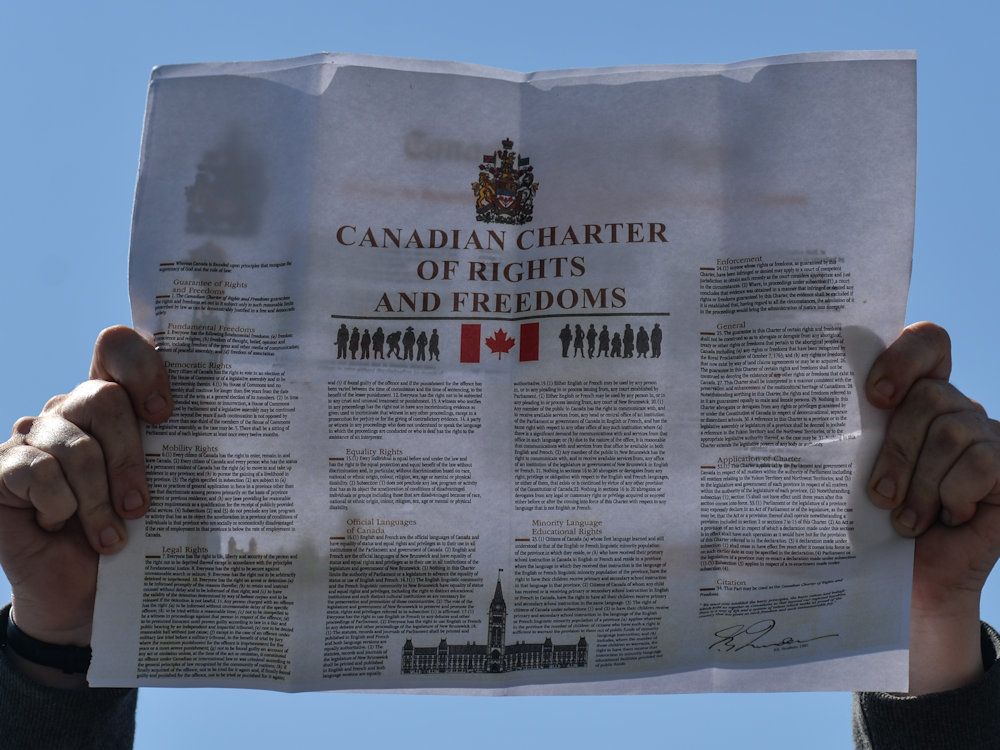
When a B.C. court declared this week that Canadians had a Charter-protected right to traffic in illicit drugs, any veteran court-watcher would have been able to guess the precise section of the Constitution that underlay the new right.
asserted
that → declare → right
It was Section 7 of the Charter of Rights and Freedoms, which guarantees the right to “life, liberty and security of the person and the right not to be deprived thereof.”
asserted
which → guarantee → person
And it was written mostly as a means of ensuring fair trials and guarding against unreasonable detention.
asserted
it → write → detention
One early Section 7 decision, for instance, deemed it unconstitutional to automatically jail Canadians for driving with a suspended licence, as the driver might not know their licence was suspended.
uncertain
licence → deem → licence
But particularly over the past 15 years, Section 7 has wound up doing the heaviest lifting of any other section of the Constitution, with its provisions being used to strike down virtually any law or government action that might theoretically have some adverse impact on life, liberty or personal security.
uncertain
that → wind → life
Legal scholar Dave Snow has called Section 7 an “unconstrained” mechanism for Canadian courts to shape public policy.
asserted
courts → call → policy
Snow has also noted that Section 7 challenges are a substantial chunk of what the Supreme Court of Canada deals with each year.
asserted
Court → note → Canada
In any given year, roughly one third of cases on the Supreme Court docket are challenging some aspect of civil society deemed to be a violation of “life, liberty and security of the person.”
asserted
third → give → person
Below, a cursory summary of just some of the new rights that Canadian judges have derived from the words “life, liberty and security of the person.”
asserted
judges → derive → person
A Charter right to run a brothel
In the 2013 Bedford v. Canada decision, the Supreme Court of Canada unanimously struck down three laws aimed at criminalizing pimps and brothels, including Criminal Code bans on operating a “bawdy house” or “living off the avails of prostitution.”
asserted
Court → run → prostitution
But the top court accepted the argument that if brothels weren’t allowed, it would force prostitutes to work on the street, which was more dangerous.
asserted
which → accept → street
Thus, the state was violating their right to “life” and “security of the person.”
asserted
state → violate → person
“By imposing dangerous conditions on prostitution (laws prohibiting bawdy houses) prevent people engaged in a risky — but legal — activity from taking steps to protect themselves from the risks,” the judgment read, adding “I conclude, therefore, that the bawdy-house provision negatively impacts the security of the person of prostitutes.”
A Charter right to die
Canada is not the only country with doctor-assisted suicide, but it is the one country where rates of assisted suicide have grown fastest and where safeguards are lowest.
asserted
safeguards → impose → suicide
This is due largely to the fact that Canada was forced to legalize MAID after a rather sweeping 2015 Supreme Court decision, Carter v. Canada.
asserted
Canada → force → Canada
While a right to life may seem to contradict a right to die, the Carter decision held that if the state didn’t allow Canadians to die by suicide legally, they might be tempted to do so illegally, which violated their “right to life.”
uncertain
which → seem → life
Or, as the decision put it, “the prohibition on physician-assisted dying had the effect of forcing some individuals to take their own lives prematurely, for fear that they would be incapable of doing so when they reached the point where suffering was intolerable.”
asserted
suffering → put → point
It added, “on that basis … the right to life was engaged.”
asserted
right → add → life
The one that gets cited most often in critiques of Section 7 overreach.
asserted
that → cite → overreach
Toronto cycling activists took the Ontario government to court, arguing that a provincial initiative to remove bike lanes violated their Section 7 rights.
asserted
initiative → take → rights
And, in Cycle Toronto v. Ontario, a judge in Ontario’s Superior Court of Justice agreed.
asserted
judge → agree → Justice
The whole case hinged on the argument that removing the lanes could make cycling less safe, thus increasing the cyclist’s risk of dying.
uncertain
cycling → hinge → risk
“If the removal of the lanes increases risk of harm, this supports the applicants’ position that the rights to life and security of the person are infringed,” it read.
asserted
it → increase → person
Although, this particular Section 7 right did end up being a step too far.
asserted
right → end → ?
In August, the Ontario Court of Appeal not only struck down the “Charter right to bike lanes” decision, but did it with flair.
asserted
Court → strike → flair
Justice Grant Huscroft wrote that while “judges may be tempted to comment on matters of policy,” it was ultimately “illegitimate” to do so.
uncertain
it → write → policy
Wrote Huscroft, “policy is for politics.”
asserted
policy → write → politics
A Charter right to do drugs basically everywhere
This week’s decision from B.C. finding a Section 7 right to traffic in drugs is far from the first time that Section 7 has been used to liberalize the trafficking and consumption of illicit drugs.
asserted
Section → find → drugs
In fact, if Canadian downtowns seem more plagued by drug disorder than ever before, that can largely be placed at the feet of a whole category of Section 7 court decisions that has kneecapped the ability of governments to sanction drug use.
asserted
that → seem → use
The most famous was the 2011 Supreme Court decision that found a Charter right to safe injection sites.
asserted
that → find → sites
The argument being that the absence of a safe injection site might cause drug users to inject in an environment that was less safe, thus infringing their Section 7 rights.
uncertain
that → cause → rights
Several subsequent decisions have similarly ruled that it is a Charter violation for the state to take any action that could conceivably make it more dangerous to do illicit drugs.
uncertain
it → rule → drugs
A 2023 B.C. Supreme Court ruling struck down a measure that specifically prohibited drug users from shooting up in playgrounds or splash parks.
asserted
that → strike → playgrounds
B.C. Supreme Court Chief Justice Christopher Hinkson ruled that it risked “irreparable harm” to drug users if the government of B.C. were to follow through with a plan of asking those users to instead do drugs in a slightly different area of the park.
asserted
government → rule → park
A Charter right to homeless encampments
It is now becoming almost routine that a Canadian municipal government will move to clear a homeless encampment on public land, only to be told this is an unconstitutional violation of Section 7.
asserted
this → become → Section
The first example came out of B.C. in 2008, with a B.C. Supreme Court decision overruling a City of Victoria bylaw forbidding homeless encampments in city parks, as the bylaw might prompt dispersed campers to seek more dangerous shelter options, thus endangering their right to “life, liberty and security of the person.”
uncertain
bylaw → come → person
Subsequent decisions have followed the same basic template: Unless a municipal government can offer free shelter to everyone pitching a tent on public land, it’s a Section 7 violation to require them to disperse.
asserted
it → follow → them
The most recent being an Ontario Superior Court of Justice decision that blocked the provincial government from clearing a Waterloo, Ont., homeless encampment standing in the way of a public transit expansion.
asserted
that → block → expansion
Even though the province argued that there were enough shelter spaces to accommodate everyone in the encampment, the decision argued that they might not want to, which would engage their “security of the person” rights.
uncertain
which → argue → rights
“Emergency shelters are not always appropriate or available for people who lack capacity, have serious mental health, and/or substance use issues,” it read.
asserted
it → lack → health
IN OTHER NEWS
This week is the Quebec election, and the most likely outcome is that Premier Christine Fréchette is blown out so thoroughly that her party may not even have a caucus in the Quebec National Assembly.
uncertain
party → blow → Assembly
…and 3 more, not listed.
 The Aporia