- Published
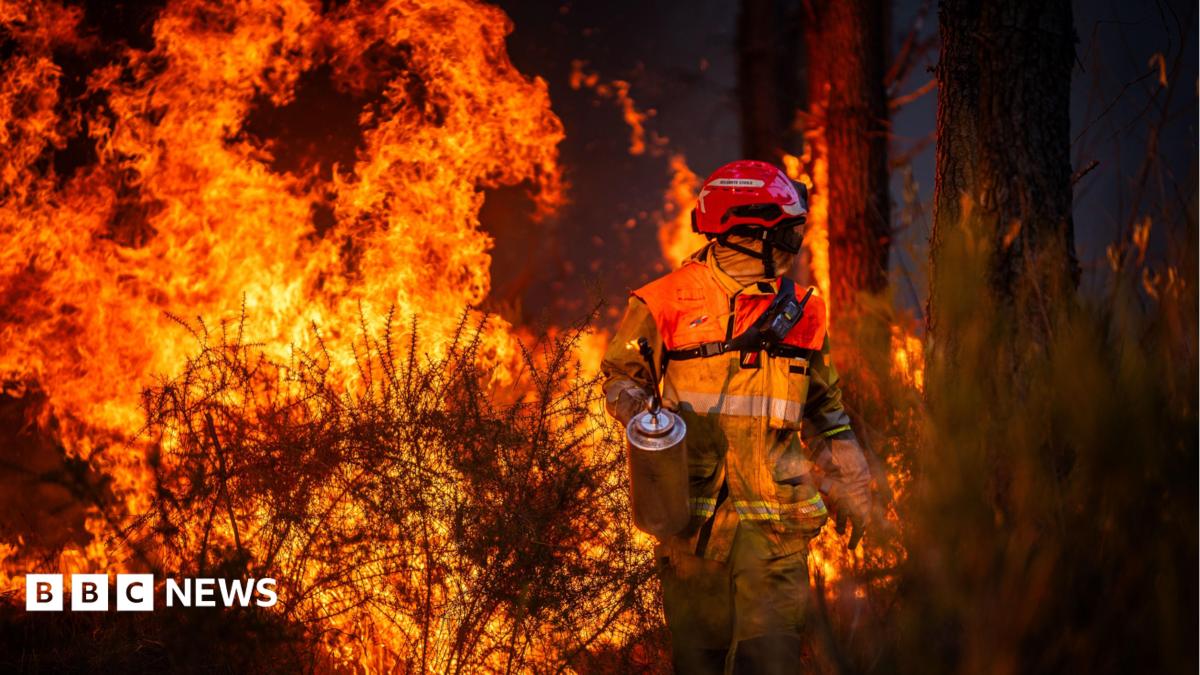
After wildfires caused more damage in France this year than at any time since World War Two, many are left asking a single question: why?
asserted
many → publish → question
A major driver is that climate is changing as a result of the well-documented way humanity is burning fossil fuels.
asserted
humanity → change → fuels
Temperatures are only rising.
asserted
Temperatures → rise → ?
But with records showing that nine out of 10 French wildfires are started by humans, the government in Paris is trying to attribute blame - although it is itself accused of being underprepared for the infernos that have now scorched more than 300,000 acres this summer.
asserted
that → show → acres
The interior ministry has announced 420 arrests of people alleged to have either started the fires deliberately or by accident.
asserted
ministry → announce → accident
In one case, a 23-year-old man has been accused of deliberately starting 10 fires in the space of five days in the south-eastern Var area last month.
asserted
man → accuse → area
He faces 15 years in prison and a €150,000 (£128,000) fine, if convicted.
asserted
He → face → prison
Many others have been tried and immediately sentenced, such as a man who received a three-year jail sentence for starting three recent fires in the Raon-L'Étape forest in the Vosges region.
"Only a few square metres of vegetation went up in smoke," noted L'Est Républicain, the newspaper that reported the story.
asserted
that → try → story
Other prosecutions have been perceived as heavy-handed and unjust.
asserted
prosecutions → perceive → ?
A homeless man and someone with severe autism have reportedly been handed jail terms for throwing cigarette butts.
uncertain
man → hand → butts
"I was amazed at the number of arrests, it feels excessive," admits Muriel Gestas, a lawyer who has represented several people accused of arson, including two firefighters.
asserted
who → feel → firefighters
She doubts many will lead to a conviction.
asserted
many → doubt → conviction
It questions to what extent police have examined these cases, given the short time frame.
asserted
police → question → frame
The authorities' silence on the details - the specific charges, notably whether they involve intent and how the numbers compare with past seasons - rules out any meaningful comparison with previous years, it argues.
asserted
it → involve → years
But Bordeaux prosecutor Renaud Gaudeul told Le Monde that a tough approach was justified by current circumstances.
asserted
approach → tell → circumstances
"The conditions for a charge of endangering lives are met for those who throw a cigarette butt or light a barbecue in wooded areas.
asserted
who → endanger → areas
It only takes a tiny spark for it to start," the newspaper quoted him as saying.
asserted
newspaper → take → him
Working out how a fire started is, unsurprisingly, not easy.
asserted
fire → work → ?
"In periods of drought such as this one, all you need is a simple lighter," explains Eric Dufayet, an officer who investigates fires.
asserted
who → need → fires
Once a fire is out, Eric's first task is to map its outline along the edge of the burnt vegetation, then trace it back to its point of origin.
asserted
task → map → origin
If the wind has been steady, that outline often forms a "V" shape.
asserted
outline → form → shape
From there, his team works backwards along the path the flames took.
asserted
flames → work → path
"If someone deliberately starts a fire, they may not have used only one device," he says.
uncertain
he → start → device
It improves the chances of a DNA or fingerprint sample being found.
asserted
It → improve → sample
Experts believe arson accounts for only a small fraction of fires.
asserted
arson → believe → fires
Most are believed to be accidental, with sparks potentially coming from construction work, faulty electrical equipment, cigarette butts and barbecues.
asserted
sparks → believe → work
"With cigarettes, it's called the '30' rule," says Eric Dufayet.
asserted
Dufayet → call → cigarettes
To start a fire, he explains, there must be "a temperature of at least 30C (86F), a maximum of 30% humidity, wind of less than 30km/h (19mph), and at least 30% of the cigarette unburnt."
asserted
he → start → cigarette
In the current drought, he says it is even easier.
asserted
it → say → drought
If those conditions are met, a fire can easily spread, and fast.
asserted
fire → meet → ?
According to Michel Lejoyeux, a professor of psychiatry and addictive behaviour at Paris 7 University, people who start fires fall into three categories: those who are careless, those who benefit - with an insurance payout, for example - and pyromaniacs.
uncertain
who → accord → example
"The pyromaniac doesn't get money, has no spirit of revenge, has no utility of the fire, but he likes the fire," he says.
asserted
he → get → fire
However, pyromania is a rare psychiatric disorder that Lejoyeux says is very difficult to diagnose, and accounts for few arson convictions.
asserted
Lejoyeux → say → convictions
Lawyer Muriel Gestas, who has handled several such cases, says some firefighters alleged to have started fires may have wanted to be seen as saviours.
uncertain
firefighters → handle → saviours
For others - notably volunteers earning tax-free overtime - the motive may be financial.
uncertain
motive → earn → overtime
Amid concerns over how officials are pursuing suspects, broader worries about wildfires are far from abating.
asserted
worries → pursue → wildfires
Forecasts suggest France's next heatwave is only days away.
asserted
heatwave → suggest → ?
President Emmanuel Macron says criticism should not be the priority right now.
asserted
criticism → say → ?
"We will have to replant and rebuild a different kind of forest because we must adapt to the structural conditions of climate change," he said this week.
asserted
he → have → change
"The time for reviewing lessons learned will come," he insisted.
asserted
he → review → lessons
…and 2 more, not listed.
 The Aporia