The Sydney Morning Herald
· collected 2026-10-08 · by Paul Dyer, Evelyne Musambi
Story summary
On October 3, Kenya confirmed its first case of Ebola, which resulted in the death of a Kenyan citizen who had traveled from the Democratic Republic of Congo (DRC) via Uganda. The patient arrived in Nairobi and was isolated at Nairobi Hospital where they tested positive for the virus after exhibiting symptoms like fever and chills; they died on October 5 while receiving treatment.
Health Minister Aden Duale identified 28 close contacts, including family members and healthcare workers who had interacted with the deceased. Additionally, officials are tracing another 23 passengers from the same flight segment. The contacts will remain in isolation for 21 days, under orders to test negative before release.
With this case, Kenya joins a list of countries grappling with Africa's fastest-spreading Ebola outbreak, which has seen over 8,400 cases and nearly 4,000 deaths since May. The disease is highly contagious, spreading through bodily fluids and contaminated surfaces or materials.
Kenya had previously never recorded an Ebola case before this incident, marking a significant public health concern. This death highlights the urgent need for heightened surveillance and quarantine measures to prevent further spread of the virus.
Written for “Ebola Outbreak In Kenya” on 2026-10-08,
grounded in this article and the 8 other(s) covering the same event.
The world’s attention over the past few days has been focused on Russia, where the death of a lab worker in Siberia has prompted global concerns about pneumonic plague.
asserted
death → focus → plague
But in Africa, deadly Ebola is crossing borders and triggering a contact-tracing scramble amid fears that the highly contagious virus is now spreading via air travel.
asserted
virus → cross → travel
Kenya’s first Ebola case – a patient who travelled for weeks by road and air through three countries without being detected until he arrived in Nairobi – has raised questions about border control and how to trace the virus across countries.
asserted
he → travel → countries
The patient, a Kenyan man, had been living in the Democratic Republic of the Congo (DR Congo) – where the disease has killed more than 4000 people – for seven years.
asserted
disease → live → years
He started feeling ill a month ago.
asserted
He → start → ?
He had travelled by road to Uganda, before boarding a flight – operated by the budget African airline Jambojet – to the Kenyan capital on Saturday.
asserted
He → travel → Saturday
There, he tested positive for Ebola in a hospital; he died on Monday.
asserted
he → test → Monday
The short period between the flight and his death means the journey took place in the final days of infection, the stage at which patients who die of the disease are most contagious, London’s Telegraph reported.
asserted
Telegraph → mean → disease
Ebola is highly contagious and spreads in the human population through contact with bodily fluids such as vomit, blood or semen, and via contaminated surfaces and materials such as bedding and clothing.
asserted
Ebola → spread → bedding
An aeroplane cabin can increase the risks because passengers share cramped spaces for prolonged periods and touch the same surfaces, such as in bathrooms.
asserted
passengers → increase → bathrooms
Africa Centres for Disease Control and Prevention (CDC) director-general Jean Kaseya said all stakeholders needed to ask themselves how one case could have driven and flown to so many places without anyone noticing.
uncertain
anyone → say → places
“We need to ensure that at point of entry, we have a strong surveillance system in place,” he said.
asserted
he → need → place
Officials are trying to trace everyone who came into contact with the patient
The Kenyan man drove for hours by road within the DR Congo and across the border into Uganda.
asserted
man → try → Uganda
He boarded a local flight while in DR Congo, but it is unclear if he used any other forms of public transport.
uncertain
he → board → transport
Authorities have looked at the flight manifest of the other flight he took from Kampala in Uganda to Nairobi, and passengers and crew onboard have been added to the contact list.
asserted
passengers → look → list
They’re also looking to trace workers who cleaned the plane after it landed, as well as passengers who travelled on the same plane subsequently.
asserted
who → look → plane
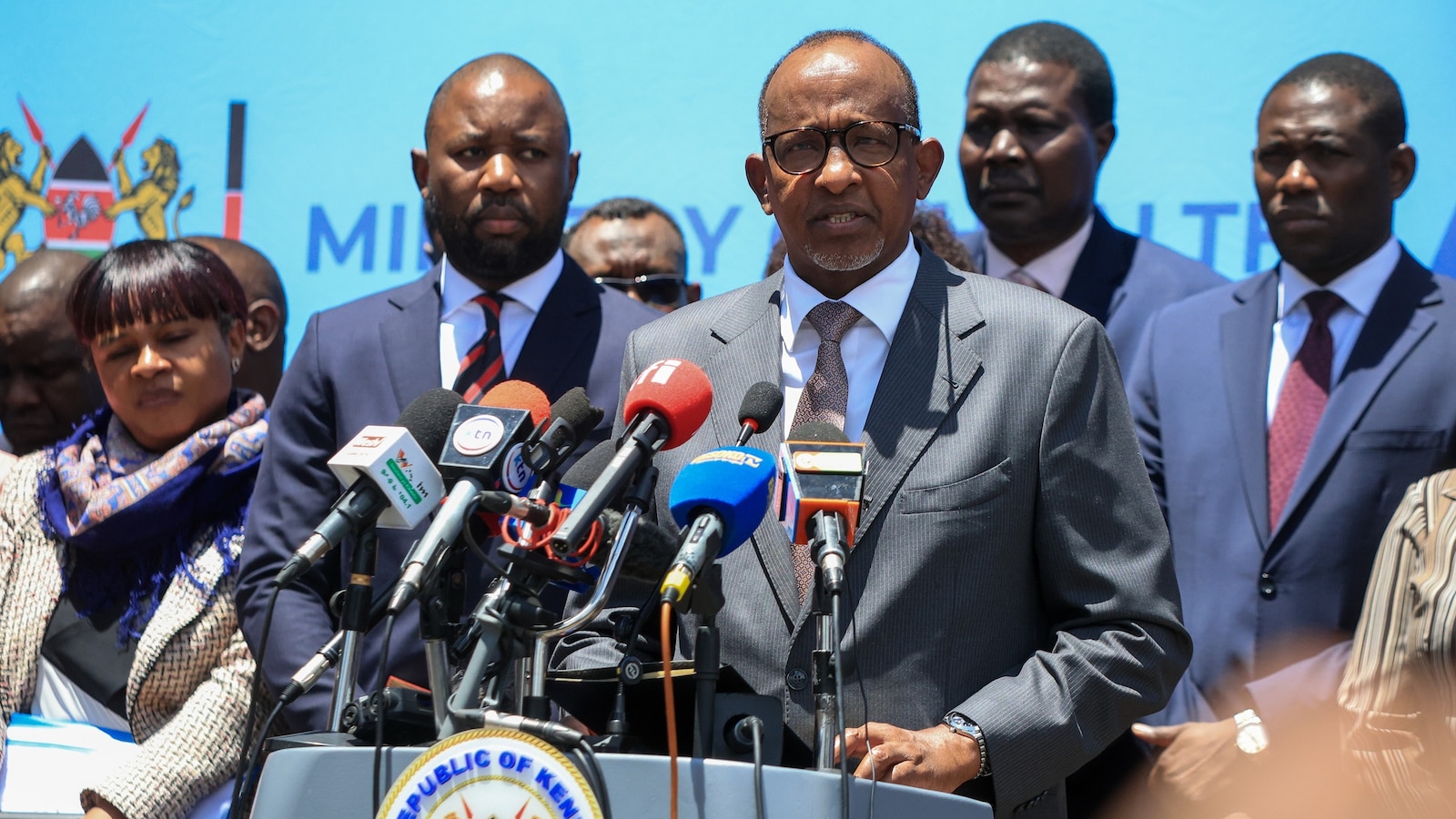
Kenya’s Health Minister Aden Duale said contact tracing was ongoing and that the number of contacts had risen to 57, with 10 already quarantined.
“Even the people who cleaned that aircraft after it landed on Saturday, they are part of the people we are tracing.
asserted
we → say → people
The immigration and the customs officials who served that patient will also be part of the contact tracing,” he said.
asserted
he → serve → tracing
Africa CDC’s Kaseya acknowledged it was a challenge.
asserted
it → acknowledge → ?
He said that the Kenyan man had not come up in existing contact lists in DR Congo.
asserted
man → say → Congo
Questions raised about how the patient travelled through Uganda
It’s also unclear how the patient was able to cross into Uganda, which has closed its border with DR Congo because of the Ebola outbreak.
uncertain
which → raise → outbreak
Alan Kasujja, executive director of the Ugandan government’s media centre, dismissed the question, saying only that journalists should instead ask Kenya how the man could bypass surveillance at its airport.
“Leave Uganda out of this conversation.
uncertain
man → dismiss → conversation
We don’t have Ebola here,” he wrote on X.
Two of the man’s journeys were by air, while the rest were by road, covering long distances and passing through various towns and cities.
asserted
rest → have → towns
On arrival in Nairobi, the patient underwent port health screening, but his symptoms were not detected.
asserted
symptoms → undergo → screening
He then boarded a private vehicle to Nairobi Hospital, where he was isolated and later tested positive for Ebola.
asserted
he → board → Ebola
When asked how the patient was able to travel through three countries undetected, Kenya’s director-general for health, Patrick Amoth, said on Wednesday that a meeting was scheduled with officials from DR Congo, Uganda and the Africa CDC to investigate what transpired during the patient’s journey.
asserted
what → ask → journey
Kenya’s Health Ministry has heightened surveillance at border entry points and created an Ebola hotline for citizens to report symptoms related to Ebola.
asserted
citizens → heighten → Ebola
The ministry said the country has enough supplies, including personal protective equipment, and has mobilised resources since the outbreak started in May in DR Congo.
It has also designated a specific gate at the country’s main airport for passengers travelling from 10 countries located within the outbreak’s epicentre.
uncertain
It → say → epicentre
What’s the latest on the DR Congo outbreak?
asserted
latest → ’ → outbreak
The outbreak in DR Congo is creating new hot spots where there’s little to no support for patients, responders and officials say, as health workers admit there could still be a long way to go in the fight against the virus.
uncertain
workers → create → virus
More than 70 per cent of new cases are still coming from outside of known contacts and at least 60 per cent of deaths are outside of treatment centres, Kaseya said.
asserted
Kaseya → come → centres
“There are so many other people who are becoming sick, who are not tested, treated, or listed.”
asserted
who → be → ?
DR Congo has recorded more than 8500 cases, according to government data, making it the fastest-growing Ebola outbreak on record and the country’s deadliest.
uncertain
it → record → record
And what is actually happening with the ‘plague’ in Russia?
asserted
what → happen → Russia
A top official with the World Health Organisation said on Wednesday it did not know how a lab worker in Siberia died and urged Russia to provide further information about a case that has prompted global concerns about suspected pneumonic plague.
asserted
that → say → plague
Maria Van Kerkhove, WHO director of epidemic and pandemic management, said the UN health agency did not have any information on the “causative agent” that was behind the woman’s death on October 2.
asserted
that → say → October
Unconfirmed reports in Russia blamed the death on pneumonic plague – a less common but severe form of plague that can spread from person to person.
uncertain
that → blame → person
In its tersely worded statements, Russia’s public health watchdog, Rospotrebnadzor, did not link the case to pneumonic plague, saying only that the lab worker had contracted pneumonia of “unknown” origin and that “extensive” testing found no evidence her illness was caused by any of the pathogens she worked with at the Irkutsk Anti-Plague Research Institute of Siberia and the Far East.
asserted
she → word → Siberia
“We don’t understand how she was infected,” Van Kerkhove said.
asserted
Kerkhove → understand → ?
“We need information in a timely way.
asserted
We → need → way
…and 11 more, not listed.
 The Aporia