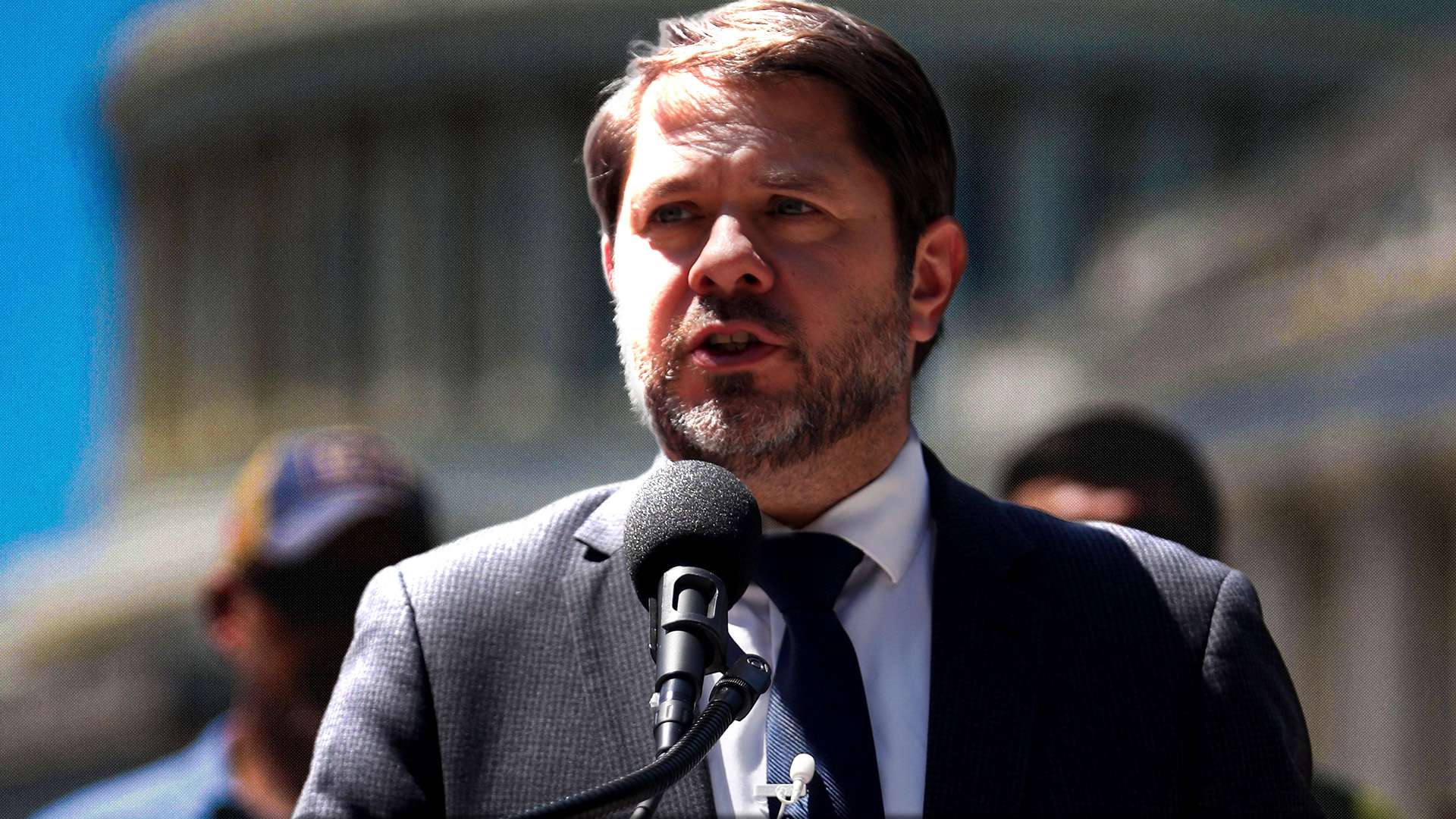
Ruben Gallego's Plan To Save America's Middle Class: Higher Taxes and More Unions

Read the original at Reason ↗
Reason · collected 2026-10-07 · by Tosin Akintola

Quick Summary

Not summarized yet. This article was analyzed before summaries existed, or the model was unreachable at the time. python maintenance.py backfill-article-summaries fills these in.

AI analysis runs on qwen2.5:14b, locally

Story summary

Ruben Gallego, a Democratic senator from Arizona, unveiled an ambitious economic plan aimed at protecting workers amid the rise of artificial intelligence. The plan includes raising the minimum wage to $20 per hour and tying it to inflation, promoting sectoral bargaining agreements for industry-wide labor standards, requiring companies to provide paid leave, and increasing overtime pay from time-and-a-half to double. Gallego also proposed a New Deal-style public service jobs program funded by taxes on AI companies and data centers. The senator's goal is to address the anxieties of American workers who feel their hard work no longer translates into adequate financial support or job security in the face of technological advancements and economic shifts.

Written for “Gallegos Economic Agenda” on 2026-10-07, grounded in this article and the 2 other(s) covering the same event.
Why this leaning score
The model judged this article politically coded and scored it -0.65, but none of the 5 quote(s) it offered could be found in the article text, so the score is not published.
Written under an earlier scoring contract, which gave a paragraph rather than checkable quotes. Re-analysing this article replaces it.
Leaning score withheld for article 64092: no verified evidence · logged 2026-10-07

Signals How these are calculated →

Claims extracted
25
claim-shaped sentences
Uncertain
16%
4 of 25 hedged
Leaning
withheld
no quote in the article backed the model's score
Correction & hedging signals
66.1
corrections and hedging in what we collected; not a measure of accuracy
Outlets on this story
3
Politics
Narrative spread
1
articles carrying this framing
Analyzed 2026-10-07 · how these are computed

Story

📰 Gallegos Economic Agenda
Politics · 3 article(s) covering the same event. See how they differ ↓

How this is being covered How these are calculated →

Article leaning vs. publisher reliability
Source leaning vs. consistency

Compared with similar articles

This article reads unscored and hedges 16% of its claims. Each row says how that neighbour differs.
NBC News
⚖️ Leans strongly left 🔴 11% hedged 5 of 45 📰 publisher trust 95
“Both articles describe Sen. Ruben Gallego unveiling a new economic plan on the same date, with similar details about boosting the minimum wage and implementing a New Deal-style public service jobs program.”
Semafor
⚖️ Leans strongly left 🔴 0% hedged 0 of 29 📰 publisher trust 95
“Both articles describe Senator Ruben Gallego unveiling a detailed policy agenda on October 7, 2026.”

Publisher

Reason · 599 article(s) · 4 correction(s) detected
Running correction rate · 4 correction(s)
2026-10-02
Would a Firing Squad Have Been More 'Humane' for Christa Pike?
2026-09-26
"I Will Not Stand for Being Jerked Around … by Any Lawyer Who Practices Before Me"
2026-09-18
New Article: Landor v. Louisiana Department of Corrections: Bringing Clarity To The Necessary and Proper Clause
2026-09-05
Lawyers' Responsibility for Hallucinations in Briefs That They Sign

Who wrote this

Tosin Akintola
15 article(s) here · 1 carrying a prediction
🔮 And that might be the tamest idea in this sprawling populist platform.
🔮 On Wednesday, the New York Post reported that the Federal Trade Commission (FTC) would be "ramping up a sweeping probe of Anthropic, OpenAI and other frontier labs to uncover the potential dangers their technology poses to consumers, and plans to slap the tech titans with formal demands, similar to subpoenas, to turn over information."
🔮 In Harlow v. Fitzgerald (1982), the Court established that government officials are entitled to qualified immunity when their conduct does not "violate clearly established constitutional rights of which a reasonable person would have known."
🔮 In another new amicus brief, the Constitutional Accountability Center argues that the border search exception runs counter to the Court's ruling in Riley, allowing federal agents to "rummage at will through the records stored on those devices," effectively giving the federal government the power to "indiscriminately search and seize the 'papers' of the people."
🔮 In an incident that began in May and ended in June, thousands of OpenAI agents hacked into a German wiki site and used it as a message board to cheat on assigned tasks.
🔮 However, the Trump administration has cut much of the voluntary funding sent to the U.N., and the president's 2027 budget would eliminate funding for most U.N. bodies, including its regular budget and peacekeeping operations.
🔮 The deal reportedly includes a "new board for CBS News and CNN to ensure editorial independence" as well as a $30 million penalty—90 percent of which would go to the company's employees—for each movie Paramount fails to release as part of its promise to produce 30 films per year, according to CNBC.
2026-09-22 · assertive framing · Paramount Bends the Knee to Rob Bonta
🔮 She notes that "while a cellphone search may not be as physically intrusive as a strip search, it is much closer on the spectrum to a strip search than it is to the search of luggage because of the amount of information it reveals."
🔮 A failed Senate procedural vote on the Digital Asset Market Clarity Act on Tuesday may have saved crypto consumers from a questionable regulatory bill backed by industry insiders.
🔮 If the U.S. wins the AI race against China, it might have South Korea to thank.
Also by Tosin Akintola
Nothing else under this byline is closely related to this article, so these are simply their most recent.
All 15 articles by Tosin Akintola →

Topics

America American Ariz. Vt. the Congressional Budget Office

Subjects

Gallego PERSON · 11× America GPE · 1× American NORP · 1× Ariz. GPE · 1× Bernie Sanders PERSON · 1× CBO ORG · 1× Ruben Gallego PERSON · 1× Vt. GPE · 1× an "Office of Worker Advocacy ORG · 1× the Congressional Budget Office ORG · 1×

Narrative

In 2023, when Sen. Bernie Sanders (I–Vt.) and a group of progressive lawmakers proposed to raise the minimum wage to $17 per hour within five years, the Congressional Budget Office (CBO) found that the plan would increase the budget deficit, lead to "higher prices for goods and services," increase social welfare spending, and lead to 700,000 fewer jobs by 2029.
framing: assertive · carried by 1 article(s) · first seen 2026-10-07
🔮 And that might be the tamest idea in this sprawling populist platform.

Claims (25 extracted, 4 hedged)

In a 32-page plan unveiled Wednesday, Sen. Ruben Gallego (D–Ariz.) claims that the American dream is being blocked by officials who have "let billionaires and giant corporations create our unbalanced economic system." uncertain
billionaires → unveil → system
To "rebuild" America's middle class, Gallego calls for establishing "a New Deal–style public service jobs program" that "funds jobs that allow AI-displaced workers to help families and serve communities. asserted
workers → rebuild → communities
And that might be the tamest idea in this sprawling populist platform. uncertain
that → sprawl → platform
It's unlikely that any of Gallego's plans will actually be signed into law anytime soon. asserted
any → sign → law
But his proposals do provide some insight into what policies progressive candidates could be offering in 2028. uncertain
candidates → provide → 2028
Gallego's plan calls on the government to mandate higher pay rates for overtime and holiday work, expanded unemployment insurance, and sick, vacation, and family leave. asserted
plan → call → overtime
He wants higher taxes on capital gains, plus a new "corporate 'robot' tax" to discourage companies from using automation. asserted
He → want → automation
He would "require employers and workers to bargain over workplace technology," ostensibly placing employees on equal footing with owners in deciding the direction of a private enterprise. asserted
He → require → enterprise
Indeed, to "protect workers," Gallego would consider banning "complete automation," would place "hard caps on technology deployment," and would institute requirements for "human operators." asserted
Gallego → protect → operators
While that might protect jobs in the short run, it could cripple the companies that employ many of those workers—autonomous ride-sharing and delivery companies, of course, and also the autonomous manufacturing companies critical to the aerospace, healthcare, software, and defense industries. uncertain
that → protect → industries
Gallego would ban mergers involving companies worth more than $100 billion, use the tax code to discourage large mergers, and "expand antitrust statutes to scrutinize serial small merger rollups." asserted
Gallego → ban → rollups
This would probably have the opposite of the intended effect: Rather than operate in the red, employers would cut jobs to pay taxes and shutter businesses altogether. asserted
employers → have → businesses
Gallego also calls for a $20 federal minimum wage. asserted
Gallego → call → wage
In 2023, when Sen. Bernie Sanders (I–Vt.) and a group of progressive lawmakers proposed to raise the minimum wage to $17 per hour within five years, the Congressional Budget Office (CBO) found that the plan would increase the budget deficit, lead to "higher prices for goods and services," increase social welfare spending, and lead to 700,000 fewer jobs by 2029. asserted
plan → propose → 2029
With Gallego pushing for a higher federal minimum wage in less time (three years, rather than five), the impacts are sure to be worse. asserted
impacts → push → five
He plans to "triple union density by 2035" by "automatically certifying a union if over 50 percent of workers have signed authorization cards, banning companies from holding captive audience meetings, granting all workers collective bargaining rights, and expanding career pathways into union work." asserted
percent → plan → work
Under federal labor law, employees can already vote to form unions if 30 percent of employees agree. asserted
percent → vote → employees
Workers can also bypass the election process entirely and ask for voluntary recognition if over 50 percent sign authorization cards. asserted
percent → bypass → cards
Gallego's plan would create new bureaucracies for those union workers to exploit, such as a "Worker Empowerment Corps" and an "Office of Worker Advocacy," and would institute "whole-of-government labor enforcement collaborations" that would bring the force of several federal agencies against employers that violate his labor laws. asserted
that → create → laws
Ironically given his misgivings about data centers and AI, Gallego proposes integrating AI into systems that monitor workers' rights enforcement. asserted
that → give → enforcement
In addition to raising taxes on capital gains, foreign profits, and stock buybacks, Gallego would explore a new 10 percent excise tax on data centers and a tax on the revenues of large AI companies to pay for his ideas. asserted
Gallego → raise → ideas
Of course, many data centers don't generate revenue in the traditional sense right now; as of November 2025, the leading AI companies had invested 16 times more than they earned in revenue. asserted
they → generate → revenue
The senator's plan is called "Saving the Middle Class and Restoring the American Dream." asserted
plan → call → Dream
But most Americans define the American dream as having "freedom of choice in how to live." asserted
Americans → define → choice
Gallego would instead give the government more control over people's lives. asserted
Gallego → give → lives

💬Give feedback
🕘History 🎫Support