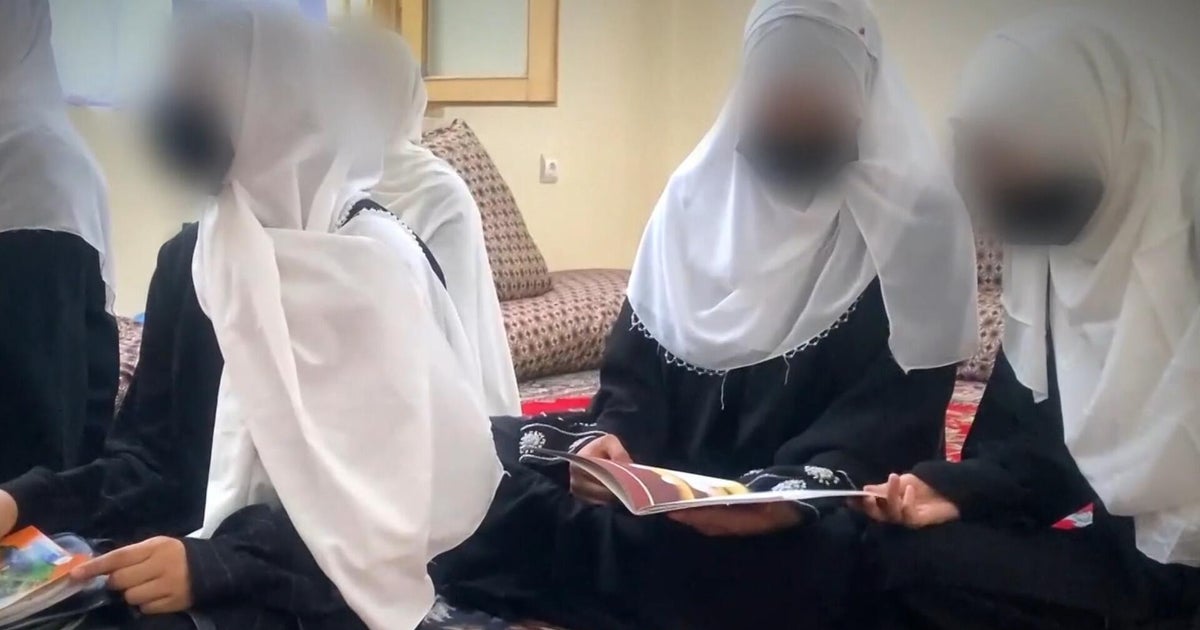
On a recent summer Friday, nearly a dozen students logged on for their online literature class.
asserted
students → log → class
It was a group of mostly young women joining from different parts of Afghanistan, eagerly waiting for their turn to discuss a story they had read the week before.
asserted
they → join → story
Before the Taliban’s return to power five years ago, the women were studying in high school or university, hoping education would give them a better future.
asserted
education → study → future
Some had just obtained their undergraduate degrees.
asserted
Some → obtain → degrees
But their plans were put on hold when, like millions of other Afghan girls, they were barred from going to school.
asserted
they → put → school
Once a week, the group gathers in a Google Meet room for a 90-minute class hosted by Toronto-based poet and educator Hazrat Wahriz.
asserted
group → gather → Wahriz
In this lesson attended by a reporter, they discussed a short story about a teenage boy’s journey fleeing the Taliban.
asserted
they → attend → Taliban
The story’s author, Shams Erfan, joined the virtual class from Toronto and listened attentively throughout the session.
asserted
author → join → session
Then he had a few words for the women.
asserted
he → have → women
“I hope you continue ... writing, critiquing, reading, protesting, attending online classes,” he said in Persian.
asserted
he → hope → Persian
“These activities are a fight,” he continued, “a fight against the Taliban ideology that is trying to remove you all.
asserted
that → continue → you
Since 2021, the Taliban regime has been excluding women from every aspect of public life by imposing what international human rights groups call a system of “gender apartheid.”
asserted
groups → exclude → apartheid
It has issued sweeping edicts to restrict women’s right to work, education and freedom of movement.
asserted
It → issue → movement
In a report published last month, the United Nations Educational, Scientific and Cultural Organization estimated that 2.4 million Afghan girls have been barred from secondary education, a number that could increase to four million by 2030.
uncertain
that → publish → 2030
The Taliban also banned education for girls and women during its first rule in the late 1990s, before the regime was toppled in 2001 by a U.S-led international coalition in response to the 9/11 attacks.
asserted
regime → ban → attacks
Canadian troops spent 13 years in the country as part of a NATO stabilization mission.
asserted
troops → spend → mission
More than 40,000 Canadian Armed Forces personnel were deployed to Afghanistan from 2001 to 2014.
asserted
personnel → deploy → 2014
Girls and women returned to classrooms in 2001, and Canadian military and aid organizations invested heavily in women’s education and empowerment projects over the years.
asserted
organizations → return → years
But the Taliban waged a bloody insurgency that paved their way back to power in 2021.
asserted
that → wag → 2021
Soon after seizing Kabul, the regime renewed its ban on women’s education.
asserted
regime → seize → education
As the ban continues, virtual and underground schools operating from overseas – including the one founded by Wahriz in Toronto – have become a lifeline for many.
asserted
schools → continue → many
“Our first school was established in one of the faraway provinces of Afghanistan and since then, we gradually expanded our activities,” he said
More than 1,600 girls are now being taught in his underground classrooms by female teachers turning their own homes into learning centres, he said.
asserted
he → establish → centres
Under current rules, girls are only allowed to go to school up to Grade 6, meaning those attending secondary and higher education are violating the Taliban’s strict religious code.
asserted
those → allow → code
If caught, they could face severe punishment including physical violence and imprisonment.
uncertain
they → catch → violence
Despite those risks, Wahriz said, girls are showing up in classrooms every day to learn math, physics, chemistry and history in a fight against the “darkness.”
asserted
girls → say → darkness
“We are challenging that darkness just by our existence,” he said.
asserted
he → challenge → existence
Wahriz said funding for the network mostly comes from “kind-hearted” people he knows, including his Canadian friends and an organization based in the United Kingdom.
asserted
he → say → Kingdom
The teachers are paid US$100 a month when funding is available, he said.
asserted
he → pay → 100
“They are dedicated, committed enough not to expect every month to get paid, but are sure that whenever we find something, they get paid,” Wahriz said.
asserted
Wahriz → commit → something
He said even though his efforts are like a “small drop in the desert” given the magnitude of the crisis, he is optimistic because others are also doing the same.
asserted
others → say → same
“Drop by drop, it becomes a sea,” he said, referring to a Persian proverb.
asserted
he → become → proverb
A number of similar organizations in other countries are also working to bypass the Taliban ban on girls’ education.
asserted
number → work → education
Taliban negotiators repeatedly said they would no longer oppose women’s right to education and employment, but “within the framework of Islamic law,” a vague promise they immediately broke after seizing power.
asserted
they → say → power
They have since issued more than 100 edicts targeting women, according to the United Nations.
uncertain
They → issue → Nations
The group’s top leader Haibatullah Akhundzada and his chief justice Abdul Hakim Haqqani are now wanted by the International Criminal Court for crimes against humanity in their treatment of women and girls.
asserted
leader → want → women
The Canadian government said it has been backing efforts to expand education opportunities for all Afghans, including girls and women, for over two decades, and has provided more than $143-million to fund education and health-care programs in the past five years while avoiding any investments through the Taliban.
“Canada strongly condemns the ongoing repression, systematic human rights abuses and erosion of fundamental freedoms under Taliban rule in Afghanistan, and is deeply concerned by the worsening humanitarian situation,” Global Affairs Canada spokesperson Brittany Fletcher said in a statement.
asserted
Fletcher → say → statement
She was in her last semester of law school when the Taliban took power in 1996 and closed the doors of Kabul University to female students.
asserted
Taliban → take → students
But she didn’t give up on her dreams, she said.
asserted
she → give → dreams
Ziayee self-studied, learned English and computer skills, and even found a job at an underground non-profit that helped educate women at the time.
asserted
that → study → time
She was able to complete her studies and obtain her degree after the Taliban were overthrown in 2001.
asserted
Taliban → complete → 2001
…and 12 more, not listed.
 The Aporia