The Guardian
· collected 2026-10-07 · by Martin Patriquin in Montreal
In Quebec's recent election, the Parti Québécois (PQ) won but fell short of a majority with five seats less than needed, despite doubling its vote share and winning 56 additional seats compared to the previous election. While PQ leader Paul St-Pierre Plamondon promised to hold a referendum after Trump leaves office in 2028, he faces significant opposition as only 28% of voters supported his party, marking the lowest percentage for any Canadian government. The majority of Quebecers voted for parties against separatism and now view Canadian unity more favorably due to ongoing tensions with Trump.
Written locally by qwen2.5:14b on 2026-10-07,
using this article's own text rather than the other coverage of the
same event (that is the story summary below).
Why this leaning score
The model judged this article politically coded and scored it -0.50, but every quote it verified points right, so the score is not published.
Written under an earlier scoring contract, which gave a paragraph
rather than checkable quotes. Re-analysing this article replaces it.
Leaning score withheld for article 62612: score contradicts its own evidence · logged 2026-10-07
The victory of the Parti Québécois in Monday’s election in Quebec might seem to bring its signature goal, of separating the French-speaking province from Canada, much closer – but Canadian unity may not be nearly as threatened as may first seem.
The PQ’s victory was both impressive and disappointing.
uncertain
victory → seem → Canada
The party added 56 seats to its roster and more than doubled its vote share compared to the 2022 election, giving it its first taste of power in 14 years.
asserted
party → add → years
Crucially, however, it was left five seats short of a majority, making its promise to hold a referendum after Donald Trump leaves office in 2028 nearly impossible.
asserted
Trump → leave → 2028
It also won with barely 28% of the popular vote, the lowest percentage for any government in Canada’s electoral history, according to the polling analyst Philippe Fournier.
uncertain
It → win → analyst
The vast majority of Quebecers voted for parties that want nothing to do with a referendum.
asserted
that → vote → referendum
It’s a reflection of the province’s 30-year aversion to another bruising debate about Quebec’s place in Canada – particularly in the wake of Trump’s tariffs and threats against the country.
asserted
It → ’ → country
The new government will also face stiff opposition to its plans to reduce immigration levels, which has angered farmers and the business community.
asserted
which → face → farmers
Meanwhile, the most popular politician in the province remains far and away the Canadian prime minister, Mark Carney, in large part because of his resistance to Trump.
asserted
politician → remain → Trump
That has left PQ leader Paul St-Pierre Plamondon in an awkward situation for a separatist: he can’t be seen as a threat to Canadian unity.
asserted
he → leave → unity
He essentially acknowledged this in his victory speech, pledging to be a “good-faith collaborator” with the rest of the country, and even addressing the crowd in English; then attempted to court the other side of the debate by announcing Tuesday he would prevent the lieutenant governor, who represents the British crown, from swearing in his new government.
asserted
who → acknowledge → government
“Seventy percent of Quebecers don’t want a referendum,” said John Parisella, who served as chief of staff to two Quebec premiers and the province’s delegate general in New York and Washington.
asserted
who → want → York
“And every time they see Trump’s picture on the screen at night, it does nothing to improve a desire for separation.
asserted
it → see → separation
The vote, in fact, may have less to do with embracing separatism and more about punishing the current government.
uncertain
vote → have → government
The election saw the total collapse of the governing Coalition Avenir Québec (CAQ), which has been in power since 2018.
asserted
which → see → 2018
An alliance of federalists and separatists (the party describes itself as nationalist), it didn’t win a single seat, and harvested just a third of its vote share compared to 2022.
asserted
it → describe → 2022
Its leader, Christine Fréchette, lost her own riding to the Parti Québécois, and on Tuesday afternoon she resigned.
asserted
she → lose → afternoon
In a province whose political discourse has focused on the federalist-separatist divide, the election also suggested a return to normalcy of sorts – with separatists returning to the PQ’s fold, while the federalist vote dispersed to the opposition Liberal party and the upstart Parti conservateur du Québec (PCQ).
The PCQ feasted on the CAQ’s support in the election, winning 19 ridings in the hinterland and in the Quebec City area, where leader Éric Duhaime won his seat for the first time.
uncertain
Duhaime → focus → time
Founded in 2009, the populist party counts a prominent anti-vaxxer and a rage-bating anti-woke radio host as two of its winning candidates.
asserted
party → found → candidates
The party was able to break through in part because of its promise to build an underground highway linking Quebec City to its suburbs across the St Lawrence, despite government reports saying the endeavor would cost as much as C$9.3bn and do little to alleviate traffic.
asserted
endeavor → break → traffic
Montreal, meanwhile, went decidedly Liberal red, with leader Charles Milliard regaining seats on the island and in the traditionally English redoubt of the Eastern Townships.
asserted
Milliard → go → Townships
The staunchly federalist Liberals, who are unaffiliated with Carney’s federal Liberals, will serve as Quebec’s official opposition.
asserted
who → serve → opposition
Governing with but a handful of seats in the province’s biggest metropolis will be challenging enough for the PQ; as history has shown, winning a referendum without it is somewhere near impossible.
asserted
winning → govern → it
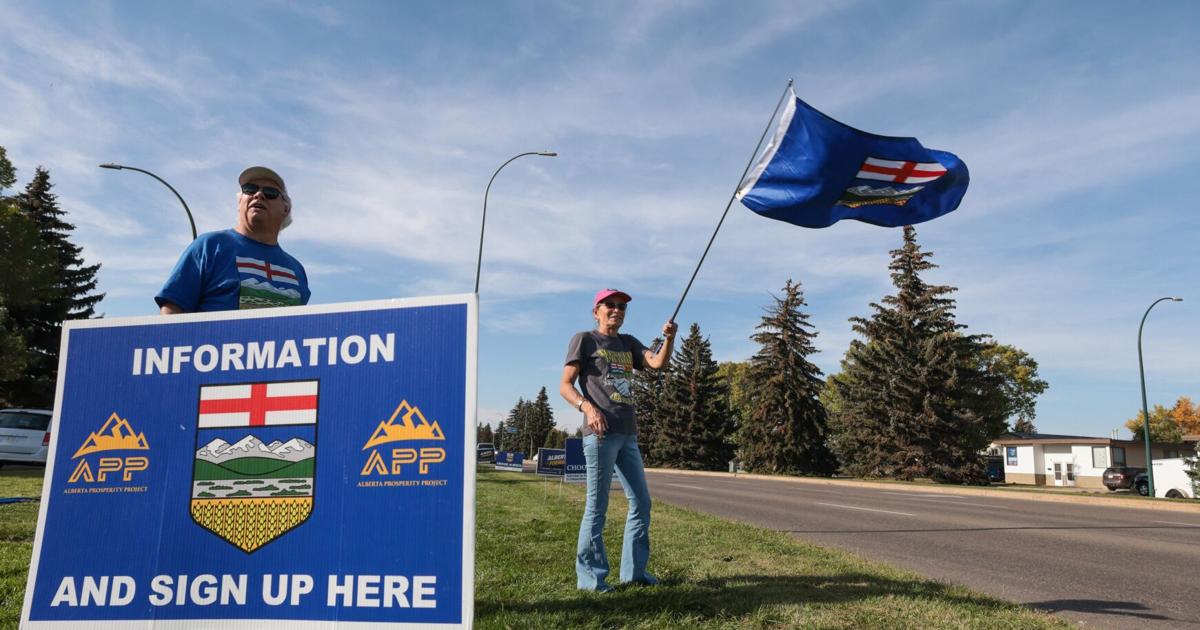
Canada faces another potential menace to its sovereignty in a little less than two weeks, when Alberta in the west holds a “referendum on a referendum” on secession.
asserted
Alberta → face → secession
Happily for Carney, and unfortunately for Trump, polls suggest Albertans are as averse to dalliances with separation as their Quebecois brethren have now become to the east – no matter the party they just chose to govern.
asserted
they → suggest → east
 The Aporia