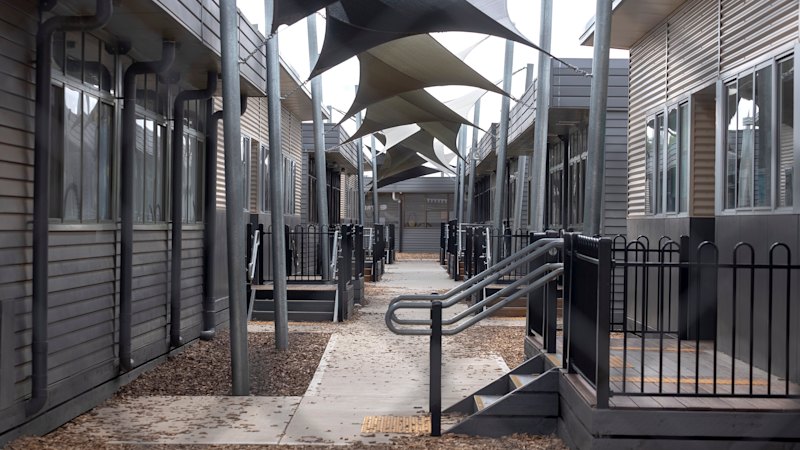
In Victoria, nearly half of public school buildings are demountable as the state struggles to meet rising enrolments in growing areas like Melbourne's suburbs. According to figures from the Victorian Auditor-General’s Office analyzed by this publication, there were 6773 relocatable buildings in government schools last December, making up 43% of total school buildings and doubling the number reported a decade ago due to a surge of 75,752 students. Experts note that while these temporary classrooms offer some comfort, they take valuable space on school grounds and limit efficient teaching layouts.
Written locally by qwen2.5:14b on 2026-10-07,
using this article's own text rather than the other coverage of the
same event (that is the story summary below).
Story summary
Melbourne's public schools, particularly those in growth corridors like Casey, are facing a surge in enrolments leading to an increase in portable classrooms. According to figures from the Victorian Auditor-General’s Office, there were 6773 relocatable buildings across government schools as of December last year, making up 43% of the state's total 15,727 school buildings. This number has doubled over the past decade due to a jump in enrolments by 75,752 students.
Ramlegh Park Primary School, which opened only five years ago and is located in Casey, exemplifies this trend with many portable buildings on its campus. The school recently completed construction for elective subjects and plans to open a new three-storey building next year featuring 24 general classrooms, science rooms, and recreational facilities. Once the project concludes, five modular buildings will be removed, enhancing play space for students.
Local government officials like Casey Mayor Michelle Crowther are addressing parent concerns over student numbers and portable usage. The council provides population data to the state government but does not directly manage school planning. Educators note that while modern portables offer better comfort than older models, they still occupy valuable open spaces on school grounds and limit efficient teaching layouts.
Written for “School Portable Buildings Impact” on 2026-10-07,
grounded in this article and the 0 other(s) covering the same event.
Almost half of the state’s public school buildings are demountable as enrolments surge in Melbourne’s growth corridors and many new schools need temporary classrooms to keep up with demand.
Figures from the Victorian Auditor-General’s Office, analysed by this masthead, show that last December there were 6773 relocatable buildings in government schools – comprising 43 per cent of the state’s 15,727 school buildings.
asserted
Figures → surge → buildings
That number is double what the auditor-general reported a decade ago, partly due to enrolments in government schools jumping by 75,752 in the past 10 years.
asserted
enrolments → report → years
Experts say that while the current buildings are more comfortable than portables of the past, they take up valuable open space on school sites and limit efficient layouts for teaching.
asserted
they → say → teaching
The numbers do not distinguish between relocatable buildings being used as classrooms from auxiliary buildings such as storerooms and sheds.
asserted
numbers → distinguish → storerooms
Relocatable buildings today, which are usually smaller than permanent buildings, equate to about 12 per cent of the total floor space in schools.
asserted
which → equate → schools
The City of Casey has 681 relocatable buildings, the most statewide, with schools that opened just five years ago, such as Ramlegh Park Primary School in Clyde North, having just four permanent buildings while 23 are relocatable.
asserted
23 → have → buildings
“Casey parents often speak to me about their concerns about the number of students in local schools and the use of portables,” said Casey Mayor Michelle Crowther, adding the council offers the state government population information but does not plan schools.
asserted
council → speak → schools
“We want to see our growing communities supported by well-planned schools.
asserted
communities → want → schools
Relocatable buildings are often a feature of a rising population, said Ben Cleveland, co-director of the Learning Environments Applied Research Network at the University of Melbourne, citing an influx of temporary buildings in Blackburn and Nunawading when these suburbs were teeming with young families several decades ago.
asserted
suburbs → rise → families
“A lot of them have gone from those suburbs now.
asserted
lot → go → suburbs
They’ve moved out to your Caseys, Cranbournes and Pakenhams,” Cleveland said.
asserted
Cleveland → move → Caseys
“The government has tried very hard to develop new schools; they’ve celebrated 100 new schools in the last five years.
asserted
they → try → years
On an international scale that’s an awful lot.
asserted
that → ’ → scale
They are going to have to continue building at that rate to make sure they don’t have schools full of relocatables for years to come.”
asserted
schools → go → years
Cleveland said an issue with the use of portables as classrooms, which usually accommodate fewer students than permanent buildings, was that formal teaching spaces were restricted, and their layouts made it harder to create complementary spaces such as classrooms next to informal common areas.
asserted
it → say → areas
Victorian Association of State Secondary Principals president Belinda Hudak said it wasn’t just expanding schools but also older ones where relocatable buildings were a welcome addition to replace ageing infrastructure.
asserted
buildings → say → infrastructure
Still, she said older buildings and longstanding temporary ones needed to be renewed at a greater rate.
asserted
buildings → say → rate
“The overarching issue is the long-term planning for school buildings and looking at not just growth corridors but areas where numbers have been stable for quite a while yet there are continuous relocatable buildings.
asserted
numbers → look → while
And some of those relocatable buildings are past their end of life,” Hudak said.
asserted
Hudak → say → life
She said many schools had to push for their own master plans and then use them to apply for grants, which school leaders found complex and frustrating.
asserted
leaders → say → grants
“What comes out of a master plan can depend on a school’s ability to manage that themselves,” she said.
asserted
she → come → that
The school with the most relocatable buildings statewide is Alamanda K-9 College, which has 59, and enrolled 3335 students last year – double the figure of a decade earlier.
asserted
which → have → students
The Point Cook school has separate timetables for students to use outdoor space during lunch and recess, due to space limitations.
asserted
students → have → limitations
“The school offers multiple timetables in order to ensure our students are able to play outside in relatively small groups and have access to the equipment and playground areas,” principal Lyn Jobson said.
asserted
Jobson → offer → equipment
A new building recently opened for elective subjects and a new three-storey building is to open next year with 24 general classrooms, new science classrooms and a rooftop futsal court and play area.
“Once the construction work is completed … five modular buildings, including general purpose classrooms, canteen and toilet facilities, will have been removed as part of the project, making way for more play space for students,” Jobson said.
asserted
Jobson → open → students
Select-entry boys’ school Melbourne High will have 18 relocatable buildings on its hockey field from term one next year while maintenance and safety works are undertaken in the main Gothic-style building, which has been the subject of school and department defect reports ranging from water damage to major structural issues.
asserted
which → have → issues
A Department of Education spokesperson said the government had spent $20.1 billion on new and existing school buildings since 2015.
asserted
government → say → 2015
“When recommending funding for school upgrades, the department uses all available information, including condition assessments, enrolment projections and pre-existing project plans.
asserted
department → recommend → assessments
 The Aporia