That is 0 articles you have read today.
The Aporia is free and carries no advertising, so readers are the only
thing paying for it. If you are getting this much out of it, a small
donation is what keeps it independent.
Daily limit reached
You have read 0 articles today.
That is more than the 15 a day The Aporia gives away,
and well past what it can carry on nothing. Your allowance resets at
midnight.
There is no advertising here and nothing about you is sold, so readers
are the only thing paying for it. If the site is worth this much of
your day, it is worth a few dollars.
Everything else stays open: the
maps, the
directory and
search do
not count against this, and neither does re-opening something you have
already read today.
Éric Duhaime, leader of the Conservative Party of Quebec (CPQ), led his party to a historic victory on Monday’s election night, securing 19 seats in the National Assembly. This marked the first time since over 90 years that the CPQ has gained representation beyond its sole member MNA Maïté Blanchette Vézina. Duhaime, who previously worked as a political advisor to various parties including the Bloc Québécois and Action démocratique du Québec, aims to cut bureaucracy and support families while opposing separatist movements like the Parti Québécois’s potential referendum plans.
Written locally by qwen2.5:14b on 2026-10-06,
using this article's own text rather than the other coverage of the
same event (that is the story summary below).
Story summary
On Monday, Éric Duhaime, leader of the Conservative Party of Quebec (CPQ), secured 19 seats for his party in the Quebec general election, marking a historic moment as the CPQ gained representation in the provincial legislature after more than 90 years. Before the election, the CPQ had only one member, Maïté Blanchette Vézina, who joined from the Coalition Avenir Québec earlier this year. Duhaime pledged to collaborate with the minority Parti Québécois government under Paul St-Pierre Plamondon to reduce bureaucracy and support families financially, while also promising not to back any referendum that would weaken Quebec's position. His political journey began when he decided at a young age to engage in politics to represent ordinary people who often feel overlooked by the establishment.
Written for “Quebec Political Leadership” on 2026-10-06,
grounded in this article and the 0 other(s) covering the same event.
Why this leaning score
This article does not take a side on a contested political
question, so it has no leaning score. That is an
answer rather than a gap: a match report or a rescue can be warmly
or critically written without being left or right, and scoring it
anyway is how approval of a subject gets recorded as a political
position.
No political leaning scored for article 60673 · logged 2026-10-06
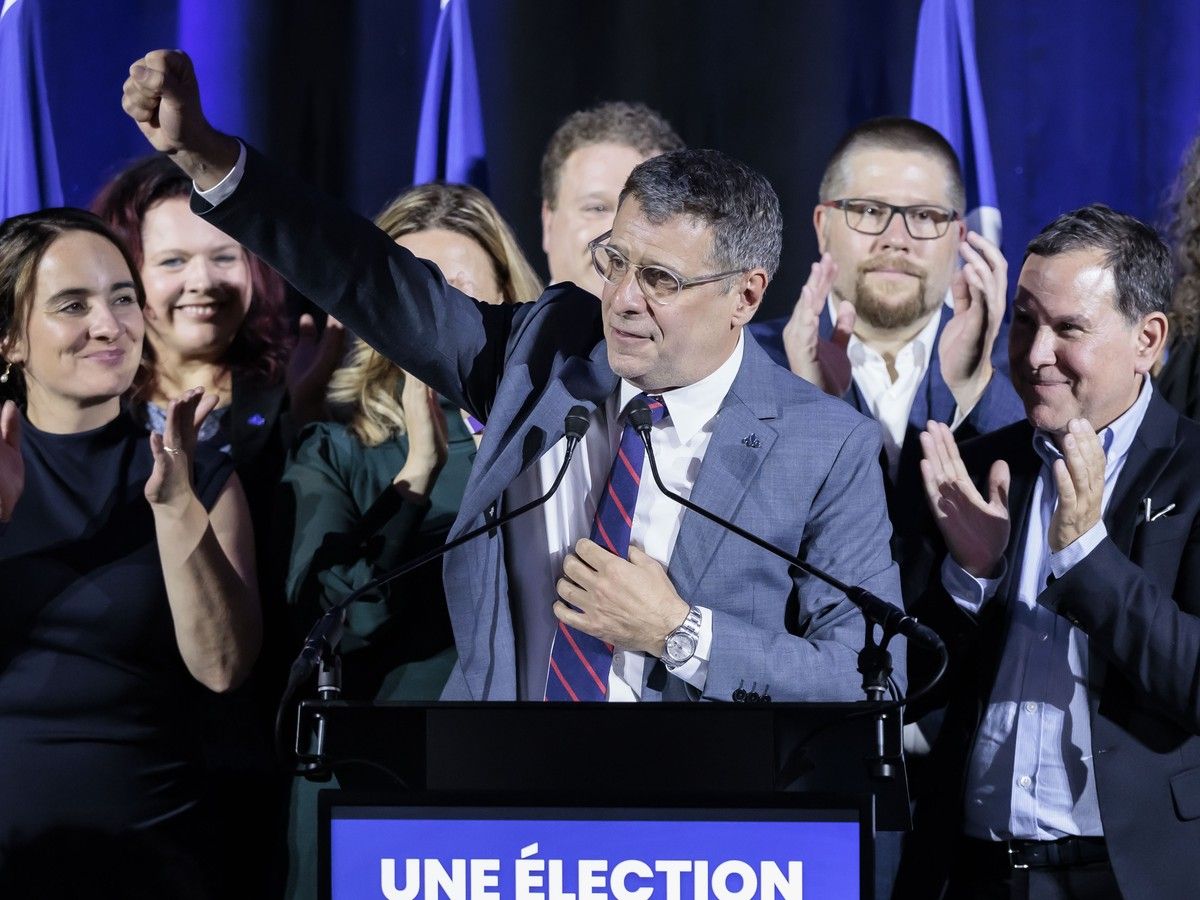
Heading into Monday’s Quebec general election, leader Éric Duhaime hoped to see a dozen Conservative Party of Quebec (CPQ) candidates, including himself, elected to the National Assembly — the minimum for official party status.
asserted
candidates → head → status
By night’s end, however, he and the party had “written a page” in the province’s history, winning 19 seats, the third most in a crowded field.
asserted
he → write → field
Duhaime committed to working with Paul St-Pierre Plamondon’s minority Parti Québécois government “to cut bureaucracy, put money back in families’ pockets and reform the old Quebec model” but said the CPQ would not “support a referendum that will weaken Quebec.”
asserted
that → commit → Quebec
Before Monday’s result, the CPQ was represented by lone MNA Maïté Blanchette Vézina (La Peltrie), who joined after leaving the Coalition Avenir Québec in the spring following extensive discussions with Duhaime.
asserted
who → represent → Duhaime
Here’s what to know about the leader who led the party to claim its first seats in the provincial legislature in more than 90 years.
uncertain
who → ’ → years
“He has said that from a young age he wanted to get involved in politics to give a voice to ordinary people, whom he believes are too often overlooked by the political elite,” it reads.
asserted
it → say → elite
He attended the Université de Montréal, earning a bachelor’s in political science, and later obtained a master’s degree in public administration from the École nationale d’administration publique (ENAP).
asserted
He → attend → ENAP
Duhaime is also gay, having come out in a 2017 book, La fin de l’homosexualité et le dernier gay (The end of homosexuality and the last gay man), his first of five books to date.
asserted
Duhaime → come → date
What did Duhaime do before politics?
asserted
Duhaime → do → politics
In the 1990s, Duhaime worked as a political advisor to Bloc Québécois leaders Lucien Bouchard and Michel Gauthier.
asserted
Duhaime → work → Bouchard
He later joined Reform Party Leader Preston Manning’s “United Alternative” movement, before throwing his support behind Stockwell Day’s successful leadership bid for the Canadian Alliance party.
asserted
He → join → party
He then served as an advisor to the leader from 2000 to 2002.
asserted
He → serve → 2002
In 2009, he joined the National Democratic Institute as a consultant — a U.S.-based non-governmental organization that promotes democratic institutions — and worked in Morocco, Mauritania and Iraq.
asserted
that → join → Morocco
 The Aporia