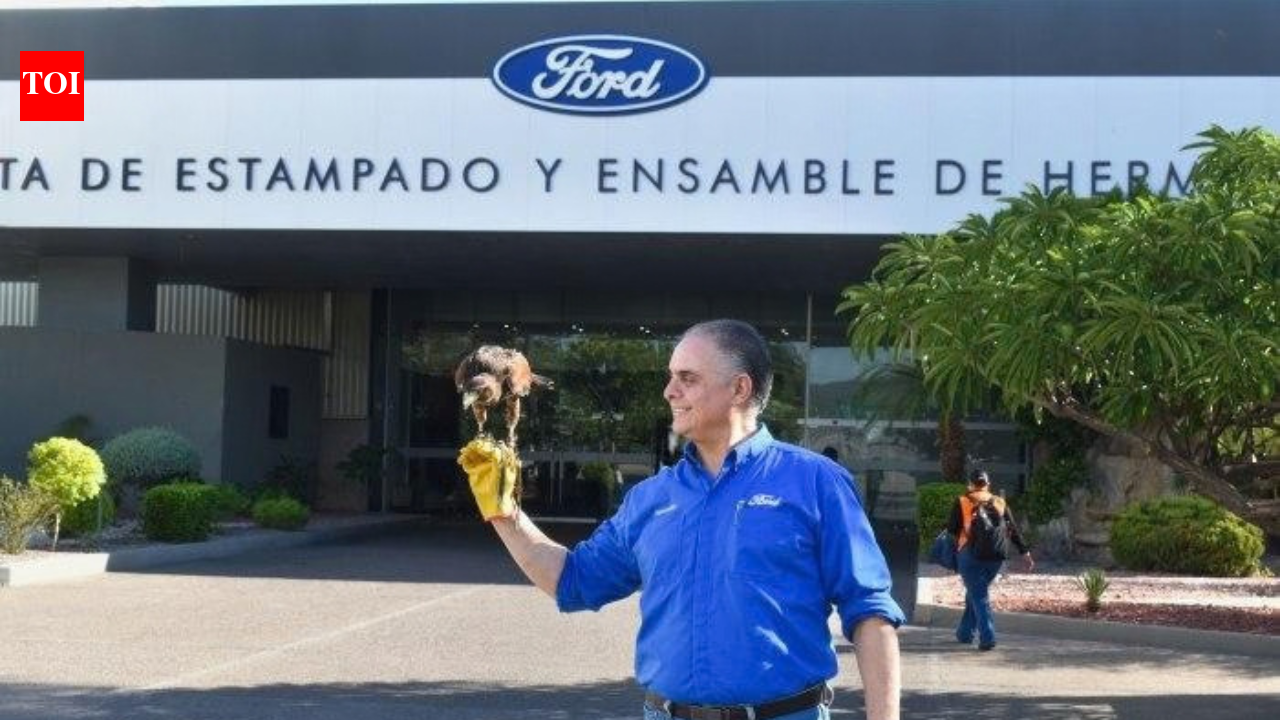
Ford’s Hermosillo assembly plant in Sonora, Mexico, employed a Harris’s hawk named El Charro starting in July 2025 to address a persistent pigeon problem affecting vehicle production. With over 4,000 employees and an annual output of more than 300,000 vehicles, the factory had previously used conventional deterrents like predator sounds and fake eyes but saw no significant reduction in bird activity. El Charro’s patrols led to an approximately 80% decrease in pigeon presence within monitored areas of the facility.
Written locally by qwen2.5:14b on 2026-10-06,
using this article's own text rather than the other coverage of the
same event (that is the story summary below).
Ford’s Hermosillo assembly plant in Sonora, Mexico, found itself dealing with an unusual workplace problem involving persistent pigeons entering the sprawling factory and leaving droppings around equipment and freshly painted vehicles.
asserted
pigeons → find → equipment
The facility employs more than 4,000 workers and produces more than 300,000 vehicles a year, making the bird problem difficult to ignore.
asserted
problem → employ → vehicles
Ford tried conventional deterrents, including predator sounds and fake predator eyes, but the pigeons gradually became accustomed to them.
asserted
pigeons → try → them
The company eventually turned to a more natural solution by bringing in a trained Harris’s hawk named El Charro.
asserted
company → turn → hawk
Since July 2025, the hawk has patrolled the facility for several hours a day, with Ford reporting an approximately 80% decline in bird activity in monitored areas.
asserted
Ford → patrol → areas
Birds repeatedly found their way into the facility, while their droppings created hygiene concerns and could end up on vehicles and around machinery.
uncertain
droppings → find → machinery
With thousands of employees working across the massive manufacturing complex, keeping the birds away became an ongoing challenge.
asserted
keeping → work → birds
Ford initially tried methods designed to make the factory appear unsafe for pigeons.
asserted
factory → try → pigeons
These included sounds associated with predatory birds and visual deterrents resembling the eyes of predators.
asserted
These → include → predators
But the pigeons eventually learned that the threats were not real.
asserted
threats → learn → ?
Their persistence reportedly reached the point where they could wait for factory doors to open before entering.
uncertain
doors → reach → point
Ford turns to a real predator
asserted
Ford → turn → predator
After artificial deterrents failed to solve the problem, Ford turned to falconry.
asserted
Ford → fail → falconry
In July 2025, the company brought in El Charro, a trained Harris’s hawk, to patrol the facility.
asserted
company → bring → facility
The species, Parabuteo unicinctus, is native to the Americas and is widely used in professional bird-control operations.
asserted
species → use → operations
His presence signals to pigeons that a genuine predator is nearby, encouraging them to leave the area or avoid settling there in the first place.
asserted
predator → signal → place
El Charro patrols the plant
El Charro typically spends around two to three hours a day patrolling the Ford facility.
asserted
Charro → patrol → facility
Before his patrol, he is fed, allowing the operation to focus on controlling bird activity rather than relying on him to hunt pigeons for food.
asserted
operation → feed → food
The hawk also helps identify areas where pigeons gather or build nests.
asserted
pigeons → help → nests
Once those locations are identified, workers can remove nests and address places where birds repeatedly congregate.
asserted
birds → identify → places
According to Ford, El Charro has completed more than 300 flights and logged more than 1,170 hours of patrol time since he began working at the plant.
uncertain
he → accord → plant
Bird activity drops by about 80%
Ford says the unusual strategy has produced a substantial improvement.
asserted
strategy → drop → improvement
Bird activity in the monitored areas has fallen by about 80% since the hawk began patrolling the facility.
asserted
hawk → monitor → facility
The figure refers specifically to bird activity in monitored areas and should not be interpreted as an 80% reduction in the overall pigeon population.
asserted
figure → refer → population
El Charro’s role is part of a broader bird-control programme that combines predator deterrence with nest removal and other measures.
asserted
that → combine → removal
The use of trained birds of prey for bird control is already established in several industries.
asserted
use → train → industries
Airports, landfills, agricultural sites and other large facilities sometimes use falcons or hawks to discourage unwanted birds from gathering in areas where they can cause safety, hygiene or operational problems.
asserted
they → use → problems
From pest control to factory celebrity
El Charro has also become an unusual presence among workers at the Hermosillo plant.
asserted
Charro → become → plant
Employees have been photographed with the hawk, and Ford has highlighted him as an unconventional member of the factory workforce.
asserted
Ford → photograph → workforce
His success illustrates the difference between artificial and natural deterrents.
asserted
success → illustrate → deterrents
Pigeons were able to become accustomed to recorded predator sounds and fake predator images, but the presence of a trained raptor creates a genuine predator threat.
asserted
presence → become → threat
For Ford, a persistent pigeon problem at one of its largest manufacturing facilities has therefore produced an unusual solution.
asserted
problem → manufacture → solution
Instead of continuing to rely only on fake predators, the company brought in a real one, turning El Charro into one of the factory’s most unconventional workers.
asserted
company → continue → workers
 The Aporia