Story summary
For years, dementia researchers faced significant challenges with failed drug trials and lack of practical diagnostic tests. However, recent developments have brought hope: Australia’s Therapeutic Goods Administration approved the first two drugs modifying Alzheimer's disease last year. Additionally, a blood test detecting biomarkers up to 20 years before symptoms appear was also recently approved, boasting an accuracy rate of 92%.
This progress marks a significant shift; dementia is no longer seen as universally untreatable. An estimated 460,000 Australians currently live with dementia, a number projected to reach half a million within three years and double to a million by 2061. These advancements include a vaccine targeting amyloid-beta that has shown promise in reducing brain plaque build-up in mice.
At the University of NSW, researchers reported that vaccinated mice exhibited an immune response against amyloid peptides, signaling potential breakthroughs for human trials. As research accelerates globally with 158 drugs in various stages of testing across 192 trials, the field is witnessing remarkable scientific momentum.
Written for “Dementia Research Breakthroughs” on 2026-10-05,
grounded in this article and the 0 other(s) covering the same event.
For 20 years, dementia researchers were stuck in a frustrating quagmire.
asserted
researchers → stick → quagmire
Promising drug trials repeatedly collapsed.
asserted
trials → collapse → ?
A practical diagnostic test remained elusive.
asserted
test → remain → ?
Billions of dollars were spent – but nothing worked.
asserted
nothing → spend → dollars
Pharmaceutical companies began to pull out.
asserted
companies → begin → ?
And dementia surged to become Australia’s No.1 killer.
asserted
dementia → surge → ?
Now, however, that impasse has lifted.
asserted
impasse → lift → ?
At clinics and labs around the world, staff are cautiously embracing a new word: “Breakthrough.”
asserted
staff → embrace → word
The first two drugs to successfully modify Alzheimer’s disease, the most common form of dementia, were approved by Australia’s medicine regulator, the Therapeutic Goods Administration, last year.
asserted
drugs → modify → regulator
A blood test that can detect biomarkers up to 20 years before a patient’s first forgotten word with 92 per cent accuracy was approved two months ago.
asserted
that → detect → accuracy
The disease is “no longer universally described as untreatable”, according to the World Alzheimer Report 2026 released late last month, and we’re entering a period of “remarkable scientific momentum”.
uncertain
we → describe → momentum
That’s evident in a busy global pipeline of 158 drugs being tested in 192 trials, from new brain-penetrating agents to mRNA vaccines and repurposed medications, including weight loss jabs and erectile dysfunction drugs.
asserted
That → ’ → jabs
“It’s like an explosion in developments across the board,” said University of NSW Professor Kaarin Anstey, who sits on the World Health Organisation’s dementia panel.
asserted
who → ’ → panel
“We are also becoming more aware of the risk factors.
asserted
We → become → factors
It’s a very exciting time.”
asserted
It → ’ → ?
Associate Professor Emma Devenney, a neurologist, recalls being urged to reconsider entering the field of dementia when she started out because it was considered so futile.
asserted
it → recall → dementia
“This is changing the trajectory, which we haven’t been able to do until now,” she said.
asserted
she → change → which
“It’s lovely for patients and their families to have some hope.”
asserted
patients → ’ → hope
An estimated 460,000 Australians are living with dementia: a figure that’s forecast to blow out to half a million in the next three years and double to a million by 2061.
asserted
that → live → 2061
Our prevalence rate sits behind countries with older populations such as Japan, Germany and Italy.
asserted
rate → sit → Japan
But the Asia-Pacific region has been singled out as a timebomb, with rates expected to triple in line with ageing populations and lifestyle factors by 2050 – at which point it will be home to half of the world’s cases.
asserted
it → single → cases
This isn’t a foregone conclusion, though.
asserted
This → forego → ?
New testing and treatments – combined with a growing body of evidence for prevention – aim to detect, and slow or stop dementia before symptoms appear.
asserted
symptoms → combine → dementia
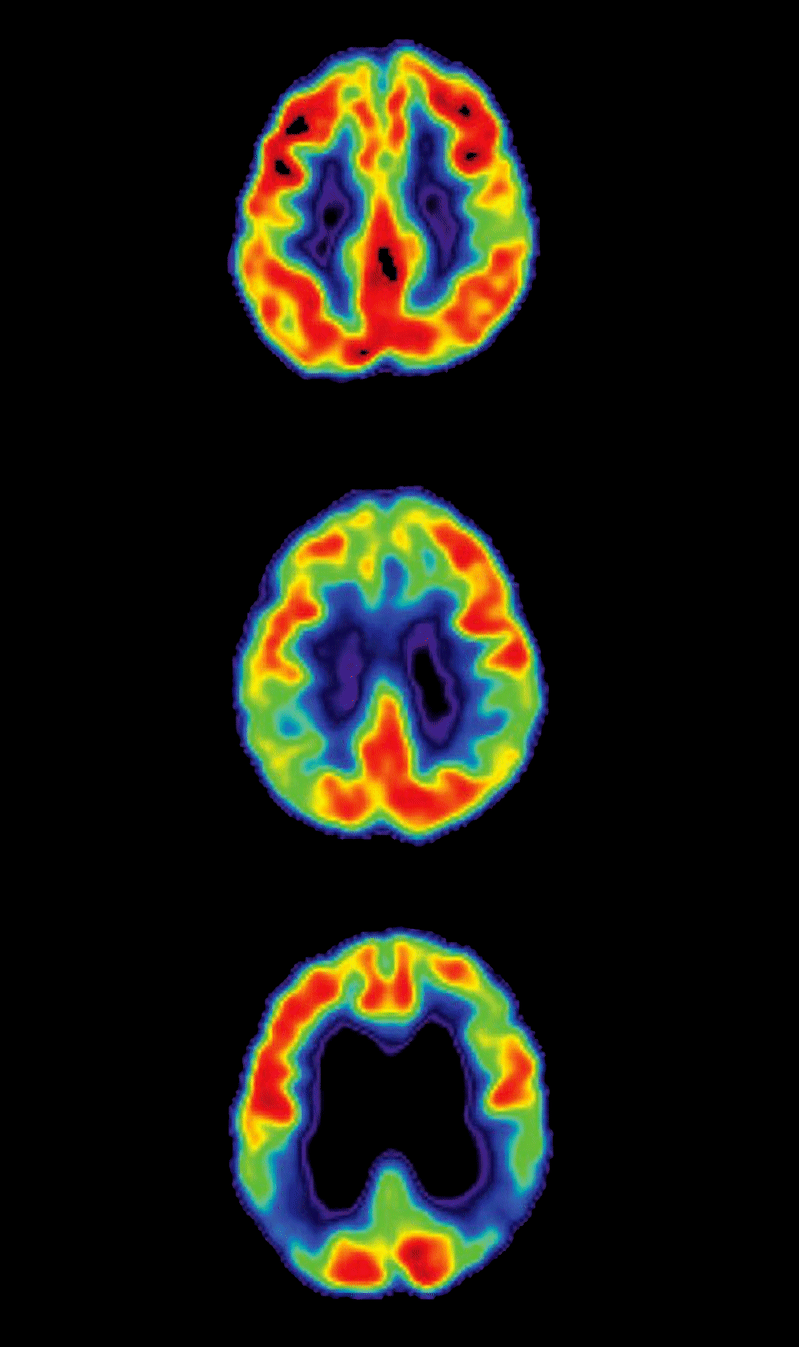
Until now, the only way to get an accurate diagnosis for Alzheimer’s was to undergo a lumbar puncture or positron emission tomography (PET) scan, both of which are expensive, invasive and impossible to scale to meet demand.
asserted
both → get → demand
An influx of new blood tests is set to simplify and democratise the process.
asserted
influx → set → process
Described as the “holy grail”, the newly approved pTau217 blood test is just as accurate as the two current gold standard tests but returns a result in minutes for a fraction of the cost, about $400.
asserted
test → describe → cost
Neuroscience Research Australia (NeuRA) chief executive Professor Matthew Kiernan said the test, which detects levels of abnormal tau proteins – a key biomarker for Alzheimer’s – empowers doctors and patients in determining treatment.
asserted
which → say → treatment
It also accelerates research.
asserted
It → accelerate → research
“Eventually, it will be a test you can get at your local blood lab,” Kiernan said.
asserted
Kiernan → get → lab
Similarly, until new drugs were approved last year, people living with Alzheimer’s disease had limited medical options.
asserted
people → approve → options
Medication could provide relief from symptoms, but there was nothing that would tackle the disease itself.
uncertain
that → provide → disease
The new drugs are monoclonal antibodies, donanemab and lecanemab, which work by harnessing a recipients’ own immune system to break down sticky amyloid-beta plaques that accumulate around the brain and are known as hallmarks of Alzheimer’s disease.
asserted
that → work → disease
While they have each been proven to remove plaque and slow progression, they’ve also faced criticism for offering limited real-world benefits to only some patients at high cost and a risk of side effects, including swelling and bleeds in the brain.
asserted
they → prove → brain
“[Donanemab and lecanemab] work in that they are really good at removing amyloid in the brain, even if the clinical benefit isn’t as much as we would hope for,” Devenney said.
asserted
Devenney → work → brain
“We’ve shown the approach can work.
asserted
approach → show → ?
Hundreds of drugs haven’t worked.”
asserted
Hundreds → work → drugs
Kiernan reports some patients are digging into their superannuation to fund the unsubsidised therapies, which can add up to $100,000 a year with medical fees and required brain scans.
asserted
which → report → fees
“It’s turning the disease back,” he said.
asserted
he → turn → disease
“The first [generation of drugs] are never the best, but they are starting the whole area of treatment.”
asserted
they → start → treatment
The next generation of monoclonal antibodies are designed to be more targeted with fewer side effects.
asserted
generation → design → effects
…and 72 more, not listed.
 The Aporia