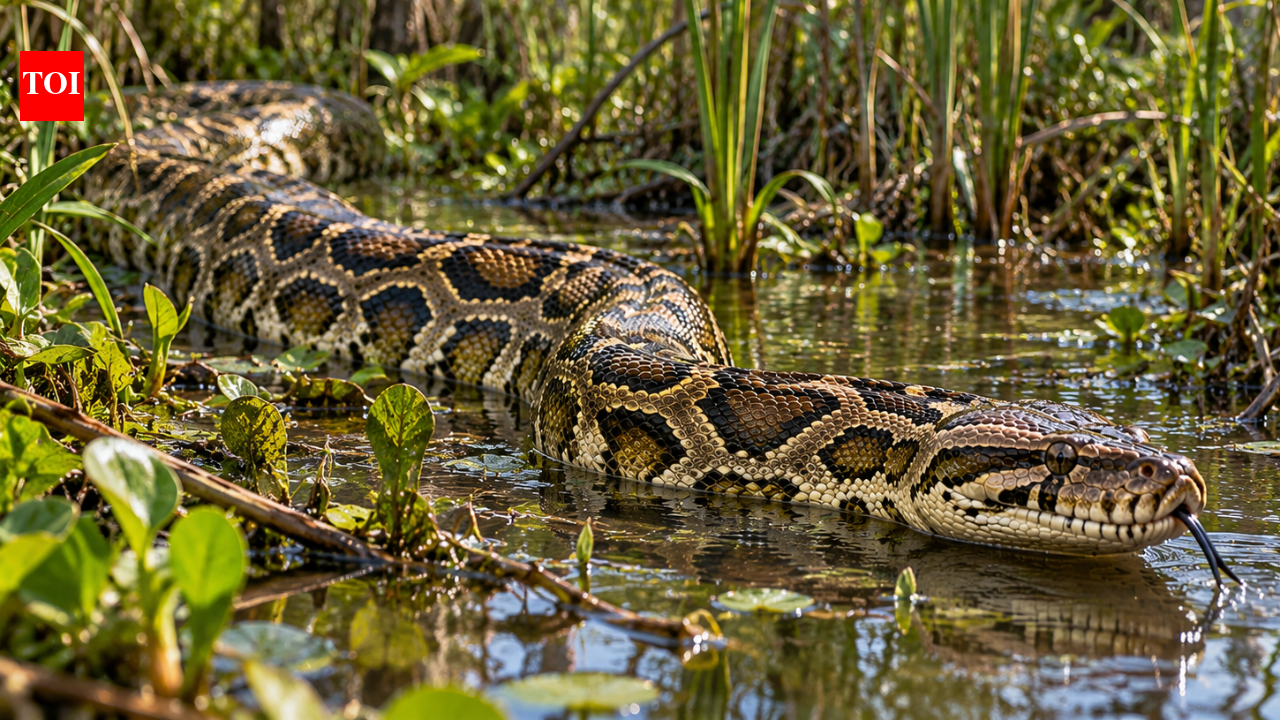
Burmese pythons in Florida's Everglades are carrying three previously unknown RNA viruses, raising questions about whether viruses harboured by the invasive snakes could eventually affect native wildlife.
uncertain
viruses → carry → wildlife
A study published in the Journal of Virology examined 40 Burmese pythons captured in and around the site of a 2020 disease outbreak among eastern mudsnakes.
asserted
study → publish → mudsnakes
Researchers did not find the ferlavirus linked to that outbreak in the pythons, but instead identified three previously undescribed viruses: an alphavirus, a hepacivirus and an arterivirus.
asserted
Researchers → find → viruses
They also detected a previously characterised serpentovirus.
asserted
They → detect → serpentovirus
While the findings expand knowledge of viruses carried by invasive reptiles, researchers say further work is needed to determine whether any of these viruses can infect native snakes.
asserted
any → expand → snakes
Florida’s Burmese pythons found carrying new RNA viruses
The research began after an outbreak among eastern mudsnakes in the Greater Everglades Ecosystem during November and December 2020.
asserted
research → find → November
Some affected snakes were found writhing on riverbanks with frothy oral discharge, while examinations revealed necrotising enteritis and pulmonary oedema.
asserted
examinations → find → enteritis
Scientists isolated a reptilian ferlavirus from the sick mudsnakes.
asserted
Scientists → isolate → mudsnakes
Ferlaviruses are known to cause serious and sometimes fatal disease in snakes kept in managed settings, but this was the first recognised outbreak in free-ranging snakes.
asserted
this → know → snakes
Because the virus was genetically related to viruses previously found in captive anacondas, researchers investigated whether an invasive constrictor species in the Everglades might be involved in its ecology.
uncertain
species → relate → ecology
Researchers tested 40 Burmese pythons
Researchers collected oral and vent swabs from 40 Burmese pythons captured in and around the outbreak area.
asserted
Researchers → test → area
None tested positive for the ferlavirus found in the mudsnakes.
asserted
None → test → mudsnakes
Instead, RNA sequencing revealed three previously undescribed viruses: Eden alphavirus, Burmese python hepacivirus and Burmese python arterivirus.
asserted
sequencing → reveal → viruses
The researchers also detected Burmese python septoviruses, a group of serpentoviruses previously identified in South Florida's Burmese pythons.
asserted
researchers → detect → pythons
Eden alphavirus was found in nearly one-third of pythons
Eden alphavirus, or EDEV, belongs to the genus Alphavirus in the family Togaviridae.
asserted
alphavirus → find → Togaviridae
Researchers detected it in 12 of the 40 pythons, or 30%.
asserted
Researchers → detect → pythons
Most detections came from vent samples.
asserted
detections → come → samples
Only a partial viral sequence was recovered, and attempts to grow the virus in laboratory cell cultures were unsuccessful.
asserted
attempts → recover → cultures
EDEV's closest known relatives include Caainguá virus, first identified in mosquito pools in Brazil.
asserted
relatives → know → Brazil
The researchers describe EDEV as the first new terrestrial alphavirus detected in the continental US in more than 50 years.
asserted
researchers → describe → years
However, its ability to cause disease remains unknown, and the study provides no evidence that it infects humans.
asserted
it → cause → humans
A new hepacivirus was found in most of the snakes
Burmese python hepacivirus, or BuPyHV, was the most frequently detected of the three newly identified viruses.
asserted
hepacivirus → find → viruses
It was found in 26 of the 40 pythons, meaning 65% had detectable viral RNA.
asserted
% → find → RNA
The virus belongs to the genus Hepacivirus in the family Flaviviridae and is described by the researchers as the first hepacivirus identified in a snake.
asserted
virus → belong → snake
Although the genus also includes hepatitis C virus, BuPyHV is genetically distinct, and there is no evidence that it causes hepatitis in humans.
asserted
it → include → humans
Researchers identified an unusually elongated region in its genome and a possible additional protease-related protein whose function remains unknown.
asserted
function → identify → genome
The third novel virus, provisionally named Burmese python arterivirus or BuPyAV, was detected in four of the 40 pythons, or 10%.
asserted
virus → name → pythons
It belongs to the family Arteriviridae.
asserted
It → belong → Arteriviridae
Researchers recovered only a short section of its genome, limiting what they could determine about its evolution.
uncertain
they → recover → evolution
Its closest known relative was a greater green snake arterivirus identified in China.
asserted
relative → know → China
The study describes BuPyAV as the first reptilian arterivirus reported from North America.
asserted
study → describe → America
Its ability to cause disease or spread between animals has yet to be established.
asserted
ability → cause → animals
More than half of the pythons carried multiple viruses
The researchers found that many of the pythons carried more than one virus.
asserted
many → carry → virus
Two or three viruses were detected in 23 of the 40 animals, representing 57.5% of the sample.
asserted
viruses → detect → sample
The most common combination was Burmese python hepacivirus and serpentovirus, detected together in nine pythons.
asserted
combination → detect → pythons
Eden alphavirus and hepacivirus were found together in seven.
asserted
alphavirus → find → seven
The serpentoviruses identified in the study have previously been associated with respiratory disease in captive snakes.
asserted
serpentoviruses → identify → snakes
However, detecting viral RNA does not by itself establish that a particular snake was ill because of the virus.
asserted
snake → detect → virus
Cross-species transmission remains an open question
The findings do not show that any of the three newly identified viruses have already spread from Burmese pythons to native snakes.
asserted
any → show → snakes
Researchers instead identify cross-species transmission as an issue that warrants further investigation.
asserted
that → identify → investigation
…and 9 more, not listed.
 The Aporia