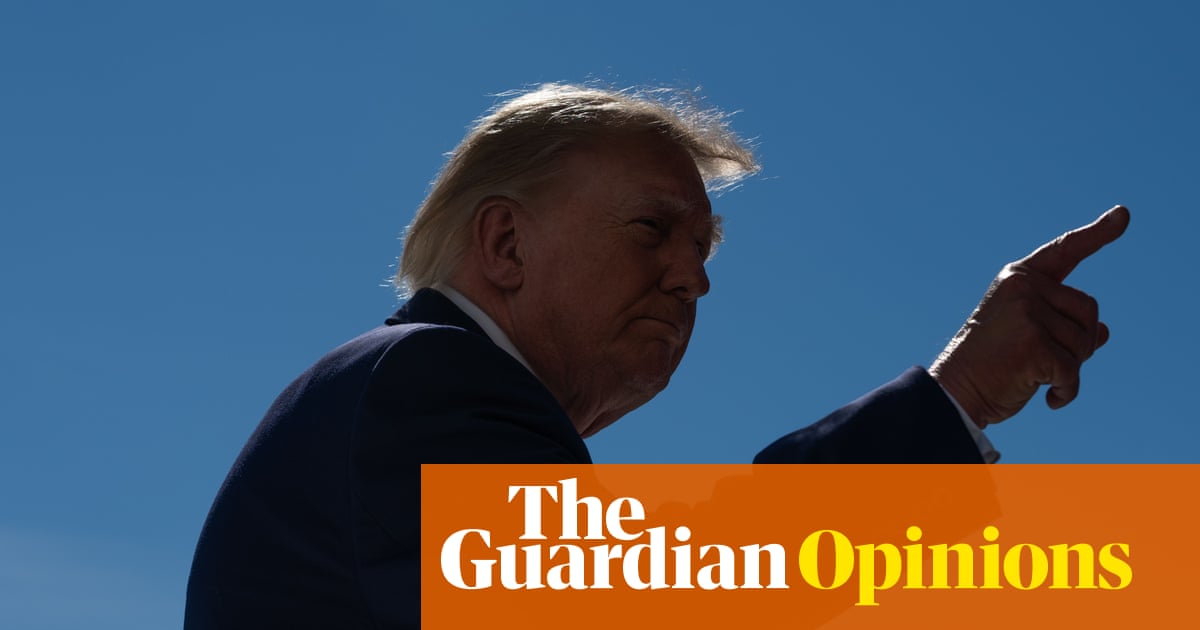
Trump’s recent statements on the economy are even more bonkers than usual | Steven Greenhouse

Read the original at The Guardian ↗
The Guardian · collected 2026-10-05 · by Steven Greenhouse

Quick Summary

Steven Greenhouse critiques former President Donald Trump's recent statements about economic policies, particularly regarding artificial intelligence regulation and trade deficits. Trump suggested halting all trade with countries where the US has a deficit and proposed cutting interest rates sharply, which economists argue would be economically disastrous. A WSJ poll shows only 7% of Americans believe Trump should lead in regulating AI, reflecting low public trust in his economic judgment.
Written locally by qwen2.5:14b on 2026-10-05, using this article's own text rather than the other coverage of the same event (that is the story summary below).

AI analysis runs on qwen2.5:14b, locally

Story summary

Donald Trump recently made several controversial economic claims, asserting on his platform Truth Social that a strong and intelligent president is needed to control AI, implying he fits this role. He then suggested cutting off all trade with countries with which the US has a trade deficit, including major partners like China, Mexico, and the EU. This would leave many US manufacturers unable to obtain critical supplies such as computer chips and rare earth metals. Trump bizarrely claimed stopping such trade could earn the US at least $1.5 trillion annually.

These statements alarmed experts who fear his policies are dangerous for both the US and global economies. Only 7% of Americans think Trump should lead AI regulation, according to a WSJ poll. A group called Republicans Against Trump criticized him as “Dumbest President Ever,” highlighting public skepticism about his economic acumen.

Written for “Trump Economy Statements” on 2026-10-05, grounded in this article and the 0 other(s) covering the same event.
Why this leaning score
The article's own words the score was based on. Each is quoted verbatim and was checked against the article text before being stored, so you can find it in the original.
Reading Leans strongly left (beta estimate) Confidence high 1 quote(s) discarded as not found in the article
Leaning: leans strongly left for article 57121 (high confidence, 3 verified quotes) · logged 2026-10-05

Signals How these are calculated →

Claims extracted
40
claim-shaped sentences
Uncertain
8%
3 of 40 hedged
Leaning
Leans strongly left
of the writing, not the subject · beta estimate
Correction & hedging signals
59.7
corrections and hedging in what we collected; not a measure of accuracy
Outlets on this story
1
Economy/Business
Narrative spread
1
articles carrying this framing
Analyzed 2026-10-05 · how these are computed

Story

📰 Trump Economy Statements
Economy/Business · 1 article(s) covering the same event.

How this is being covered How these are calculated →

Article leaning vs. publisher reliability
Source leaning vs. consistency

Compared with similar articles

This article reads leans strongly left and hedges 8% of its claims. Each row says how that neighbour differs.
Washington Examiner
⚖️ leaning not scored 🔴 3% hedged 1 of 37 📰 publisher trust 72
“The articles discuss different aspects of Trump's presidency and economic messaging without focusing on the same specific incident or time.”
Washington Examiner
⚖️ Leans strongly left 🔴 6% hedged 1 of 17 📰 publisher trust 72
“The articles discuss different aspects of President Trump's involvement with AI regulation; Article A covers Jeffries' criticism of an agreement made by Trump, while Article B discusses broader statements and policies from Trump regarding AI.”
Trump + AI = Blue Tsunami different event · 95%
The Bulwark
⚖️ Leans left further right than this 🔴 7% hedged 6 of 81
“The articles discuss different statements made by Trump on separate dates with distinct topics.”
Times of India
⚖️ leaning not scored 🔴 10% hedged 2 of 20 📰 publisher trust 59
“The articles describe different aspects of Trump's public statements; one focuses on his defense of data centers during a rally, while the other discusses his broader economic statements and claims.”
New York Post
⚖️ Leans strongly right further right than this 🔴 0% hedged 0 of 10 📰 publisher trust 64
“The articles discuss different aspects of President Trump's stance on AI and his general economic statements, not the same specific incident.”
New York Post
⚖️ Leans strongly right further right than this 🔴 21% hedged 3 of 14 📰 publisher trust 64
“The articles discuss different aspects of President Trump's statements, with Article A focusing on reassurances about AI safety and existing laws, while Article B focuses on outlandish economic statements and trade policies.”
CBS News
⚖️ leaning not scored 🔴 18% hedged 2 of 11 📰 publisher trust 66
“Article A describes Trump announcing the formation of the 'Super Intelligence Force', while Article B discusses Trump's general statements about AI needing strong presidential leadership and other unrelated economic claims.”
The Independent
⚖️ leaning not scored 🔴 14% hedged 5 of 35 📰 publisher trust 59
“The articles discuss different aspects of Trump's statements, with Article A focusing on AI regulation and Article B discussing broader economic claims.”
The Bulwark
⚖️ leaning not scored 🔴 50% hedged 3 of 6
“The articles discuss different aspects of Trump's recent statements, with Article A focusing on an interview in Time Magazine about Iran and IQ claims, while Article B discusses economic policies and intelligence concerns on Truth Social.”

Publisher

The Guardian · 961 article(s) · 3 correction(s) detected
Running correction rate · 3 correction(s)
2026-10-03
Prison chief in Christa Pike case oversaw five ‘botched’ executions, lawyers say
2026-09-20
Judge orders Kennedy Center to give 30 days’ notice before major physical changes
2026-09-07
Former Louisiana mayor completes 90-day jail term for raping 16-year-old boy

Who wrote this

Steven Greenhouse
4 article(s) here · 1 carrying a prediction
🔮 The second disconcerting statement was: “If we stopped Trading with every country that we have a Deficit with, which is most of them, we would make, at least, 1.5 Trillion Dollars a year.”
🔮 In campaign speeches this summer, Trump has sought to milk these accounts for maximum political advantage, making big promises about how much these accounts will help the nation’s children.
🔮 In a move that will cut pay for many low-wage workers, the Trump administration has proposed eliminating federal minimum wage and overtime protections for 3 million often low-paid homecare workers who take care of seniors and the disabled.
🔮 Dear reader, I recognize that your eyes might glaze over at any mention of the nation’s $40tn federal debt.
Also by Steven Greenhouse
Nothing else under this byline is closely related to this article, so these are simply their most recent.

Topics

Econ 101 Fed Truth Social U.S.A. the Federal Reserve

Subjects

Trump PERSON · 13× Fed ORG · 3× Truth Social ORG · 2× the Federal Reserve ORG · 2× Americans NORP · 1× China GPE · 1× Donald Trump PERSON · 1× Republicans Against Trump ORG · 1× U.S.A. GPE · 1× WSJ ORG · 1×

Narrative

If Trump ordered the US to terminate all trade with every place with which it has a trade deficit – that includes China, Mexico, Taiwan and the European Union – many US manufacturers would quickly find themselves in desperate straits, unable to obtain critically needed computer chips, rare earths, auto parts, aluminum and much more.
framing: assertive · carried by 1 article(s) · first seen 2026-10-05
🔮 The second disconcerting statement was: “If we stopped Trading with every country that we have a Deficit with, which is most of them, we would make, at least, 1.5 Trillion Dollars a year.”

Claims (40 extracted, 3 hedged)

Donald Trump recently made a bold claim about his abilities, writing on Truth Social: “The only control or ‘guardrails’ that AI needs is a STRONG AND SMART (High IQ!) PRESIDENT, and the U.S.A. has that, in spades!” uncertain
U.S.A. → make → spades
But in the days before and after that post, Trump made one mind-boggling statement after another, including one that raised the possibility of cutting off all trade with dozens of the US’s trading partners. asserted
that → make → partners
The president’s statements had many experts questioning not just his intelligence, but also whether he – and the outlandish policies he was proposing – were a clear and present danger to both the US economy and the world economy. asserted
he → have → economy
Public respect for Trump’s economic sense has fallen so low that just 7% of Americans think he should take the lead in regulating AI, according to a recent WSJ poll. uncertain
he → fall → poll
Responding to Trump’s reckless statements, one prominent advocacy group, Republicans Against Trump, derided him as “Dumbest. President. Ever.” asserted
group → respond → President
First, he wrote on Truth Social: “I’ll stop trading with countries with which we have a deficit” if the Federal Reserve doesn’t cut interest rates. asserted
Reserve → write → rates
The second disconcerting statement was: “If we stopped Trading with every country that we have a Deficit with, which is most of them, we would make, at least, 1.5 Trillion Dollars a year.” asserted
we → stop → Dollars
Not only is Trump’s arithmetic childishly silly here, but any college student who took Econ 101 knows that if a trade-dependent nation like the US suddenly ended all trade with dozens of countries, that would lead to economic disaster. asserted
that → take → disaster
What’s more, it was worrisome that Trump views himself as almighty emperor with the power to singlehandedly halt hundreds of billions of dollars in trade. asserted
Trump → ’ → trade
If Trump ordered the US to terminate all trade with every place with which it has a trade deficit – that includes China, Mexico, Taiwan and the European Union – many US manufacturers would quickly find themselves in desperate straits, unable to obtain critically needed computer chips, rare earths, auto parts, aluminum and much more. asserted
themselves → order → chips
As a result, many factories would be forced to close. asserted
factories → force → result
Not only that, many farmers would be crippled because they couldn’t import the fertilizer they need, while many homebuilders would have to stop work because they couldn’t import needed lumber. asserted
they → cripple → lumber
Those were by no means Trump’s only recent mind-boggling statements. asserted
Those → boggle → means
Two days before the Federal Reserve raised its short-term interest rates to 3.75% to 4% to combat inflation, Trump was on a tear, badgering and bullying the Fed, telling it not only not to raise interest rates, but to cut rates sharply. asserted
Trump → raise → rates
“We should be at 1% or half a percent,” Trump said. asserted
Trump → say → %
Again, anyone who took Econ 101 knows that cutting rates so sharply and so low will push prices skyward at a time when the Fed and consumers already think inflation is too high. asserted
inflation → take → time
And let’s not forget that Trump was the guy who promised to reduce prices on day one as president. asserted
who → let → president
With that statement, the self-described “stable genius” president showed his utter failure to understand one of the most basic teachings of Econ 101 – when interest rates are extremely low, like 1%, that heats up the economy and that revved-up economic activity fuels inflation. asserted
activity → describe → inflation
Trump said that if the Fed bowed to his demands and slashed interest rates, “we could have a GDP [growth] of 14, 15, 16 and 20.” uncertain
we → say → 14
Considering that the US economy grew at a moderate 2.2% rate in this year’s second quarter and rarely grows faster than 5%, talk of 20% growth is delusional. asserted
talk → consider → growth
Since the second world war, the US economy has grown at a rate at 20% or higher just once. asserted
economy → grow → %
That happened in the third quarter of 2020 due to extraordinary circumstances – in that quarter, myriad businesses rushed to reopen after the worst pandemic in a century caused many to suddenly shut down during the previous quarter. asserted
many → happen → quarter
(GDP plunged at a 28% rate that quarter.) asserted
GDP → plunge → rate
Then there was this colossally wrong-headed statement about trade: “The word ‘Deficit’ is nothing more than a fancy word for LOSS.” asserted
word → be → LOSS
Trump coupled that assertion with his misbegotten statement that the US would magically be $1.5tn richer if it terminated all trade with every nation with which it has a deficit. asserted
it → couple → deficit
This shows an infantile understanding of trade – and a stunning blindness to its mutual benefits. asserted
This → show → benefits
To explain how inane Trump is being here, let’s hypothesize for a second that in the US-France trade relationship, the only goods traded are wine and bourbon. asserted
goods → explain → relationship
Under Trump’s ludicrous logic, if the US buys $2bn of wine from France, and the French import $1bn worth of Kentucky bourbon, the resulting $1bn trade deficit means the US is simply giving away $1bn to France. asserted
US → buy → France
Trump bafflingly sees that as an outright $1bn loss. asserted
Trump → see → loss
Blinded by ignorance, ideology or an idée fixe, Trump fails to see that that’s not a harmful $1bn “loss” – rather, Americans are getting $1bn worth of fine wine to enjoy. asserted
Americans → blind → wine
No doubt wine lovers across the US see that as a gain and certainly not as a $1bn loss. asserted
lovers → see → loss
Bottom line, Trump’s delusional statements on the economy show that he is becoming more detached from reality and from rational understanding of how the world works. asserted
world → show → understanding
One can’t help but wonder why his economic advisers don’t stop him from making such ridiculous and at times dangerous statements. asserted
advisers → help → statements
If Trump turns his absurd economic notions into reality, as he done in his ugly, unnecessary trade war with Canada, that will be more bad news for Americans. asserted
that → turn → Americans
Voters should realize that Trump, with his failure to grasp basic economics, is a danger to the economy. asserted
Trump → realize → economy
He has brought us higher prices, slower GDP growth, and constant economic chaos and uncertainty. asserted
He → bring → prices
His tariffs and disastrous war against Iran have hit the great majority of Americans in their wallets and pocketbooks. asserted
tariffs → hit → wallets
Tragically, Trump’s Republican supporters in Congress either cheer him on or remain dismayingly silent while Trump does serious damage to the economy and to the finances of millions of struggling families. asserted
Trump → cheer → families
Americans shouldn’t forget this when they vote in November’s midterm elections. asserted
they → forget → elections
- Steven Greenhouse is a journalist and author, focusing on labor and the workplace, as well as economic and legal issues asserted
Greenhouse → focus → labor

💬Give feedback
🕘History 🎫Support