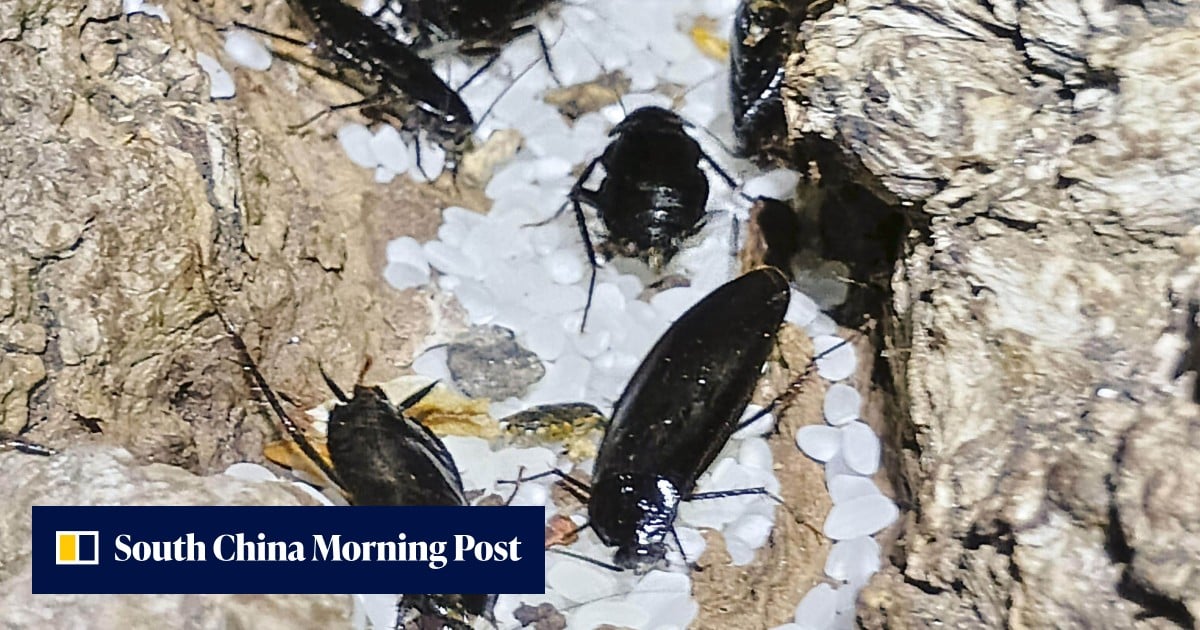
Cold comfort: Japan’s Hokkaido battles cockroach surge amid global warming

Read the original at South China Morning Post ↗
Cite

Ryall, J. (2026, September 6). Cold comfort: Japan’s Hokkaido battles cockroach surge amid global warming. South China Morning Post. https://www.scmp.com/week-asia/lifestyle-culture/article/3366338/cold-comfort-japans-hokkaido-battles-cockroach-surge-amid-global-warming?utm_source=rss_feed

Dated when The Aporia collected the article, usually within hours of publication. Check the original for its exact date and byline.

South China Morning Post · collected 2026-09-06 · by Julian Ryall

Quick Summary

Japan's Hokkaido island is experiencing an unexpected surge in cockroach populations due to rising temperatures and warmer winters caused by global warming. According to Japan Meteorological Agency statistics, the average daytime temperature on the island has increased by 1.5 degrees Celsius over the past three decades. Local resident Makoto Watanabe, who previously considered Hokkaido too cold for cockroaches, now encounters them regularly in his home town of Eniwa. The warmer temperatures have allowed cockroaches to thrive in what was once a relatively inhospitable environment for them.
Written locally by qwen2.5:14b on 2026-09-06, using this article's own text rather than the other coverage of the same event (that is the story summary below).

AI analysis runs on qwen2.5:14b, locally

Story summary

Hokkaido, Japan's northernmost island, has seen a significant surge in cockroach populations due to rising temperatures and "artificial environments" such as buildings and homes. According to the Japan Meteorological Agency, the average daytime temperature on Hokkaido has risen by 1.5 degrees Celsius over the past 30 years, reaching up to 35 degrees Celsius in some areas during summer. This warming trend is attributed to global warming. Residents like Makoto Watanabe, who lives in the town of Eniwa, have noticed the increase in cockroach populations, with some recalling that they were rarely seen on the island even 30 years ago when it was considered too cold for them to thrive.

Written for “Pest Infestation in Japan” on 2026-10-22, grounded in this article and the 0 other(s) covering the same event.

Story

📰 Pest Infestation in Japan
Environment · 1 article(s) covering the same event.

Compared with similar articles

Nothing to compare against. No article is close enough to this one for the pipeline to have linked or judged the pair.
How this article was measured signals, leaning charts, publisher record, byline, topics and claims

Signals How these are calculated →

Claims extracted
8
sentences that state something as happening or true
Uncertain
12%
1 of 8 hedged ("reportedly", "may", "according to")
Leaning
Centre
of the writing, not the subject · beta estimate
Publisher signals
64/100
South China Morning Post's corrections and hedging, across everything collected from it. Not a measure of accuracy.
Outlets on this story
1
Environment
Same framing elsewhere
1
articles that frame the event the way this one does
Analyzed 2026-09-06 · how these are computed

How this is being covered How these are calculated →

Article leaning vs. publisher reliability
Source leaning vs. consistency

Publisher

South China Morning Post · 2839 article(s) · 6 correction(s) detected
Running correction rate · 6 correction(s)

Who wrote this

Julian Ryall
26 article(s) here · 0 carrying a prediction
🔮 "The North Korean regime… is selling the labor of its citizens under a state-to-state arrangement, controlling whether they may leave and collecting most of their wages," it said.
🔮 Japan’s dilemma over frosty ties with Russia deepens after reporter’s arrest Given Japan’s lack of response to recent provocative Russian moves, Moscow could be emboldened to antagonise Tokyo further, analysts say The arrest of a Japanese journalist in Russia has finally woken Tokyo up to the fact that Moscow is playing hardball in their diplomatic relationship, and the country’s apparent unwillingness to push back with commensurate force could encourage the Kremlin to test its neighbour’s resolve, analysts say.
🔮 In September, Japan’s aviation authorities and airlines tightened check-in deadlines, including requiring passengers on domestic flights to complete travel procedures 30 minutes before their scheduled departure time, up from 20 minutes previously, which observers say may lead to more confrontations between airline staff and passengers in the future.
🔮 "Comrade Kim Jong Un expressed the expectation and belief that all the nation's missile forces would remain faithful to their missions of defending the sovereignty and security of the republic in a responsible combat posture," the KCNA reported.
🔮 "This is a serious situation because this incident is believed to have taken advantage of artificial intelligence, and if AI is used in phishing attacks, it could lead to secondary damage," Yonhap News quoted Han as saying at a Cabinet meeting.
🔮 Japan explores ‘ownership’ of nuclear submarines as regional rivalries worsen Proposed changes could allow research into developing a domestically built nuclear-powered submarine without a firm decision on acquiring a fleet Analysts acknowledge there will inevitably be pushback from some sectors of Japan – the only nation to have suffered a nuclear attack – but say there is a growing recognition that regional rivalries are worsening and Japan needs to do more to guarantee its own security. Quoting government sources, the Yomiuri newspaper reported on Wednesday that the expert panel set up to consider changes to the National Security Strategy and other key security documents would state that Japan was “considering ownership” of nuclear submarines.
🔮 Marine’s arrest for murder in Japan fuels anger over US military presence Residents say the killing of an Okinawan woman shows they are paying the price of shouldering Japan’s heaviest security burden The alleged murder of an Okinawan woman by a US marine has put newly elected Governor Genta Koja under intense pressure, raising questions about whether the incident could deepen opposition against the American military presence just as Okinawa assumes greater importance in Japan’s regional security strategy.
🔮 Campaigners and advocates have welcomed the change, but say it lacks teeth and came years too late, even as societal attitudes may have already moved ahead of it.
🔮 Viral lies about foreign crime are fuelling political division in a country desperate for workers, analysts say The trend is reportedly deepening divisions within Japanese society and creating a feedback loop that experts say will be difficult to break.
Also by Julian Ryall
Nothing else under this byline is closely related to this article, so these are simply their most recent.
All 26 articles by Julian Ryall →

Topics

Eniwa Hokkaido Japan This Week in Asia Tokyo

Subjects

Hokkaido GPE · 3× Watanabe PERSON · 2× Eniwa GPE · 1× Japan GPE · 1× Japan Meteorological Agency ORG · 1× Makoto Watanabe PERSON · 1× Sapporo ORG · 1× This Week in Asia ORG · 1× Tokyo GPE · 1×

Narrative

“Since I moved back here, I have always thought that one of the big advantages of living in a place where it is so cold for much of that year is that there are far fewer insects, but cockroaches in particular,” said Watanabe, an academic who lives in the town of Eniwa.
framing: assertive · carried by 1 article(s) · first seen 2026-09-06
2026-09-06 · South China Morning Post
Cold comfort: Japan’s Hokkaido battles cockroach surge amid global warming · assertive framing

Claims (8 extracted, 1 hedged)

Japan’s Hokkaido battles cockroach surge amid global warming asserted
Hokkaido → battle → warming
Rising temperatures and ‘artificial environments’ enable the insects to thrive in a region once considered too hostile for them, experts say In all his five decades of living in Hokkaido, Makoto Watanabe cannot recall ever being confronted by a cockroach. asserted
Watanabe → rise → cockroach
“When I was a university student in Tokyo 30 years ago, I used to see them in my accommodation and I absolutely hated them,” Watanabe told This Week in Asia. asserted
Watanabe → use → Asia
“Since I moved back here, I have always thought that one of the big advantages of living in a place where it is so cold for much of that year is that there are far fewer insects, but cockroaches in particular,” said Watanabe, an academic who lives in the town of Eniwa. asserted
who → move → Eniwa
But Hokkaido has changed in those 30 years. asserted
Hokkaido → change → years
According to Japan Meteorological Agency statistics, the average daytime temperature across the nation’s most northerly main island is 23 degrees Celsius (73.4 degrees Fahrenheit), rising to 29 degrees in major cities such as Sapporo, in the summer. uncertain
temperature → accord → summer
More recently, localised summer temperatures have spiked as high as 35 degrees, a figure that was unthinkable even a decade ago. asserted
that → spike → degrees
Winter temperatures have also become milder, with the mean average at minus 3.7 degrees in January 1996, but up to minus 2 degrees in January this year. asserted
average → become → January
💬Give feedback
🕘History 🎫Support