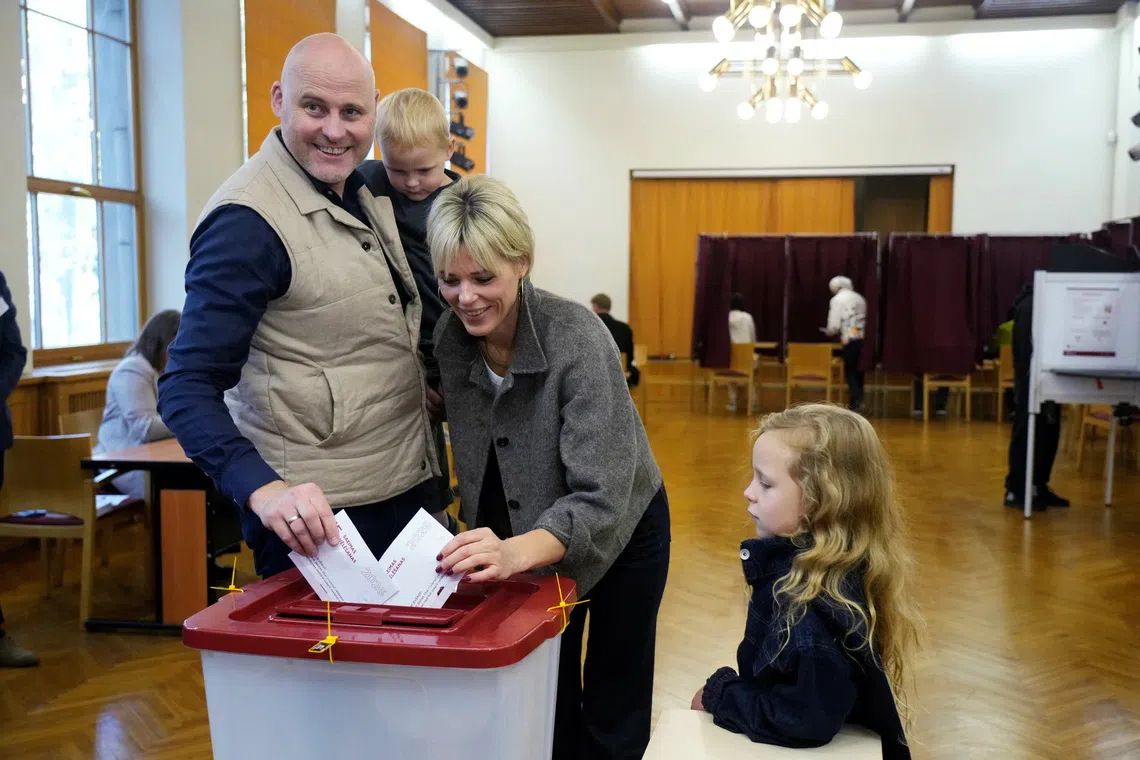
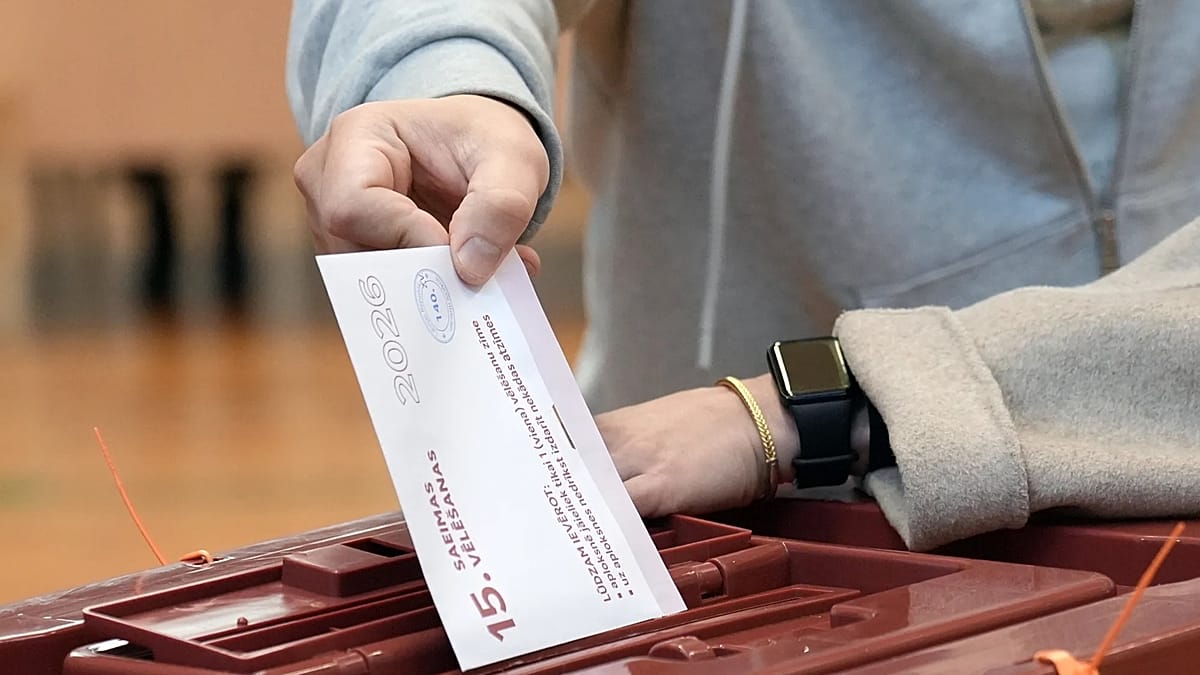
Photo via Euronews

Latvia's pro-European ruling party wins election as populists gain ground

Read the original at Euronews ↗
Cite

Fisayo-Bambi, J. (2026, October 4). Latvia's pro-European ruling party wins election as populists gain ground. Euronews. https://www.euronews.com/2026/10/04/latvias-pro-european-ruling-party-wins-election-as-populists-gain-ground

Dated when The Aporia collected the article, usually within hours of publication. Check the original for its exact date and byline.

Euronews · collected 2026-10-04 · by Jeremiah Fisayo-Bambi

Quick Summary

Prime Minister Andris Kulbergs' center-right United List party won Latvia's parliamentary election with 35.4% of the vote and secured 42 seats out of 100 in parliament. This outcome indicates a strong pro-European and pro-Ukrainian stance for Latvia, despite concerns over Russia and high living costs. While Kulbergs' coalition is likely to change due to some parties underperforming, populist parties have gained ground, reflecting shifts among the Russian-speaking minority population.
Written by AI on 2026-10-04, from this article's own text only (the story summary below draws on all the coverage).
See how they differ ↓

AI analysis

Story summary

On October 1, Latvians went to vote in a parliamentary election amidst concerns over potential Russian aggression and economic challenges. The incumbent Prime Minister Andris Kulbergs, leading the centrist United List party, was expected to retain power despite his party's relatively low poll numbers of around 14-20%. His victory became clear as exit polls indicated that the United List received 35.6% of the vote, the best result since Latvia regained independence in 1991. The election highlighted deep political fragmentation; while Kulbergs won significantly, forming a new coalition will be challenging due to the expected gains by populist parties focusing on economic issues. With 42 seats out of 100, Kulbergs is positioned to form a pro-Ukrainian government, reinforcing Latvia's stance within NATO and against perceived Russian threats.

Written for “Latvia Election Amid Russia Threat” on 2026-11-18, grounded in this article and the 11 other(s) covering the same event.

How they differ

7 outlets covered “Latvia Election Amid Russia Threat”.

What each outlet says

One AI summary per outlet of its latest article on this story, written from that article alone and checked against it. Open the article for the outlet's own words.

EuronewsThis outlet4 Oct

Prime Minister Andris Kulbergs' center-right United List party won Latvia's parliamentary election with 35.4% of the vote and secured 42 seats out of 100 in parliament. This outcome indicates a strong pro-European and pro-Ukrainian stance for Latvia, despite concerns over Russia and high living costs. While Kulbergs' coalition is likely to change due to some parties underperforming, populist parties have gained…

Latvia's pro-European ruling party wins election as populists gain ground (this article)2 articles from Euronews on this story
The Straits Times4 Oct

Latvian Prime Minister Andris Kulbergs is set to continue in power after his United List party won 42 out of 100 seats in parliament following the October 7 election, securing 35.3% of the vote with nearly all ballots counted. The centrist victory comes as Latvia aims to maintain a strong stance against Russia and support for Ukraine, while addressing domestic economic challenges. Kulbergs has promised to improve…

Latvian PM on track to lead pro-Ukraine coalition after election win →3 articles from The Straits Times on this story
South China Morning Post3 Oct

Latvian Prime Minister Andris Kulbergs’ United List is projected to win a significant portion of votes in Saturday’s parliamentary election, according to an exit poll by LTV public broadcaster. The poll indicates that the United List received 35.6% of the vote, which would be the best result for any party since Latvia's independence from the Soviet Union in 1991. Kulbergs could potentially secure a majority with…

Latvian leader poised for big win in election shadowed by Putin →2 articles from South China Morning Post on this story
Toronto Star4 Oct

Latvian lawmakers are set to start forming a new government after Sunday's parliamentary election where Prime Minister Andris Kulbergs' four-party coalition won 35% of the vote. The previous governing coalition had been dissolved due to a political crisis triggered by stray drones possibly originating from Ukraine, as well as other unresolved issues.

Pro-Ukraine governing coalition wins 35% in Latvian election →2 articles from Toronto Star on this story
Al Jazeera3 Oct

Latvia held parliamentary elections on Saturday amid concerns about security threats from Russia and economic pressures like rising living costs. Prime Minister Andris Kulbergs, whose United List party is polling at around 20%, faces a complex negotiation for coalition-building as two of his allies are declining in popularity. With polls open from 05:00 GMT to 17:00 GMT, about 1.5 million eligible voters chose among…

Polls open in Latvia against backdrop of perceived Russia threat →
The Hindu4 Oct

On October 3, 2026, Latvia held a parliamentary election where Prime Minister Andris Kulbergs’ pro-Ukraine coalition won with 35% of the vote. The election followed a political crisis in May due to tensions over Ukrainian drones and broader issues. Voter turnout was above 51%, resulting in the United List party securing around 42 seats, necessitating a multiparty coalition for governance.

Pro-Ukraine governing coalition wins 35% in Latvian election →
Show 1 more outlets
CBC4 Oct

In Sunday's Latvian parliamentary election amid concerns over potential Russian aggression, Prime Minister Andris Kulbergs’s pro-Ukraine coalition won 35% of the vote and secured 42 seats out of 100 in parliament. The election was marked by a voter turnout exceeding 51%, with nearly 1.56 million eligible voters choosing among parties needing at least five percent to enter parliament, necessitating coalition…

Pro-Ukraine governing coalition wins 35% in Latvian election →

Where they agree and split

The full story: what happened, how it changed, and all 12 articles →

Compared with similar articles

This article reads unscored and hedges 20% of its claims. Each row says how that neighbour differs.
Toronto Star
Hedges 1 of 3 claims Outlet record 64/100
South China Morning Post
Centre Hedges 5 of 6 claims Outlet record 62/100
The Straits Times
Hedges 4 of 19 claims Outlet record 64/100
Euronews
Hedges 5 of 39 claims Outlet record 60/100
South China Morning Post
Leans left Hedges 1 of 5 claims Outlet record 62/100
Toronto Star
Hedges 1 of 4 claims Outlet record 64/100
The Straits Times
Hedges 2 of 19 claims Outlet record 64/100
The Hindu
Centre Hedges 2 of 10 claims Outlet record 60/100
CBC News
Hedges 2 of 11 claims Outlet record 60/100
Al Jazeera
Hedges 3 of 15 claims Outlet record 60/100
“While both articles discuss an election in Latvia, Article A describes the opening of polls on October 3rd, whereas Article B discusses the results and aftermath of the election on October 4th.”

Story

Latvia Election Amid Russia Threat
Politics · 12 article(s) covering the same event. Compare every outlet's account →
How this article was measured signals, leaning charts, publisher record, byline, topics and claims

Signals How these are calculated →

Claims extracted
20
sentences that state something as happening or true
Uncertain
20%
4 of 20 hedged ("reportedly", "may", "according to")
Leaning
withheld
no quote in the article backed the model's score
Publisher signals
60/100
Euronews's corrections and hedging, across everything collected from it. Not a measure of accuracy.
Outlets on this story
12
Politics
Same framing elsewhere
1
articles that frame the event the way this one does
Analyzed 2026-10-04 · how these are computed

How this is being covered How these are calculated →

Article leaning vs. publisher reliability
Source leaning vs. consistency

Publisher

Euronews · 1478 article(s) · 1 correction(s) detected
Running correction rate · 1 correction(s)

Who wrote this

Jeremiah Fisayo-Bambi
10 article(s) here · 1 carrying a prediction
The Commission spokesperson also pointed to a ruling by the European Court of Human Rights, which on 5 May 2026 issued interim measures requiring the competent Polish authorities “to refrain from hindering the taking up and exercise of judicial duties by judges appointed by the Sejm in March 2026”.
“A wave of stones, an attempt to overthrow the government and change those in power through the imposition of violence — something that will never be allowed to happen, in any form or for any reason,” he said after meeting teachers and school representatives on Tuesday.
Independent diplomat Luca Niculescu wins parliamentary backing for a minority government, but analysts warn the calm may not last.
Five space agencies have joined forces for the five-year mission, which will attempt to land a robotic prospector and a rover on Phobos, the larger and closer of Mars’ two pint-sized moons.
Trump's late backing comes as the two leaders’ strategies on Iran and Gaza have diverged, and he warns the US may not “do this work” if Israel changes leaders. US President Donald Trump on Sunday endorsed embattled Israeli Prime Minister Benjamin Netanyahu in the final stretch of his reelection campaign. The endorsement is a coveted boost given Trump’s popularity in Israel, but one he withheld for months as the vote approached and the two leaders’ strategies in the Middle East diverged.
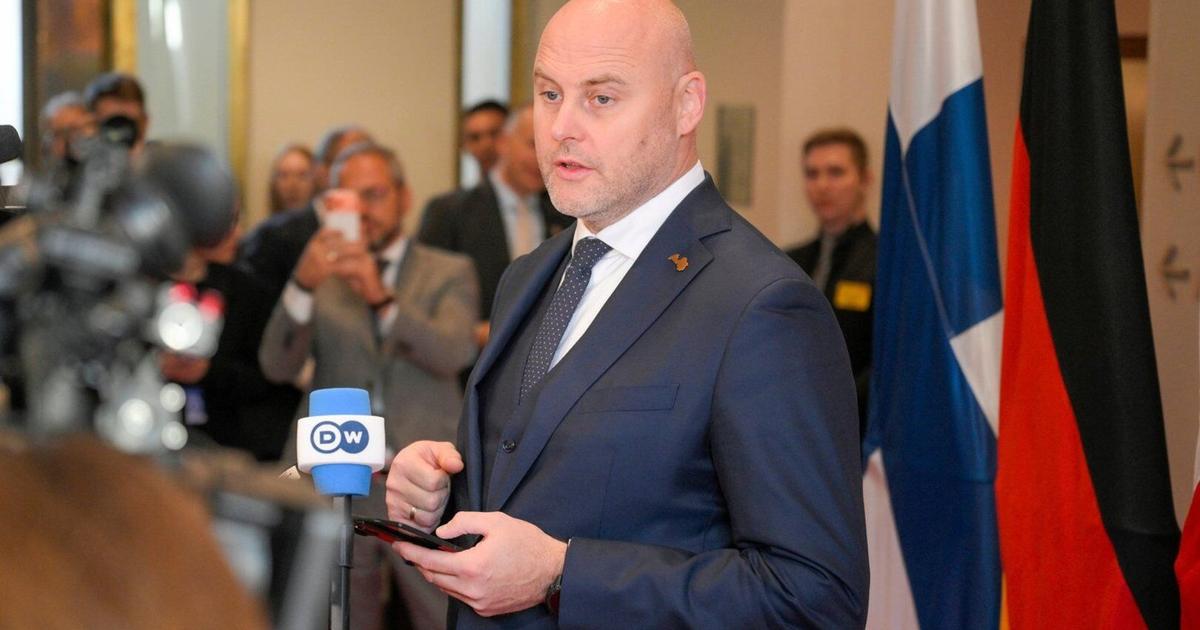
Kulbergs, who became prime minister only in May, said the result was higher than expected and matched the lead shown in exit polls.
She also claimed it can alter its trajectory at low altitudes and has unspecified artificial intelligence capabilities, which she said would make it extremely hard to intercept.
Salko Bijavica, from Mostar, welcomed the change and said it gives people hope that the elections will be fair.
"The stance towards Russia is the main reason for Latvians' Western, NATO and European anchoring," a Western diplomat in Riga said, adding that it would be hard to imagine major political changes.
The analysis did not determine whether the collapse would have happened without climate change, caused mainly by the release of greenhouse gases when fuels like oil, gas and coal are burnt.
Also by Jeremiah Fisayo-Bambi
Nothing else under this byline is closely related to this article, so these are simply their most recent.
All 10 articles by Jeremiah Fisayo-Bambi →

Topics

Harmony Latvia Russia Ukraine United List

Subjects

Latvia GPE · 4× Russia GPE · 4× Kulbergs PERSON · 3× Ukraine GPE · 3× United List ORG · 3× Andris Kulbergs PERSON · 2× Harmony PERSON · 2× Baltic NORP · 1× Soviet NORP · 1× the United List ORG · 1×

Narrative

A member of NATO and the European Union since 2004, this small Balkan state sees Russia as its main security threat and has sharply raised defence spending in response. "Because we are the external border of Europe, we must have a strong economy... a strong border region," Kulbergs said.
framing: assertive · carried by 1 article(s) · first seen 2026-10-04
Kulbergs, who became prime minister only in May, said the result was higher than expected and matched the lead shown in exit polls.

Claims (20 extracted, 4 hedged)

With more than 99.9 per cent of votes counted, Prime Minister Andris Kulbergs' United List party was in the lead with 35.4 percent, according to state TV. uncertain
party → count → TV
Latvia's Prime Minister Andris Kulbergs' centre-right United List party has won the Baltic state's parliamentary election, preliminary results showed Sunday. asserted
results → win → election
With more than 99.9 percent of votes counted, the United List led with 35.4 percent, according to state television. uncertain
List → count → television
In the 100-seat parliament, Kulbergs' United List party secured 42 seats, a record for the post-independence history of the former Soviet republic, local media reports. asserted
party → secure → republic
The results point to a continued pro-European and pro-Ukrainian course for Latvia. asserted
results → point → Latvia
Kulbergs, who became prime minister only in May, said the result was higher than expected and matched the lead shown in exit polls. uncertain
result → become → polls
"That means people truly want change," he said, adding that this meant "economic growth" and "a future for (Latvia's) children." His coalition, which pre-election polls had suggested would weaken, will not survive in its current form. uncertain
polls → mean → form
One member looked set to lose its seats, and others fared worse than they had hoped. asserted
they → look → seats
Populist parties, however, also performed strongly, helped by support from Latvia's Russian-speaking minority, after a campaign dominated by fears over neighbouring Russia and the cost of living. asserted
parties → perform → living
Security at the centre of the debate More than four years after Russia's invasion of Ukraine, security remains central to Latvian politics. asserted
security → remain → politics
A member of NATO and the European Union since 2004, this small Balkan state sees Russia as its main security threat and has sharply raised defence spending in response. "Because we are the external border of Europe, we must have a strong economy... a strong border region," Kulbergs said. asserted
Kulbergs → see → economy
Rising living costs, low wages, a strained healthcare system and long-term population decline also featured prominently in campaign debates. asserted
costs → rise → debates
Most parties expected to enter parliament support both high military spending and continued aid to Kyiv. asserted
parties → expect → Kyiv
The exception is the Sovereign Power party, which opposes military aid to Ukraine and further increases in defence spending. asserted
which → oppose → spending
Having campaigned on cost-of-living issues, it looked set to finish third. asserted
it → campaign → issues
However, it has been criticised as pro-Russian by its detractors, and most major parties have ruled out working with it. asserted
parties → criticise → it
Latvia First, a conservative party run by a property magnate often compared with US President Donald Trump, looked set for second place. asserted
First → run → place
Both populist parties were seen as benefiting from changes in voting patterns among the Russian-speaking minority who make up a third of the population. asserted
who → see → population
They had long rallied around the Harmony party, which is broadly seen as pro-Russia and was at one time the country's biggest party. asserted
which → rally → time
However, Harmony's support collapsed dramatically in the last election, held shortly after Russia's full-scale invasion of Ukraine, and it lost its parliamentary representation. asserted
it → collapse → representation
Give feedback · no sign-in needed

No sign-in needed for now. Your note is sent without a name, so it cannot be answered.

History Support