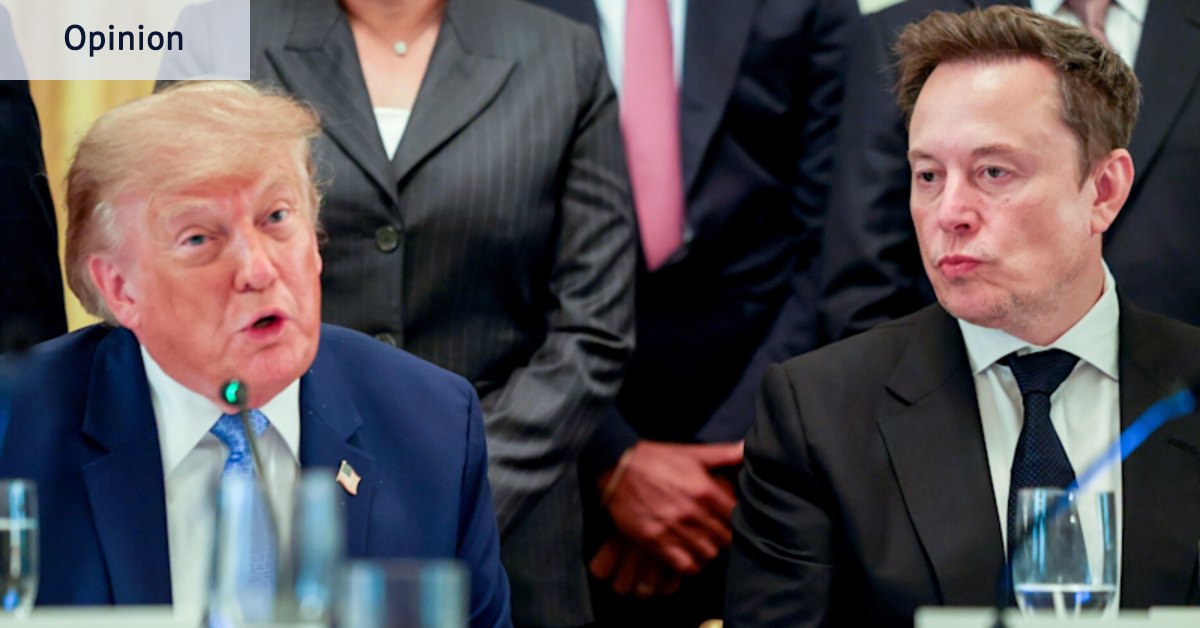
Photo via The Sydney Morning Herald

Elon Musk is back in the White House as privatisation spreads to warfare

Read the original at The Sydney Morning Herald ↗
Cite

Alpert, C. (2026, October 4). Elon Musk is back in the White House as privatisation spreads to warfare. The Sydney Morning Herald. https://www.smh.com.au/world/north-america/elon-musk-is-back-in-the-white-house-as-privatisation-spreads-to-warfare-20261004-p612ox.html?ref=rss&utm_medium=rss&utm_source=rss_feed

Dated when The Aporia collected the article, usually within hours of publication. Check the original for its exact date and byline.

The Sydney Morning Herald · collected 2026-10-04 · by Cory Alpert

Quick Summary

Elon Musk has rejoined government circles as one of three members on a new Pentagon commission called Project Meridian, alongside former House Speaker Newt Gingrich and Palmer Luckey, CEO of military tech firm Anduril. This $76 billion initiative involves mapping future warfare strategies for the US military, marking a shift towards private companies defining defense requirements rather than government bodies setting them. The article argues that this trend represents an extension of neoliberal policies by privatizing not just operational tasks but also strategic decision-making previously reserved for public institutions.
Written by AI on 2026-10-04, from this article's own text only (the story summary below draws on all the coverage).
See how they differ ↓

AI analysis

Story summary

The US Navy established the Robotic and Autonomous Systems Warfighting Development Center (RASWDC) at Joint Expeditionary Base Little Creek-Fort Story in Virginia to rapidly integrate robotic and autonomous systems into naval operations, training, and deployment. Announced on September 24, RASWDC aims to consolidate efforts across air, surface, and undersea domains, developing doctrine and tactics for unmanned platforms. Meanwhile, US Defense Secretary Pete Hegseth announced the creation of AUTOWARCOM, a new four-star command dedicated to autonomous warfare technology, at Marine Corps Base Quantico in Virginia. This initiative will oversee rapid scaling of autonomous technologies across military forces, shifting focus from costly conventional weapons to cheaper AI-driven systems proven effective in recent conflicts like Ukraine. Additionally, Hegseth launched Project Meridian, involving tech leaders Elon Musk and Palmer Luckey, to forecast future warfare domains and capabilities needed for American dominance.

Written for “US Military AI Drone Warfare Development” on 2026-11-18, grounded in this article and the 12 other(s) covering the same event.

How they differ

10 outlets covered “US Military AI Drone Warfare Development”.

What each outlet says

One AI summary per outlet of its latest article on this story, written from that article alone and checked against it. Open the article for the outlet's own words.

Sydney Morning HeraldThis outlet4 Oct

Elon Musk has rejoined government circles as one of three members on a new Pentagon commission called Project Meridian, alongside former House Speaker Newt Gingrich and Palmer Luckey, CEO of military tech firm Anduril. This $76 billion initiative involves mapping future warfare strategies for the US military, marking a shift towards private companies defining defense requirements rather than government bodies…

Elon Musk is back in the White House as privatisation spreads to warfare (this article)
South China Morning Post9 Oct

The article discusses how the US tech industry, through initiatives like Project Meridian, is increasingly aligning with the military-industrial complex, mirroring China's model but from a different direction. It highlights this shift as a significant departure from past dynamics, where defense contractors influenced policy in Washington, D.C., while now Silicon Valley companies are becoming directly involved in…

With war project, US tech ecosystem is beginning to look a lot like China’s →3 articles from South China Morning Post on this story
Washington Examiner30 Sep

War Secretary Pete Hegseth announced Wednesday at Marine Corps Base Quantico that the Pentagon is creating a new four-star command called AUTOWARCOM to focus on autonomous warfare technology such as drones and AI. This initiative aims to streamline development and deployment of these technologies by giving combat units more direct control over procurement decisions, moving away from traditional bureaucratic…

Pentagon to create first-ever autonomous warfare command, Hegseth reveals →2 articles from Washington Examiner on this story
Fox News30 Sep

Elon Musk has joined a Trump administration initiative, Project Meridian, aimed at identifying future warfare domains and necessary military technologies. Along with defense tech entrepreneur Palmer Luckey and former House Speaker Newt Gingrich, Musk will work under War Secretary Pete Hegseth to forecast potential conflicts over 120 days. The project seeks to map out the trajectory of wars from underground to outer…

Elon Musk lands new Trump admin role shaping future of American warfare →
New York Post30 Sep

Chris Hegseth, secretary of war, has assembled Elon Musk, Palmer Luckey, and Newt Gingrich to study future military technologies for the U.S. The group will identify critical battlefield advancements expected in coming years and produce both classified and unclassified reports on their findings. This initiative, called Project Meridian, was announced alongside other reforms at Marine Corps Base Quantico in Virginia…

Hegseth taps Musk, Luckey, Gingrich to study future of war for US military →
The Straits Times30 Sep

US Defense Secretary Pete Hegseth announced the creation of the Autonomous Warfare Command (Autowarcom) to expand AI and drone capabilities across the US military. This new command, which will be led by a four-star officer, highlights the shift towards cheaper autonomous systems in warfare, as seen in Ukraine where drones have become prevalent. Experts warn of potential risks associated with unchecked AI…

Pentagon creates 'Autowarcom' to expand AI and drone capabilities →
Show 4 more outlets
Evening Standard1 Oct

Pete Hegseth, US defense secretary, used the Battle of Agincourt as an analogy during his announcement of a major overhaul in American military drone technology and weapons procurement processes. The initiative, named Project Agincourt, aims to modernize how the military acquires, tests, and employs drones and other advanced weaponry. Hegseth emphasized adapting to new technologies like autonomous systems and…

Hegseth harks back to Battle of Agincourt for US hi-tech weapons’ overhaul →
The Independent1 Oct

The U.S. defense secretary announced plans to work with tech entrepreneurs like Elon Musk on future military technology, aiming to dominate future battlefields across various domains. This includes the establishment of an Autonomous Warfare Command and Project Meridian, which will focus on developing autonomous systems and artificial intelligence for military use. The announcement reflects a shift in the Pentagon's…

US is working with Elon Musk and others to build the ‘future of warfare’, government announces →
The Guardian1 Oct

Defense Secretary Pete Hegseth appointed tech billionaires Elon Musk and Palmer Luckey as advisors to a new Pentagon project called "Project Meridian," which focuses on future warfare strategies. This move grants significant influence to two major MAGA donors who own companies that benefit from federal defense contracts. The project, announced in an event at Quantico, Virginia, is led by Emil Michael, a former Uber…

Hegseth puts the future of warfare in the hands of major Maga donors →
NPR6 Oct

Defense Secretary Pete Hegseth announced "Project Meridian: The Future of Warfare," a 120-day study on automated and AI-powered weaponry. Leading the project are Elon Musk from SpaceX and Palmer Luckey of Anduril Industries, alongside former House Speaker Newt Gingrich. Critics argue that the involvement of these tech leaders with significant U.S. defense contracts—SpaceX has secured over $8 billion in 2026…

Elon Musk and Palmer Luckey's new Pentagon roles raise ethics worries →

Where they agree and split

Agreed

AI · cited, from two or more outlets

  • Elon Musk is co-leading Project Meridian, a Pentagon initiative focused on future warfare capabilities.23
  • Project Meridian aims to identify emerging domains of warfare and necessary military capabilities for the future.24

Framing

How the first headlines put it

  • Fox News frames Musk's role as part of the Trump administration's efforts to shape future warfare, whereas The Guardian highlights ethical concerns and potential conflicts of interest.25
The full story: what happened, how it changed, and all 13 articles →

Compared with similar articles

This article reads leans strongly left and hedges 6% of its claims. Each row says how that neighbour differs.
South China Morning Post
Hedges 1 of 5 claims Outlet record 62/100
The Guardian
Hedges 26 of 307 claims Outlet record 64/100
“The articles discuss different phases in Elon Musk's involvement with government and do not describe the same specific incident.”

Story

US Military AI Drone Warfare Development
Politics · 13 article(s) covering the same event. Compare every outlet's account →
How this article was measured signals, leaning charts, publisher record, byline, topics and claims

Signals How these are calculated →

Claims extracted
50
sentences that state something as happening or true
Uncertain
6%
3 of 50 hedged ("reportedly", "may", "according to")
Leaning
Leans strongly left
of the writing, not the subject · beta estimate
Publisher signals
61/100
The Sydney Morning Herald's corrections and hedging, across everything collected from it. Not a measure of accuracy.
Outlets on this story
13
Politics
Same framing elsewhere
1
articles that frame the event the way this one does
Analyzed 2026-10-04 · how these are computed

How this is being covered How these are calculated →

Article leaning vs. publisher reliability
Source leaning vs. consistency

Publisher

The Sydney Morning Herald · 7597 article(s) · 15 correction(s) detected
Running correction rate · 15 correction(s)

Who wrote this

Cory Alpert
7 article(s) here · 1 carrying a prediction
Every few minutes, a new race would be called.
Republicans may well still hold some ground in today’s midterms.
Despite these efforts, voters are expected to pummel Trump’s party at next week’s midterm election and leave his power diminished for the remainder of his presidency.
He then spent the next 18 months slapping his name on policy after policy despite many of them – including his tariffs, the war on Iran and changes to tax rates and food assistance – seeming to ensure that those same people would get an even worse deal.
Rather than privatising how the state operates, Trump’s Washington is now testing the privatisation of decisions about what the state will need.
Also by Cory Alpert
The cult of Trump is waning. Now beware the death throes
2026-10-28 · The Sydney Morning Herald
Nothing else under this byline is closely related to this article, so these are simply their most recent.
All 7 articles by Cory Alpert →

Topics

American House Pentagon Project Meridian the White House

Subjects

American NORP · 9× Trump PERSON · 4× the White House ORG · 3× Luckey PERSON · 2× Musk PERSON · 2× Pentagon ORG · 2× Project Meridian ORG · 2× Donald Trump PERSON · 1× Elon Musk PERSON · 1× House ORG · 1×

Narrative

Now Musk has been announced as one of three members of a new Pentagon commission tasked with mapping the future of American warfare, alongside former House Speaker Newt Gingrich and Palmer Luckey, chief executive of military technology company Anduril.
framing: assertive · carried by 1 article(s) · first seen 2026-10-04
Rather than privatising how the state operates, Trump’s Washington is now testing the privatisation of decisions about what the state will need.
2026-10-04 · The Sydney Morning Herald
Elon Musk is back in the White House as privatisation spreads to warfare · assertive framing

Claims (50 extracted, 3 hedged)

Last year, the world’s wealthiest man left the White House after 130 chaotic days as the technically informal head of a department that hacked at the federal government’s ability to deliver on its duties. asserted
that → leave → duties
On his last day, he stood in the Oval Office with a black eye and a golden key to the White House. asserted
he → stand → House
Weeks later, he ignited a public feud with President Donald Trump, finding himself outside the president’s small decision-making circle. asserted
he → ignite → circle
Now Musk has been announced as one of three members of a new Pentagon commission tasked with mapping the future of American warfare, alongside former House Speaker Newt Gingrich and Palmer Luckey, chief executive of military technology company Anduril. asserted
Musk → announce → Anduril
Project Meridian marks a new step in a political transformation larger than any of those men, shifting important responsibility away from democratic government. asserted
Meridian → mark → government
Rather than privatising how the state operates, Trump’s Washington is now testing the privatisation of decisions about what the state will need. asserted
state → privatise → what
Beginning in 1980, the Reagan administration redrew the line between the private and public sector. asserted
administration → begin → sector
Services once seen as the duty of a responsible government were entrusted to the open market, which could price them as they saw fit. uncertain
they → see → them
Despite the logging of the pillars of government, judgment remained the core responsibility of the state. asserted
judgment → remain → state
Companies could sell to the government, but the companies did not decide what a defence strategy required. uncertain
strategy → sell → what
Project Meridian moves this line yet again. asserted
Meridian → move → line
The old relationship between defence and industry is falling apart. asserted
relationship → fall → defence
It used to point from requirements, set by the government, to capabilities, built by private companies. asserted
It → use → companies
Now, the same firms and technologies (including artificial intelligence) cover much more territory on either side of the dividing line between civilian and defence than they did before. asserted
they → include → civilian
Musk and Luckey lead companies with a combined $US53 billion ($76 billion) in Pentagon contracts and are now tasked with identifying the capabilities that the US military should develop to fight the battles of the future. asserted
military → lead → future
Luckey described his company’s business model as using “our own money to decide what products to build, how to build then, then we build those products, then we sell them to the government”. asserted
we → describe → government
He is now one of three people tasked with defining exactly what the government wants to buy. asserted
government → task → what
The neoliberal dream of the 1970s resulted in private companies taking on public tasks. asserted
companies → result → tasks
We are now seeing the privatisation of strategic imagination. asserted
We → see → imagination
But governments and businesses are not meant to do the same thing. asserted
governments → mean → thing
Navies should not be designed to run a profit. asserted
Navies → design → profit
Governments exist to weigh the interest of its citizens above all else, including alliances and the risk of war itself. asserted
Governments → exist → war
This project is part of a longer strategy played out by the Trump administration. asserted
project → play → administration
In the opening weeks of his second term, Trump signed executive orders making the sale and export of American weapons a top diplomatic and trade priority, to be hawked by American embassies and consulates abroad. asserted
sale → sign → embassies
The America First Arms Transfer Strategy published this year by the White House says American arms deals are a core part of American foreign policy, used to expand production at home. asserted
deals → publish → home
The administration even made a handy catalogue of items that it encourages allies to acquire, cheapening the highwire task of diplomacy in the 21st century to selling expensive weapons. asserted
it → make → weapons
The strategy doesn’t stop at bombs. asserted
strategy → stop → bombs
Earlier this year, Trump signed another executive order, declaring another foreign policy goal of the administration to get other countries to adopt American AI technology. asserted
countries → sign → technology
An ally buying an American F-35 fighter jet is one thing. asserted
ally → buy → jet
An ally building its military decision-making capability around American AI models is more tightly wound. asserted
ally → build → models
As allies become more dependent on American technology, the question of who gets to define the priorities of that technology becomes extremely important. asserted
who → become → technology
That was made painfully obvious last month with news about OpenAI, a company with deep ties to the White House, gaining unauthorised access to Australian government systems without any human direction. asserted
That → make → direction
The stakes for Australia stretch wide. asserted
stakes → stretch → Australia
One step below the famous submarines of the AUKUS deal is Pillar II, which focuses on building technological capabilities. asserted
which → focus → capabilities
It’s designed to make the Australian, British and American militaries work more closely together. asserted
militaries → design → ?
The three countries are already jointly testing autonomous systems. asserted
countries → test → systems
They’re sharing sensitive data, and refining how new cutting-edge technology works, together. asserted
technology → share → data
Integration of the old generation meant ensuring that ammunition from one country could fire in the guns of another. uncertain
ammunition → mean → another
Today, it’s about making sure their software and sensors can talk to each other. asserted
software → ’ → other
A change in how America decides what future military power should look like becomes a change in the assumptions around which Australian defence capability is built. asserted
capability → decide → which
…and 10 more, not listed.
Give feedback · no sign-in needed

No sign-in needed for now. Your note is sent without a name, so it cannot be answered.

History Support