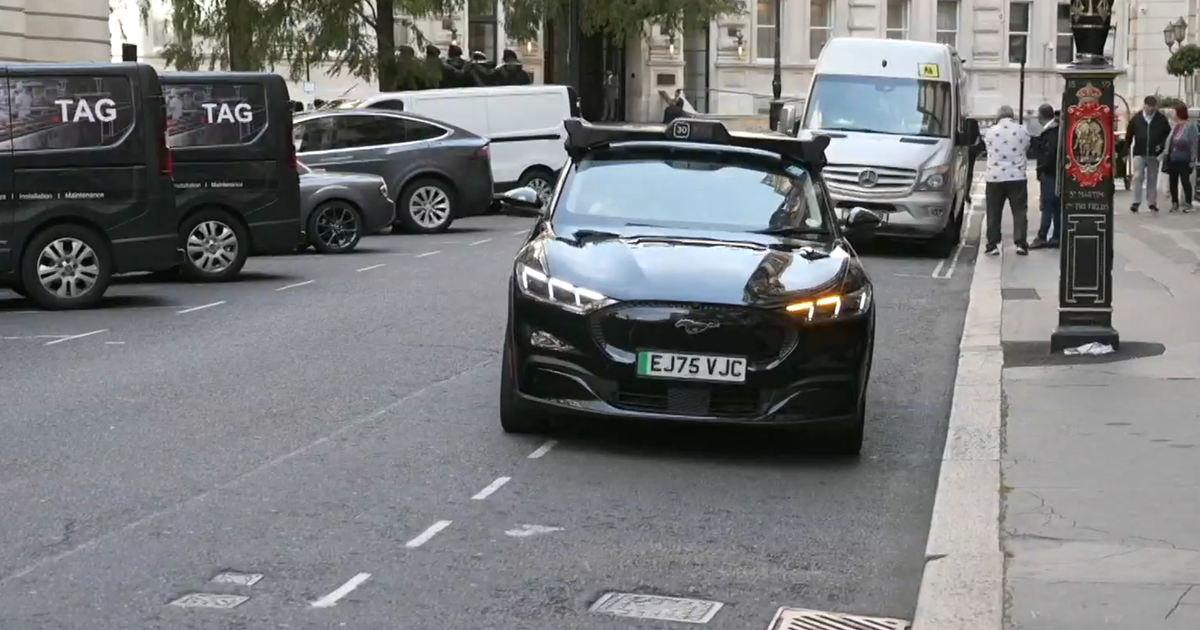
Uber has rolled out 15 autonomous Ford Mustang Mach-E vehicles in London, powered by artificial intelligence from partner Wayve, but a human supervisor must still be on board due to regulatory restrictions. The vehicle can travel anywhere within London except to the airport. Kendall, a representative of Wayve, notes that the AI is trained on millions of hours of driving experience worldwide, allowing it to adapt to new situations. A test by CBS News found that the vehicle got stuck in a narrow passageway and required human intervention.
Written by the local model on 2026-09-06,
using this article's own text rather than the other coverage of the
same event (that is the story summary below).
Story summary
Uber, in partnership with British technology company Wayve, has launched 15 autonomous Ford Mustang Mach-E vehicles on the roads of London, powered by artificial intelligence. However, a supervisor must still be present in each vehicle due to regulatory restrictions that only allow partial autonomy on London's roads. The robotaxis can travel anywhere within the city, but cannot yet make trips to the airport. Wayve's chief executive, Kendall, noted the challenges of developing autonomous vehicles in a busy and complex city like London, with its narrow streets, numerous roundabouts, and high density of cyclists and pedestrians. This project is part of a larger partnership between Wayve, Uber, and investors such as Nvidia and Microsoft. Waymo, a subsidiary of Google's parent company Alphabet, has also been mapping London's roads, but has not yet launched its own autonomous vehicles in the city. The launch of Uber's robotaxis in London marks one of the biggest challenges for the company so far in terms of implementing autonomous vehicle technology.

Written for “Uber Robotaxi Trials UK” on 2026-09-07,
grounded in this article and the 0 other(s) covering the same event.
Why this leaning score
This article does not take a side on a contested political
question, so it has no leaning score. That is an
answer rather than a gap: a match report or a rescue can be warmly
or critically written without being left or right, and scoring it
anyway is how approval of a subject gets recorded as a political
position.
No political leaning scored for article 5384 · logged 2026-09-06
Robotaxis are on the roads of London, marking Uber's biggest real-world challenge yet in a busy city built on a dense layout and countless roundabouts.
asserted
Robotaxis → mark → layout
This week, Uber rolled out 15 autonomous Ford Mustang Mach-E vehicles in London powered by artificial intelligence.
asserted
Uber → roll → intelligence
As of now, a supervisor must be on board the vehicle because London regulators still do not allow full autonomy on the roads yet.
asserted
regulators → allow → roads
And while the robotaxis can travel anywhere within London, they cannot yet make trips to the airport.
asserted
they → travel → airport
Kendall noted some of the challenges that Wayve and Uber faced in the development process in a city with some roads that are hundreds of years old.
asserted
that → note → roads
"There's many roundabouts, interaction scenarios, there's more than 10 times more cyclists and pedestrians than you can see in cities like San Francisco," Kendall said.
asserted
Kendall → be → Francisco
"More than 10 times the amount of roadwork, so it's just a constantly busy and evolving city."
asserted
it → evolve → roadwork
Wayve's investor base, along with Uber, also includes Nvidia and Microsoft.
asserted
base → include → Nvidia
Its chief competitor, Waymo, a subsidiary of Google's parent company Alphabet, has been mapping London with its vehicles, but has not yet rolled them out for public use.
asserted
competitor → map → use
In
earlier this year, Kendall explained that Wayve's AI differs from that of Waymo in that it does not map out a city before driving it.
asserted
it → explain → it
"We train it on millions of hours of experience driving all around the world," Kendall said at the time.
asserted
Kendall → train → time
"So this means when it goes somewhere it's never seen before or that's never been mapped, it can understand what's in front of it and make decisions in real time.
asserted
what → mean → time
Wayve has driven its vehicles in more than 500 cities in Europe, Asia and North America, according to Kendall.
uncertain
Wayve → drive → Kendall
"That level of diversity, you need to have a system that can learn concepts, and apply them to things it hasn't seen before, and that's exactly what we've built with our AI," Kendall said.
asserted
Kendall → need → AI
For 20% more than the standard Uber fare, a CBS News crew called an Uber robotaxi and put the AI to the test.
asserted
crew → call → test
The vehicle operated autonomously at first, but when it tried to go through a narrow passageway, it eventually got stuck and the supervisor had to take over and drive.
asserted
supervisor → operate → passageway
For those who don't want an amateur jockey, there are London's famous black cab drivers who have required knowledge of the city.
asserted
who → want → city
But their numbers have dropped in recent years, from about 25,000 in 2010, down to approximately 16,000 today, according to Transport for London statistics.
uncertain
numbers → drop → statistics
When asked if robotaxis pose a risk to black cab drivers, Sarfraz Maredia, Uber's global head of autonomous mobility and delivery, said that in the short term, he doesn't believe so.
asserted
he → ask → term
"No, we don't really see that as a near-term risk," Maredia told CBS News.
asserted
Maredia → see → News
"So, the reality is the market is growing.
asserted
market → grow → ?
And we think AVs are going to help take up some of the growth in the market."
asserted
AVs → think → market