Pakistan on Thursday signalled a cautious shift in its approach to the newly imposed US sanctions on Iran, saying it would adhere to “all applicable sanctions regimes” under international and domestic law, a formulation that goes beyond Islamabad’s earlier emphasis on international law and bilateral trade commitments with Tehran.
asserted
that → signal → Tehran
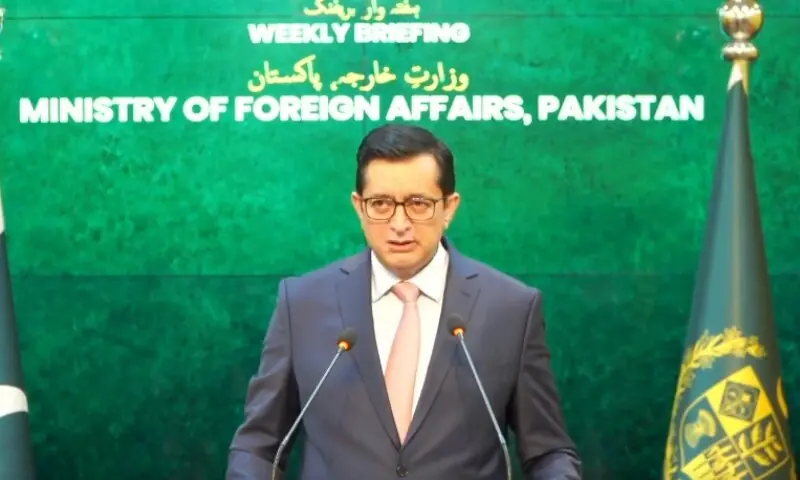
“Pakistan is a responsible member of the international community and adheres, and shall continue to adhere, to all applicable sanctions regimes in accordance with international and domestic laws,” Foreign Office spokesperson Sajjad Haider Khan said at the weekly media briefing.
asserted
Khan → adhere → briefing
The spokesperson did not explain what Islamabad considers “applicable” even though there is a fine difference between restrictions being legally applicable or practically applicable.
asserted
restrictions → explain → ?
The shift is nevertheless significant because when the US announced its latest sanctions against Iran, the then FO spokesperson Tahir Andrabi had said: “About trade with Iran, Pakistan is following international law and our bilateral trade agreements with Iran.”
asserted
Pakistan → announce → Iran
FO reiterates commitment to strategic ties with Washington, rules-based international system
asserted
FO → reiterate → system
Technically, the earlier formulation placed the emphasis on Pakistan’s international legal obligations and its bilateral commitments to Iran while the new one is broader, bringing “all applicable sanctions regimes” and “domestic law” into the framework.
asserted
one → place → framework
That does not mean US unilateral sanctions automatically become binding international law for Pakistan, but it’s an acknowledgement that their practical reach can extend to Pakistani banks and companies because they operate within the international financial system and depend on access to dollar clearing, correspondent banking and financial messaging networks.
asserted
they → mean → clearing
SWIFT, the international financial network, neither works as a sanctions authority nor does it decide whether transactions are lawful, but it says responsibility for compliance rests with the financial institutions handling transactions and the relevant national and international authorities.
asserted
responsibility → work → transactions
SWIFT, which is incorporated under Belgian law, has previously disconnected Iranian banks to comply with European sanctions.
asserted
which → incorporate → sanctions
This showed how sanctions adopted by a jurisdiction to which SWIFT is legally subject can affect a bank’s access to the international financial messaging network.
asserted
SWIFT → show → network
For Pakistan, the issue is therefore less about complying with US sanctions and more about the financial consequences of dealing with Iranian entities because US secondary sanctions can expose foreign financial institutions to restrictions on their access to the US financial system, including correspondent or payable through accounts.
asserted
sanctions → comply → accounts
Washington has specifically warned of such exposure as part of its expanded Iran sanctions campaign.
asserted
Washington → warn → campaign
Therefore, the new Foreign Office formulation appears to leave Islamabad room to take those risks into account without explicitly accepting the US unilateral sanction as legally binding.
asserted
formulation → appear → sanction
Here the assertion about compliance with domestic laws comes into play as this potentially gives Islamabad regulatory space to restrict or limit Iran-related transactions on the basis of Pakistani banking, foreign exchange and AML requirements.
asserted
this → come → requirements
For instance, State Bank’s Pakistan-Iran trade mechanism expressly requires clarity that transactions with Iran do not involve entities subject to international sanctions.
asserted
transactions → require → sanctions
Due to this clause, the businesses have been generally cautious about transacting with Iran, even before the latest sanctions.
asserted
businesses → transact → sanctions
However, the government has per se not announced a suspension of trade with Iran or any decision to join the US sanctions campaign.
asserted
government → announce → campaign
The Foreign Office spokesman also sought to underline Pakistan’s relationship with Washington.
asserted
spokesman → seek → Washington
“Pakistan highly values its enduring and multifaceted strategic partnership with the United States and remains fully committed to further strengthening its long-standing diplomatic, economic and security ties with Washington,” Mr Khan said.
asserted
Khan → value → Washington
At the same time, Islamabad reaffirmed its commitment to multilateralism and international law.
asserted
Islamabad → reaffirm → multilateralism
“Pakistan reaffirms its commitment to a rule-based international system rooted in multilateralism and international law,” Mr Khan said, adding that Islamabad remained in “constant and constructive communication with all relevant stakeholders”.
asserted
Islamabad → reaffirm → stakeholders
The balancing act comes at a time when Pakistan is trying to preserve its role as an intermediary between the US and Iran.
asserted
Pakistan → come → US
Mr Khan said Pakistan would continue urging US and Iran to exercise restraint and settle their differences through diplomacy.
asserted
Pakistan → say → diplomacy
“Pakistan, being a mediator in communication between Iran and the United States, believes that it is important to continue urging both sides to exercise restraint, resolve outstanding issues through dialogue and diplomacy, and honour their respective commitments under the Islamabad Memorandum of Understanding,” he said.
asserted
he → believe → Understanding
Pakistan believes this remains the “only viable pathway” to resolving the conflict peacefully, he added.
asserted
he → believe → conflict
 The Aporia