Swiss glaciers lost 5.5% of their ice volume this year due to heat waves and low winter snowfall, making it the second-biggest percentage drop on record according to GLAMOS, the Swiss glacier monitoring service. This loss is equivalent to four times Switzerland's annual water consumption. Experts warn that under current conditions, Alpine glaciers have no long-term survival chance, with ice volume declining by nearly a fifth over the past five years. The accelerated melting impacts not only Switzerland but also feeds into major European rivers like the Danube and Rhine, underscoring the broader consequences of global warming on water resources in Europe.
Written locally by qwen2.5:14b on 2026-10-01,
using this article's own text rather than the other coverage of the
same event (that is the story summary below).
Story summary
In 2026, Swiss glaciers experienced significant ice loss, with more than 5% of the remaining glacier volume disappearing over the year. This near-record melt is attributed to intense summer heatwaves following a winter with little snowfall, accelerating long-term climate-driven glacial retreat. Since 2021, Switzerland has lost nearly 20% of its glaciers, making it one of the most dramatic losses observed globally. Scientists from organizations like GLAMOS warn that such rapid melting could threaten water supplies for farming, hydropower, and transport in coming decades, destabilizing mountain slopes and increasing landslide risks. Researchers stress that without human-induced climate change and fossil fuel emissions, this warming would not be occurring, underscoring the urgent need to address global warming.
Written for “Swiss Glaciers Melting” on 2026-10-05,
grounded in this article and the 7 other(s) covering the same event.
This is how fast Swiss glaciers, the 'water tower of Europe,' are melting away
Water lost so far this year is 4 times Switzerland's annual consumption
Glaciers in Switzerland — the home to the most in the Alps — lost 5.5 per cent of their ice volume this year, the second-biggest percentage drop on record due to heat waves and low winter snowfall, experts report.
asserted
experts → melt → waves
"Alpine glaciers have no chance of surviving in the long term under such conditions," the GLAMOS Swiss glacier monitoring service and Swiss Academy of Sciences said in a statement Thursday.
asserted
service → have → statement
The trend has worsened in recent years.
asserted
trend → worsen → years
Over the past five years alone, the volume of ice in Switzerland has declined by nearly a fifth, the experts say.
asserted
experts → decline → fifth
The report testifies to the latest concerns that global warming is wreaking havoc on Europe, the world's fastest-warming continent.
asserted
warming → testify → Europe
"The warming that we are experiencing now can be attributed 100 per cent to anthropogenic climate change.
asserted
we → experience → change
It's as simple as that," said Matthias Huss, who heads GLAMOS.
asserted
who → say → GLAMOS
"Without human emissions or fossil fuels we wouldn't have any warming at the moment.
asserted
we → have → moment
"
Why low snowfall was a big problem
The record retreat of glacier ice in Switzerland came in 2022, when summer heat, low winter snowfall and an unusual smattering of reddish dust blown in from the Sahara darkened the glaciers and caused them to absorb more heat.
asserted
them → come → heat
Huss said the snow cover in winter was important for two reasons.
asserted
cover → say → reasons
"On the one hand, it protects the bare ice from melting.
asserted
it → protect → ice
The longer you have snow, the longer you avoid the loss of old ice," said Huss in an interview at the Federal Polytechnic Institute ETHZ, where he is a glaciology professor.
asserted
he → have → Institute
"On the other hand, the snow is important also for generating new food for the glacier.
asserted
snow → generate → glacier
The more snow you have, the higher the potential to keep some of the snow at high elevation and to form new ice.
asserted
you → have → ice
"
The great thaw in Europe's legendary Alps is not alone: Experts say global warming helped to destabilize a Himalayan slope that collapsed in August and unleashed catastrophic and deadly flooding across Nepal.
asserted
that → say → Nepal
Satellites have shown vast shrinkage of glaciers in places like Greenland and Antarctica over the last half-century or so.
asserted
Satellites → show → century
In Switzerland, in absolute terms, volume lost has been less than that in 2003, but the percentage decline this year is greater.
asserted
decline → lose → 2003
Such accelerated ice melt has had an impact in Switzerland — the loss of 2.2 trillion litres from July to September amounts to four times the annual consumption of water in the country of about 9.1 million people.
asserted
loss → accelerate → people
Switzerland gets more than half of its electricity from hydropower.
asserted
Switzerland → get → hydropower
But the impact of accelerated glacier melt ripples far beyond: Switzerland is the water tower of Europe, and feeds some of the continent's most important rivers: the Danube, Po, Rhine and Rhone.
asserted
Switzerland → ripple → rivers
The experts say the "extreme melting" faced by Switzerland's glaciers this year included a decline in the average thickness of individual glaciers between two and half and four metres — and a reduction of up to 10 metres on the tongue of some glaciers.
asserted
melting → say → glaciers
Which glaciers saw the biggest melt
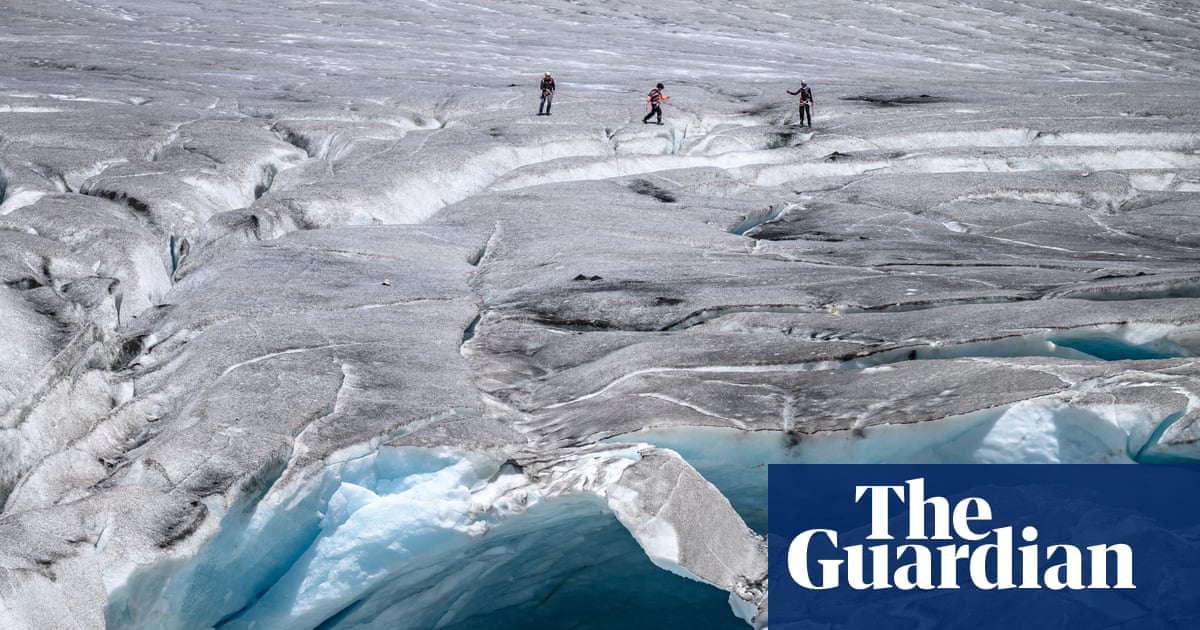
The expert teams have fanned out to assess runoff and crevices caused by the running water through the glaciers, in part by dumping red dye into the streams to track the water flows.
The Allalin, Clarident, Rhone and Aletsch glaciers — Aletsch being the largest in the Alps — were among the glaciers to experience their biggest melt on record this year.
asserted
Aletsch → see → record
"We just need to stabilize the climate by reducing CO2 emissions and this will help the glaciers," said Huss, of GLAMOS, though he added that it is "almost too late" to save those in the Swiss Alps.
asserted
it → need → Alps
"For the ice in the polar regions like the ice sheets, there it's not yet too late," he said.
asserted
he → say → sheets
"There, we can make a difference and we need to make a difference in order to limit sea level rise, for example, a factor that is a fundamental threat to billions of people living along the coast."
asserted
that → make → coast
 The Aporia