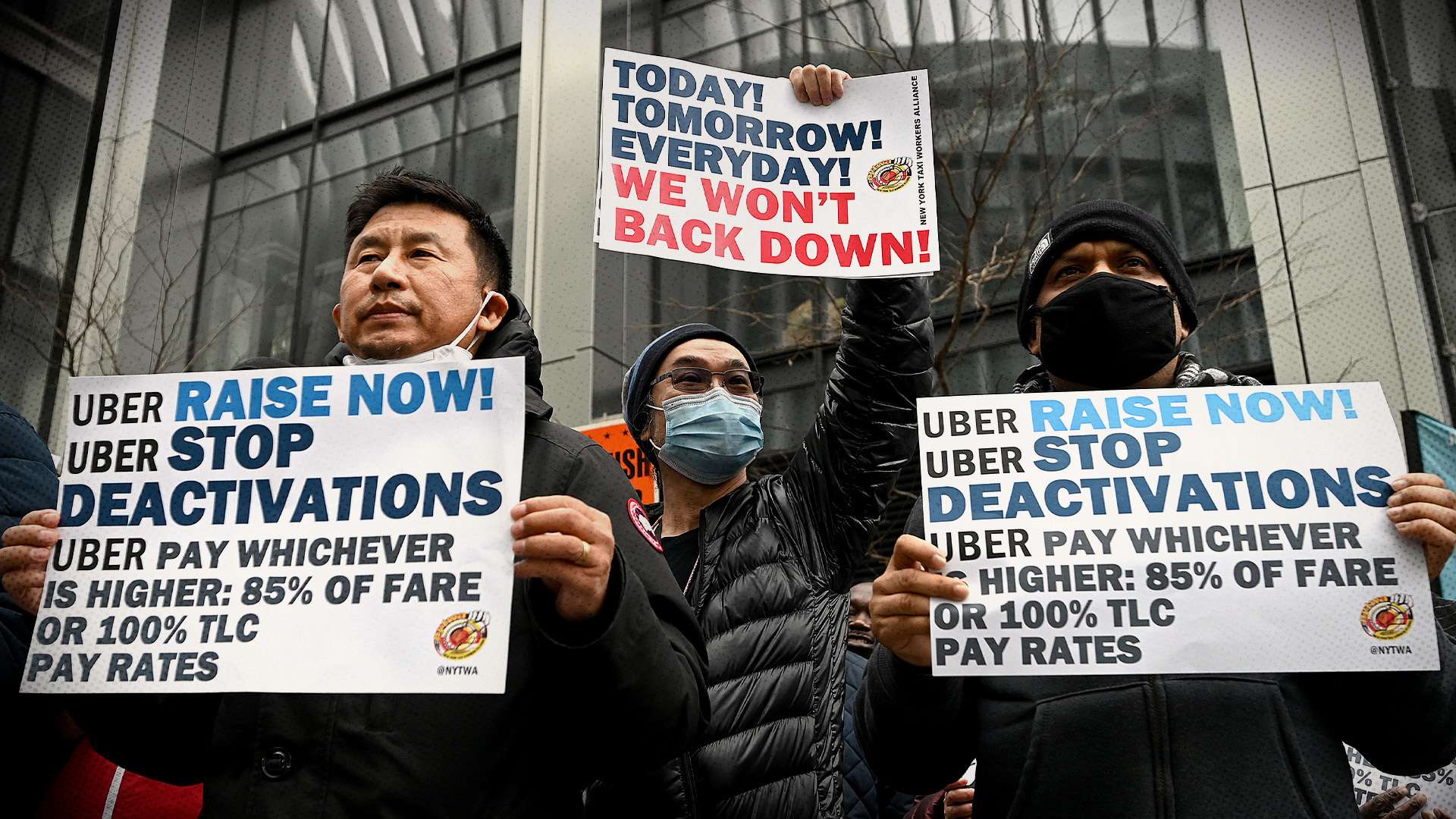
A federal judge last month blocked a New York City law eliminating the ability of rideshare companies to kick drivers off of their platforms unless they demonstrate "just cause."
asserted
they → block → cause
But NYC should cut its losses anyway.
asserted
NYC → cut → losses
Under NYC's "just cause" law, Uber and Lyft would have been barred from deactivating any drivers on their platform without providing 14 days' notice and establishing "just cause" or "bona fide economic reasons."
asserted
Uber → bar → cause
What did "bona fide economic reasons" actually entail?
asserted
reasons → entail → What
The statute left that frustratingly ambiguous, since it was merely defined as a "proportionate reduction in volume of sales or profit" from the prior quarter, without any indication as to what, exactly, that meant.
asserted
that → leave → what
Deactivated drivers were also given the ability to appeal through the city's Department of Consumer and Worker Protection (DCWP) or in court.
asserted
drivers → deactivate → court
The law even featured a seven-year lookback period, meaning that it applied to deactivations dating back to 2019.
asserted
it → feature → 2019
Under the law's terms, it only applied to a "high-volume for-hire vehicle service," a definition that was meant to only apply to Uber and Lyft.
asserted
that → apply → Uber
In response to the law's passage, Uber sued, arguing that it was a violation of the Contracts Clause of the U.S. Constitution, among other things.
asserted
it → sue → things
The Contracts Clause forbids state and local governments from passing laws that impair the "obligation of contractions."
asserted
that → forbid → contractions
While it has been watered down over the years by the Supreme Court, any legislative abridgment of contracts must still advance a legitimate and broad public purpose.
asserted
abridgment → water → purpose
The U.S. District Court for the Southern District of New York said that NYC had failed to clear this bar.
asserted
NYC → say → bar
In a decision issued by Judge Gregory Woods—appointed to the bench by President Barack Obama—the court found that the law was mostly designed to assist a small subset of drivers and was targeted at just the two large rideshare companies.
asserted
law → issue → companies
Uber deactivated only around 1 percent of its drivers, Woods noted.
asserted
Woods → deactivate → drivers
If Lyft deactivated its drivers at a similar rate, this would work out to just under 900 individuals, which amounts to around .01 percent of the population of NYC.
asserted
which → deactivate → NYC
Given that at least some of these drivers were likely dismissed for particularly egregious conduct, such as assaulting a passenger, the number of potential drivers who could have been wrongly deactivated would be a vanishingly small pool.
uncertain
who → give → drivers
As Uber pointed out in its complaint, the law's 14-day notice requirement also meant that potentially dangerous drivers would have to be kept on the road for two weeks before the platform could deactivate them and start the "just cause" proceedings.
uncertain
platform → point → proceedings
While the law includes an exception to the notice requirement for situations where drivers display "egregious conduct," it only defines this as "imminent danger to other persons."
asserted
it → include → persons
(The New York City Council rejected a proposal to change the language to "conduct that endangers others" on the grounds that it would be over-inclusive).
asserted
it → reject → grounds
Judge Woods' ruling enjoined the law six days before it was set to go into effect, while also halting the city's plan to stand up a $73.4 million compliance office at DCWP, which would have housed hundreds of staffers and attorneys tasked with enforcing the law.
asserted
which → enjoin → law
The gig economy has long operated under an at-will employment arrangement, in which both workers and platforms can end the relationship at any time and for any reason.
asserted
workers → operate → reason
But in recent years, the progressive left has attempted to reclassify gig workers from being independent contractors to being full-scale employees.
asserted
left → attempt → workers
While this effort has largely failed, applying "just cause" protections to these workers is the sort of workplace protection that usually attaches to more traditional employees.
asserted
that → fail → employees
In other words, what progressives have not been able to achieve outright they're attempting to do in piecemeal fashion.
asserted
they → achieve → fashion
Drivers work when they please and often use multiple platforms, while the labor supply is ideally meant to fluctuate dynamically based on demand.
asserted
supply → work → demand
Attaching more rules to driver deactivation inevitably raises labor costs as platforms are less able to weed out bad apples.
asserted
platforms → attach → apples
In the end, the flexibility that drivers themselves most prize when it comes to gig work will be eroded, as companies respond to the regulations by potentially limiting the number of drivers they allow on the platform.
asserted
they → prize → platform
For their part, gig companies are hardly being recalcitrant when it comes to protecting improperly deactivated drivers.
asserted
it → come → drivers
A companion "just cause" bill for food delivery drivers also recently passed in New York and was not opposed by gig platforms like Uber, likely because it lacked the onerous 14-day notice provision of the rideshare version.
asserted
it → pass → version
It's unclear whether NYC will appeal the recent decision or instead accept that the law needs to be rewritten.
uncertain
law → appeal → decision
A better idea would be to scrap the misguided idea entirely.
asserted
idea → scrap → idea
 The Aporia